What Sleeping Pill Works the Fastest for Insomnia — Speed, Science, and Smart Choices
It is 11:30pm. You have an important meeting tomorrow morning. Your alarm is set for 6am. And you are lying in bed with your brain running at full speed — replaying conversations, making mental to-do lists, thinking about the email you forgot to send.
In that moment, you do not want a long explanation about sleep hygiene. You want to know one specific thing — what sleeping pill works the fastest for insomnia?
It is a completely practical question that deserves a completely practical answer. And the answer is more specific — and more interesting — than most sites give you. Speed depends on the medication, the mechanism, the individual, and even something as basic as whether you have eaten recently.
This guide covers all of it. Real onset times, real comparisons, and clear guidance on which fast-acting option fits which situation. For the full picture on how to access any of these medications quickly, our guide on buy Ambien online covers everything from authorization to doorstep delivery.
Why Speed Varies So Much Between Sleep Aids
Before ranking the options it helps to understand why some sleep aids kick in within 15 minutes while others take a full hour. The difference is not random — three main factors drive it.
The Mechanism
Medications that directly slow down the central nervous system — like GABA-targeting sedative-hypnotics — work faster than those that work through hormone pathways, serotonin receptors, or histamine blockade. The more directly a medication acts on the brain’s alertness systems, the quicker the result.
How It Gets Absorbed
Immediate-release tablets dissolve and enter the bloodstream faster than extended-release formulations. Sublingual tablets — placed under the tongue — bypass the digestive system entirely and hit the bloodstream even faster. This is why the same active ingredient in a sublingual form works noticeably quicker than a standard swallowed tablet.
Whether You Have Eaten Recently
This one genuinely surprises people. Taking a sleep aid right after a heavy meal can delay absorption by 45 minutes to a full hour compared to taking it on an empty or light stomach. The FDA’s guidance on zolpidem specifically notes that a high-fat meal before taking it significantly delays both onset and peak effect. On an empty stomach the same pill works noticeably faster.
According to the Sleep Foundation, onset time is one of the most clinically important factors when choosing the right sleep medication — particularly for people whose main complaint is difficulty initiating sleep rather than staying asleep.
The Speed Rankings — Every Major Sleep Aid Compared
Here is where the real answer lives. These are realistic onset times based on clinical data for each major sleep aid — ranked from fastest to slowest.
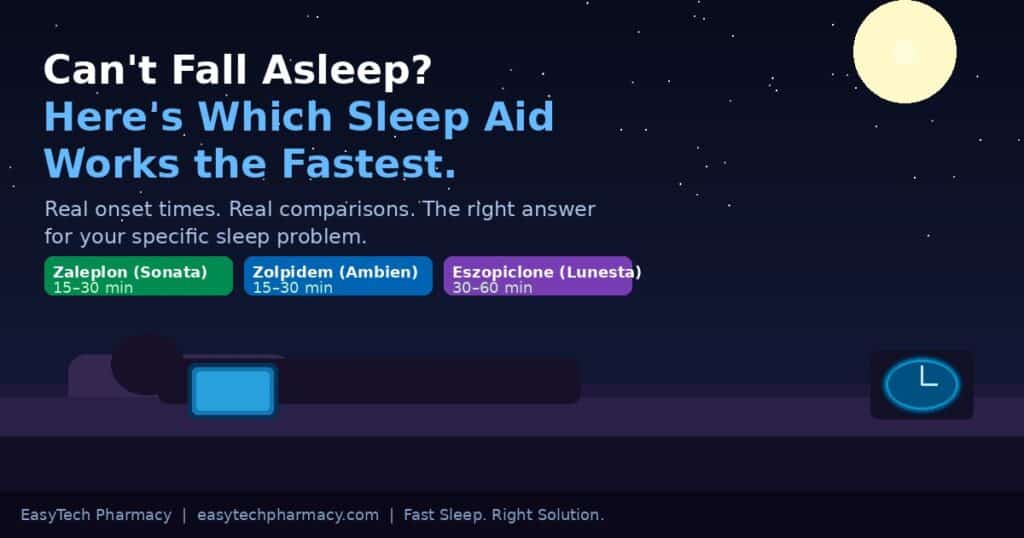
Fastest — Zaleplon (Sonata): 15 to 30 Minutes
Zaleplon holds the top spot. According to MedlinePlus, zaleplon reaches peak plasma concentration within approximately one hour — but its sleep-inducing effect often begins within 15 to 30 minutes. This makes it the fastest-acting prescription sleep aid currently available in the US.
Its other standout feature is a very short half-life of roughly one hour. This means two important things:
- Next-morning grogginess is minimal compared to longer-acting options
- It can actually be taken in the middle of the night if you wake up and have at least 4 hours of sleep time remaining — something that is simply not safe or practical with most other sleep medications
The tradeoff is duration. Zaleplon is almost exclusively effective for sleep onset — helping you fall asleep fast. It does not maintain sleep through the full night. However, for people whose only problem is falling asleep, Sonata’s speed and clean morning profile make it the most targeted fast-acting option available.
Very Fast — Zolpidem Immediate-Release (Ambien): 15 to 30 Minutes
Zolpidem immediate-release sits in the same speed bracket as zaleplon — typically producing sleepiness within 15 to 30 minutes when taken correctly. However, its half-life of 2.5 to 3 hours means its effects extend meaningfully further into the night.
This makes zolpidem the more versatile fast-acting choice. It works quickly and it covers enough of the night to help with both falling asleep and staying asleep through the first several hours. For most people dealing with sleep onset insomnia — or mild sleep maintenance issues — this combination of fast onset and reasonable duration makes it the most widely used prescription sleep aid in the US.
One important factor that affects its speed — food. Taking zolpidem right after a heavy meal delays onset by 45 minutes to an hour. The fastest results come from taking it on an empty stomach or after a very light snack, immediately before getting into bed.
Moderate Speed — Eszopiclone (Lunesta): 30 to 60 Minutes
Eszopiclone works within 30 to 60 minutes for most people — somewhat slower than zaleplon or zolpidem but with a significantly longer duration. As covered in detail in our guide on the best sleeping pills for people who wake up at night, Lunesta’s longer half-life makes it more valuable for sleep maintenance than pure onset speed.
If speed of falling asleep is your only priority, Lunesta is not the top pick. However, if staying asleep through the full night matters alongside getting to sleep at a reasonable speed — it moves up the rankings considerably.
Moderate Speed — Suvorexant (Belsomra): 30 to 60 Minutes
Belsomra works through a completely different mechanism — blocking orexin rather than amplifying GABA — and its onset reflects that difference. It typically takes 30 to 60 minutes to produce meaningful sleepiness, making it slower than zolpidem or zaleplon for pure onset.
However, its unique mechanism means it produces a more gradual, natural-feeling fade into sleep rather than a sharp sedation. Many people who find zolpidem’s rapid onset disorienting actually prefer Belsomra’s softer approach. Furthermore, for people whose zolpidem has lost effectiveness over time, switching to this different mechanism often restores sleep quality — our breakdown on why does Ambien stop working explains exactly why.
Slower — Trazodone: 45 to 90 Minutes
Trazodone’s onset is noticeably slower than the medications above — typically 45 to 90 minutes. It is therefore not the right choice for someone who needs to fall asleep as fast as possible tonight. However, its advantages elsewhere — non-controlled status, longer-term use safety, and affordability — make it the right choice for many people whose priority is consistent nightly support rather than emergency speed.
Variable — Melatonin: 30 to 120 Minutes
Melatonin’s onset varies enormously — anywhere from 30 minutes to 2 hours depending on timing, dose, and individual metabolism. It is also doing something fundamentally different from the medications above — signaling to the brain that it is time to prepare for sleep rather than directly inducing it. For acute insomnia when fast sleep is the goal, melatonin is generally not the fastest or most reliable tool in the kit.
Speed Comparison Table — All Options at a Glance
| Sleep Aid | Onset Time | Duration | Best For | Controlled? |
|---|---|---|---|---|
| Zaleplon (Sonata) | 15–30 min | 1–2 hours | Falling asleep fast, middle-of-night use | Yes — IV |
| Zolpidem IR (Ambien) | 15–30 min | 5–6 hours | Fast onset + first half of night | Yes — IV |
| Zolpidem CR (Ambien CR) | 15–30 min | 6–8 hours | Fast onset + full night coverage | Yes — IV |
| Eszopiclone (Lunesta) | 30–60 min | 6–8 hours | Full night sleep maintenance | Yes — IV |
| Suvorexant (Belsomra) | 30–60 min | 7–8 hours | Natural fade to sleep, maintenance | Yes — IV |
| Trazodone | 45–90 min | 6–8 hours | Consistent nightly support, longer term | No |
| Melatonin | 30–120 min | Varies | Circadian rhythm reset, mild insomnia | No |
Four Things That Slow Down Even the Fastest Sleep Aid
Even the fastest-acting sleep medication can be undermined by factors that delay absorption or reduce effectiveness. Understanding these helps you get the full speed benefit every single time.
Eating a Heavy Meal Beforehand
A high-fat, high-calorie meal within an hour of taking a sleep aid slows gastric emptying and delays absorption significantly. The practical fix is straightforward — take sleep medication at least 2 hours after your last substantial meal, or eat lightly on evenings when you plan to use one.
Staying Active After Taking It
Taking a sleep aid and then continuing to work, scroll social media, or have a stimulating conversation actively counteracts the sedation. The brain is trying to wind down while the body and mind are simultaneously telling it to stay alert. Fastest onset consistently happens when you take the medication and immediately go to a dark, quiet bedroom.
Anxious Monitoring of Whether It Is Working
This sounds paradoxical — but anxiously watching for the medication to kick in activates the very arousal systems the sleep aid is trying to suppress. The hypervigilant watching and waiting — is it working yet? Why isn’t it working? What if it doesn’t work tonight? — significantly extends the time to sleep onset regardless of what medication has been taken. Trusting the process and letting the medication do its job is itself a meaningful factor in how quickly it works.
Caffeine Timing
Caffeine has a half-life of 5 to 6 hours. Coffee or tea consumed at 3pm still has half its caffeine content active at 8pm. This background stimulation directly competes with even the fastest-acting sleep aids. According to the Mayo Clinic, cutting caffeine off by 2pm is one of the most impactful single behavior changes for people dealing with sleep onset insomnia.
Which Fast-Acting Option Fits Your Situation
Speed is just one factor. It also needs to match your specific sleep pattern.
You Only Struggle to Fall Asleep — Sleep Is Fine Once You Get There
Zaleplon (Sonata) is your best match. Fastest onset, shortest duration, minimal morning grogginess, and the unique option to use it mid-night if needed. Its precision for sleep onset with minimal side effects makes it the most targeted choice for this specific pattern.
You Struggle to Fall Asleep and Also Wake During the Night
Zolpidem CR (Ambien CR) gives you both fast onset and extended coverage through the night. Alternatively, eszopiclone covers more of the night with slightly slower onset. Either is a better choice than immediate-release zolpidem for this combined pattern.
You Want the Fastest Option That Is Not a Controlled Substance
Trazodone is the most practical non-controlled prescription option — though its onset is slower. Our full guide on sleeping pills that are not habit forming covers the complete range of non-controlled options and their relative speed profiles compared to each other.
Your Current Sleep Aid Has Stopped Being Effective
Tolerance to zolpidem reduces both its speed and its effectiveness over time. Switching to Belsomra’s different orexin-blocking mechanism often restores faster sleep onset because the brain has not built tolerance to that specific pathway.
The One Thing That Makes Every Sleep Aid Work Faster
Regardless of which medication you choose — one environmental factor consistently speeds up every sleep aid more than anything else.
A completely dark, cool, quiet room with no screens.
This is not a lifestyle platitude — it is basic neuroscience. Light — particularly blue light from phones — directly suppresses melatonin production and activates the brain’s alertness system. A sleep aid trying to wind your brain down while a phone screen is simultaneously telling your circadian system it is daytime is working against itself from the start.
Dark room. Cool temperature around 65 to 68 degrees Fahrenheit. No phone within reach. Silence or white noise. According to the NIH, environmental sleep improvements combined with appropriate medication consistently outperform medication alone for both speed and quality of sleep onset.
Frequently Asked Questions
What sleeping pill works the fastest for insomnia?
Zaleplon (Sonata) and zolpidem immediate-release (Ambien) both produce sleep onset within 15 to 30 minutes — making them the fastest prescription options currently available in the US. Between the two, zaleplon clears the system faster with less next-morning grogginess, while zolpidem provides longer duration coverage through the night.
Can any sleeping pill work in under 10 minutes?
Standard oral sleep medications — even the fastest — typically take at least 15 minutes to produce meaningful sedation. Sublingual formulations placed under the tongue can produce slightly faster onset by bypassing digestion, however 15 to 20 minutes is the realistic lower limit for most people under any delivery method.
Does food really slow down how fast sleeping pills work?
Yes — significantly. A high-fat meal before taking zolpidem can delay peak effect by 45 minutes to over an hour. The FDA specifically warns against taking zolpidem with or immediately after a meal for this reason. For fastest results take sleep medication at least 2 hours after your last substantial meal.
Is Sonata faster than Ambien?
Both have similar onset times of 15 to 30 minutes. However, Sonata clears the system significantly faster due to its shorter half-life, which produces less next-morning impairment. The key practical difference is duration — Sonata’s effects fade within a couple of hours while Ambien provides coverage through much more of the night.
What is the fastest over-the-counter sleeping pill?
Diphenhydramine — the active ingredient in ZzzQuil, Unisom SleepTabs, and Tylenol PM — typically produces sedation within 30 to 60 minutes. However, tolerance develops rapidly with regular use, sometimes within just 3 to 5 consecutive nights, significantly reducing its effectiveness for anyone using it regularly.
How can I make my sleeping pill work faster tonight?
Take it on a light or empty stomach, go directly to a dark and quiet bedroom immediately afterward, put your phone out of reach, keep the room cool, and avoid watching the clock. These environmental and behavioral factors consistently reduce onset time regardless of which sleep aid is being used.
Bottom Line — The Fastest Sleep Aid Is the Right One for Your Pattern
The answer to what sleeping pill works the fastest for insomnia is zaleplon and immediate-release zolpidem — both consistently producing onset within 15 to 30 minutes under the right conditions. However, fastest is not always best. Duration, dependency profile, next-morning impairment, and your specific sleep pattern all matter just as much as raw speed.
Match the medication to the problem. Use zaleplon if you only need help falling asleep and want the cleanest morning. Use zolpidem immediate-release if you need fast onset plus reasonable night coverage. Use Ambien CR or Lunesta if staying asleep through the full night is also a concern.
And regardless of which option you choose — the environment you sleep in will always be the single biggest factor in whether a fast-acting medication actually performs at its fastest.
For cost comparisons across all these options before deciding, our guide on how much does Ambien cost without insurance covers real pricing across all major sleep medications. And for local and delivery options near you, our Ambien near me guide covers access across the US.
At EasyTech Pharmacy, we carry FDA-approved fast-acting sleep medications including generic zaleplon, generic zolpidem, and more — with transparent pricing, fast shipping, and real pharmacist support.
👉 Visit EasyTech Pharmacy — find the fastest sleep solution for your situation today.