Can Ambien Cause Constipation? The Gut–Brain Connection Nobody Explains
Nobody talks about this one at the pharmacy counter. You get the standard warnings about driving, alcohol, and making sure you have a full night ahead of you. But constipation? That one tends to come as a surprise.
So you start wondering — is this really from Ambien? How does a sleep medication end up affecting the gut? And more practically — what can you actually do about it?
The answer to can Ambien cause constipation is yes. But the reason why is genuinely interesting — and understanding it makes fixing it significantly easier. This guide covers the full picture, keeping it clear and practical throughout.
Already familiar with Ambien’s other side effects and looking at your broader options? Our comparison of trazodone vs Ambien covers alternatives with different side effect profiles worth knowing about.
The Short Answer — Yes, Ambien Can Cause Constipation
Constipation is a documented side effect of zolpidem. It is not the most common one — next-day drowsiness and dizziness are reported more frequently. However, it appears consistently enough in clinical data that it is worth taking seriously if you experience it.
According to MedlinePlus, gastrointestinal effects including constipation are listed among the known side effects of zolpidem. They occur in a minority of users. However, for the people who experience it, it can be uncomfortable and persistent enough to affect quality of life alongside the sleep issue.
Why Ambien Causes Constipation — The Gut-Brain Connection
This is the part most sites skip. They list constipation as a side effect and move on. However, understanding why it happens tells you exactly how to address it.
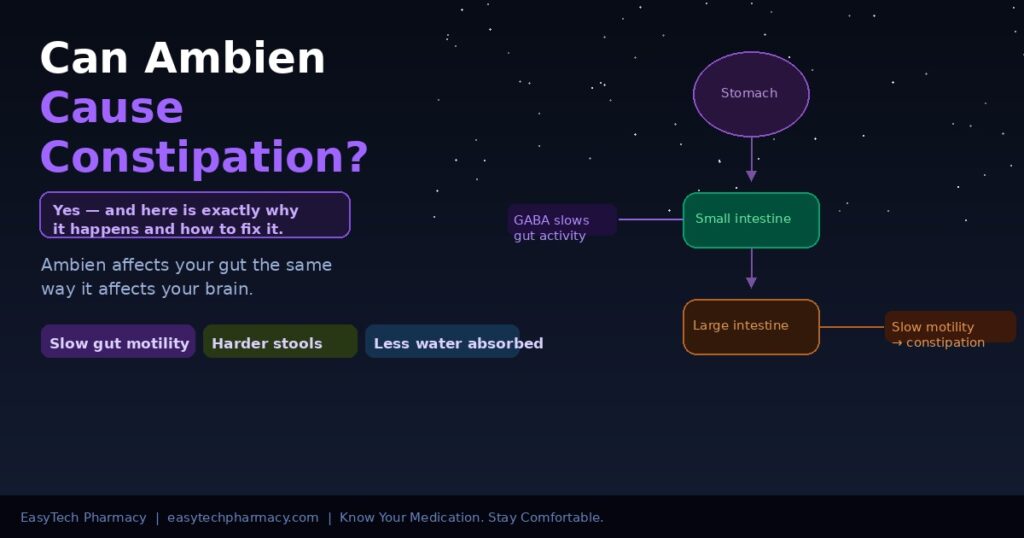
Ambien works by amplifying GABA-A receptor activity in the brain. GABA is the nervous system’s primary inhibitory signal — the braking mechanism that slows neural activity down. When Ambien amplifies this signal in the brain, you become drowsy and eventually sleep.
Here is what most people do not know. GABA receptors are not only in the brain. They exist throughout the body — including in the gut. The gastrointestinal tract has its own nervous system. It is sometimes called the “second brain.” It contains as many neurons as the spinal cord. It regulates the coordinated muscular contractions that move food through your digestive system — a process called peristalsis.
When Ambien amplifies GABA activity broadly, it does not only slow brain activity. It can also slow gut activity. The smooth muscle contractions that normally push waste efficiently through the large intestine become slower and less coordinated. The result is slower transit time. The longer waste sits in the large intestine, the more water gets reabsorbed from it. Harder, drier stool forms. Constipation follows.
This is the same mechanism that makes opioid medications famous for causing constipation — just through a different receptor pathway. The principle is identical. Slow the nervous system and you often slow the gut along with it.
How Common Is This Side Effect
Constipation from Ambien is a minority experience. Most people taking zolpidem at standard doses for a short period will not develop significant constipation. However, certain factors increase the likelihood.
Higher Doses
The GABA amplification effect is dose-dependent. Higher doses produce stronger inhibitory effects — including on the gut nervous system. People taking 10mg zolpidem are more likely to experience constipation than those taking 5mg.
Extended Use
Short-term Ambien use of two to four weeks produces the least cumulative gut impact. With extended nightly use, the ongoing suppression of gut motility can lead to a pattern of constipation that becomes noticeable over time.
Low Fluid and Fiber Intake
Someone already at the lower end of adequate hydration and dietary fiber intake has less buffer against medication-induced gut slowing. If the gut is already working at reduced efficiency, zolpidem’s additional inhibitory effect tips it into constipation more readily.
Older Adults
Digestive motility naturally slows with age. Older adults already have less reserve gut function than younger adults. Ambien’s suppressive effect on the gut, combined with age-related slowing, produces a more pronounced outcome.
Sedentary Behavior
Physical movement stimulates gut motility. People who take Ambien and are less physically active — as often happens when managing insomnia and its associated fatigue — may find the combination of medication and reduced movement compounds the constipation effect.
Other Gastrointestinal Side Effects Worth Knowing About
Constipation is the most commonly discussed GI side effect of Ambien, but it is not the only one. Here is the full digestive picture.
- Nausea: One of the more common early side effects. Usually occurs in the first few days of use and resolves as the body adjusts. More likely when Ambien is taken with food or immediately after a meal.
- Diarrhea: Less common than constipation but reported by some users — particularly during the initial adjustment period. The gut’s response to a new medication is not always uniform.
- Abdominal discomfort: A general sense of bloating or cramping. More commonly reported with extended use rather than short-term.
- Dry mouth: Not strictly a GI issue but relevant to digestion. Saliva plays a role in initial digestion. Reduced saliva production — a common Ambien side effect — can contribute to downstream digestive difficulty.
How to Prevent and Manage Ambien-Related Constipation
The good news is that constipation from Ambien is manageable. These approaches work with the body’s natural mechanisms rather than fighting them.
Stay Consistently Hydrated
Water is the single most effective tool against drug-induced constipation. Adequate hydration keeps stool soft and maintains the fluid content that makes normal bowel movement comfortable. Aim for at least 8 glasses of water daily. This is particularly important because Ambien’s dry mouth side effect can cause people to drink less than they realize.
Keep a glass of water on the nightstand alongside your medication. Drink a full glass before taking Ambien. Drink another when you wake up in the morning. These two habits alone go a long way.
Increase Dietary Fiber Meaningfully
Fiber adds bulk to stool and helps stimulate the peristaltic contractions that medication is partially suppressing. Both soluble fiber — oats, psyllium, legumes, fruits — and insoluble fiber — whole grains, vegetables, bran — contribute to healthy bowel function.
The daily fiber target for most adults is 25 to 38 grams. Most Americans consume only about half that. If you are taking Ambien and experiencing constipation, bringing fiber intake toward the recommended level produces noticeable improvement within 3 to 5 days for most people.
One practical note — increase fiber gradually rather than dramatically overnight. A sudden large increase in fiber intake can cause bloating and gas before the gut adjusts. Add one high-fiber food per day over a week rather than overhauling everything simultaneously.
Move Your Body — Even Briefly
Physical activity is one of the most consistently effective natural stimulants of gut motility. Even a 20-minute walk after your main meal stimulates peristalsis meaningfully. For people who are not active, starting with daily walking is one of the fastest ways to improve medication-induced constipation.
The gut responds to movement. Sedentary periods of several hours consistently slow transit time. If fatigue from insomnia is keeping you less active — which is understandable — even short bursts of movement throughout the day help maintain gut function better than extended sitting.
Try Osmotic Laxatives If Needed
For constipation that does not improve with dietary and hydration adjustments alone, osmotic laxatives like polyethylene glycol (Miralax) are safe for short-term use and widely available without authorization. They work by drawing water into the colon and softening stool — directly counteracting the dehydrating effect of slow transit time.
Miralax is tasteless and dissolves completely in water or any beverage. It works within 24 to 72 hours. It is not habit-forming at standard use patterns and is safe for short periods while addressing the underlying medication-related cause.
Avoid stimulant laxatives — like bisacodyl or senna — as a first response. These work differently and are more aggressive on the gut. They are appropriate for occasional use but not as a regular management strategy for medication-induced constipation.
Probiotic Foods
The gut microbiome affects motility, stool consistency, and overall digestive health. Supporting it with probiotic-rich foods — yogurt with live cultures, kefir, kimchi, kombucha — helps maintain a gut environment less prone to constipation from external factors including medication effects.
Probiotics are not a rapid fix for acute constipation. However, consistent inclusion in your diet builds a more resilient gut baseline that is more resistant to the suppressive effects of sleep medications over time.
Should You Stop Taking Ambien Because of Constipation
For most people — no. Constipation from Ambien is manageable with the strategies above. Stopping a medication because of a manageable side effect, without exploring management options first, means losing the sleep benefit without necessarily having to.
However, if constipation is severe — multiple days without a bowel movement despite adequate hydration and fiber, or accompanied by significant abdominal pain — that is worth a direct conversation with your pharmacist or healthcare provider. These symptoms may warrant a dosage review or a switch to an alternative medication.
Trazodone — covered in detail in our guide on trazodone vs Ambien — works through a completely different mechanism and does not carry the same gut-suppressive effects. For people who need ongoing sleep support and find Ambien’s GI side effects problematic, it is worth considering as an alternative.
Our guide on sleeping pills that are not habit forming covers every non-controlled option available — several of which have minimal GI side effect profiles.
Lifestyle Factors That Compound the Problem
Ambien does not cause constipation in isolation. It interacts with your existing lifestyle. Several common patterns significantly worsen the effect.
- Late-night eating: Large meals close to Ambien use slow gastric emptying and compound gut suppression. Try to finish eating at least 2 hours before taking Ambien.
- Low fluid intake in general: Many people are mildly dehydrated as a baseline. Ambien’s dry mouth side effect worsens this. Deliberately increasing fluid intake is one of the highest-impact adjustments available.
- Caffeine as a constipation offset: Some people use coffee to stimulate bowel movements. This works for many people but can affect sleep quality at night if consumed later in the day — creating a cycle worth being aware of.
- Reduced physical activity from fatigue: Insomnia causes fatigue. Fatigue reduces activity. Reduced activity slows gut motility. Ambien slows it further. The combination creates a compounding effect that dietary adjustments alone may not fully resolve without also addressing the activity component.
How Long Does the Constipation Last
For most people who experience constipation from Ambien, the pattern follows one of two timelines.
Adjustment period constipation: Occurs in the first week or two of starting Ambien. The gut is adjusting to the medication’s effects. This typically resolves on its own within 10 to 14 days as the body adapts. Dietary and hydration adjustments during this period speed up the resolution.
Ongoing constipation with continued use: If constipation persists beyond the initial adjustment period or develops with extended use, it reflects a sustained suppression of gut motility. This type does not resolve on its own while the medication continues. Active management through diet, hydration, movement, and if needed an osmotic laxative is required to keep it comfortable.
Constipation associated with Ambien typically resolves fully once the medication is stopped. The gut returns to its normal motility pattern within a few days of discontinuing zolpidem in most cases.
Frequently Asked Questions
Can Ambien cause constipation?
Yes — constipation is a documented side effect of zolpidem listed in clinical data and on MedlinePlus. It occurs because Ambien amplifies GABA activity throughout the body, including the gut nervous system, which slows the muscular contractions that normally move waste through the digestive tract.
How quickly does Ambien-related constipation develop?
It can develop within the first few days of starting Ambien for some people. For others it develops gradually over weeks of regular use. The timing depends on dose, hydration level, dietary fiber intake, activity level, and individual gut sensitivity to GABA-acting medications.
What is the fastest way to relieve constipation from Ambien?
Increase water intake significantly, add fiber to your diet, and take a short walk. If these do not produce relief within 24 to 48 hours, an osmotic laxative like Miralax is safe for short-term use and typically produces results within 24 to 72 hours. Avoid stimulant laxatives as a first response.
Should I stop taking Ambien if it causes constipation?
Not necessarily as a first response. Constipation from Ambien is manageable with dietary and hydration adjustments for most people. However, if it is severe or persistent despite management efforts, discussing dosage or an alternative medication with your pharmacist is the right next step.
Does Ambien CR cause more constipation than regular Ambien?
Ambien CR releases zolpidem more slowly over a longer period. The sustained presence of the medication in the system means sustained GABA activity in the gut throughout the night — potentially producing more pronounced gut slowing than the faster-clearing immediate-release version. People who notice more GI symptoms on CR than on regular Ambien should mention this to their pharmacist.
Are there sleep medications that do not cause constipation?
Yes. Trazodone works through serotonin and histamine pathways rather than GABA amplification and has a significantly lower GI side effect profile. Melatonin is the gentlest option and produces no significant digestive effects. Ramelteon (Rozerem) also avoids the GABA-gut connection. Our full guide on sleeping pills that are not habit forming covers every alternative with their respective side effect profiles.
Bottom Line — Manageable, Not Inevitable
The answer to can Ambien cause constipation is yes — through a well-understood mechanism involving GABA activity in the gut nervous system. However, knowing why it happens makes fixing it significantly more straightforward than most people expect.
Hydration, fiber, movement, and if needed a short course of an osmotic laxative resolve the vast majority of Ambien-related constipation without requiring any change to the sleep medication itself. For people with persistent or severe symptoms, switching to a medication with a different mechanism — like trazodone — eliminates the gut-related side effect entirely.
At EasyTech Pharmacy, we carry a full range of FDA-approved sleep medications — including generic zolpidem and generic trazodone — with transparent pricing, fast delivery, and pharmacist support available when you need guidance on managing side effects or exploring alternatives.
Looking for the most affordable option for your situation? Our guide on buy Ambien online covers the full process. And for local access near you, our Ambien near me guide covers pharmacy options across the US.
Visit EasyTech Pharmacy — sleep well and feel comfortable doing it.