How long does Ambien make you sleep? for a fixed number of hours
You set your alarm for 7am. You take Ambien at 10:30pm. The reasonable expectation is a solid night of sleep — falling asleep around 11pm and waking when the alarm goes off.
But does it actually work that way? How long does Ambien genuinely keep you asleep? And why do some people wake up in the middle of the night even after taking it while others sleep straight through?
These are the questions this guide answers. Not in general terms. In specific, practical detail — because how long Ambien works for you depends on factors that are more within your control than most people realize.
If you are also curious about how quickly Ambien starts working in the first place, our guide on how long does Ambien take to work covers the onset timeline in the same level of detail.
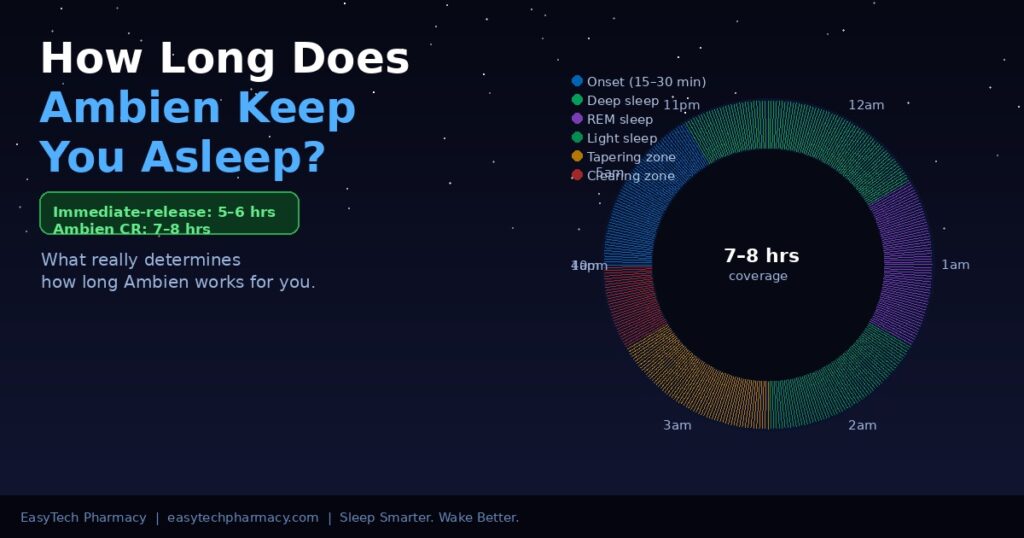
The Direct Answer — By Formulation
Ambien comes in two forms. Each has a different sleep duration profile. Understanding which one you have is the starting point for everything else.
Immediate-Release Zolpidem (Regular Ambien) — 5 to 6 Hours
Standard immediate-release zolpidem releases its full dose quickly. It reaches peak blood concentration within 1 to 2 hours. The half-life in healthy adults is approximately 2.5 to 3 hours.
What this means in practice: therapeutic sleep-supporting levels of zolpidem are typically active for 5 to 6 hours after taking the tablet. After that point, blood levels fall below the threshold needed to maintain sleep effectively. Many people wake naturally around this mark — which at a 10:30pm dose means waking somewhere around 4am to 5am.
This is not a malfunction. It is the medication working exactly as designed. Immediate-release zolpidem was built to help you fall asleep — not necessarily to keep you asleep for a full 8 hours.
Extended-Release Zolpidem (Ambien CR) — 7 to 8 Hours
Ambien CR uses a two-layer tablet. The first layer dissolves quickly — producing the same fast onset as the immediate-release version. The second layer dissolves slowly. It maintains therapeutic zolpidem blood levels through the second half of the night.
The result is a more sustained sleep window. Most people find Ambien CR supports 7 to 8 hours of sleep without the early morning waking that standard Ambien can produce. For people whose sleep pattern involves falling asleep but waking at 3am or 4am, Ambien CR directly addresses that gap.
Our guide on the best sleeping pills for people who wake up at night covers the extended-release option alongside every other sleep maintenance medication available.
Why the 7 to 8 Hour Rule Exists — And Why It Matters
Every piece of Ambien guidance you will ever read includes some version of this instruction: only take it when you have 7 to 8 hours available for sleep.
Most people assume this is a general caution. It is not. It is a specific safety requirement tied directly to how long the medication stays active in your system.
Here is why it matters. Zolpidem does not simply switch off when your alarm goes off. It is metabolized gradually. If you take Ambien at 11pm and wake at 5am — only 6 hours later — the medication has not fully cleared your system. You may feel alert enough to get up. But cognitive function, reaction time, and coordination can be meaningfully impaired even when you feel subjectively awake.
According to the FDA, next-morning driving impairment is one of the most significant clinical concerns associated with zolpidem use. The agency specifically recommends lower doses for women — because women clear zolpidem more slowly — and for this reason next-morning blood levels are particularly relevant for female patients.
The 7 to 8 hour rule is not about getting a full night of sleep for comfort. It is about giving the medication enough time to clear to a level that is safe for driving and complex tasks.
The Factors That Change How Long Ambien Keeps You Asleep
The 5 to 6 hour (immediate-release) and 7 to 8 hour (CR) windows are averages. Several factors shift that window significantly in either direction.
Age
Older adults metabolize zolpidem more slowly. The liver enzyme systems responsible for breaking it down operate at lower efficiency with age. For adults over 65, the effective duration of zolpidem extends — meaning the medication stays active longer and the risk of next-morning impairment is significantly higher.
This is exactly why clinical guidelines recommend lower starting doses for older adults. A 5mg dose in a 70-year-old may produce a longer effective duration than a 10mg dose in a 35-year-old. The lower dose is not about less efficacy. It is about appropriate duration management.
Sex
Women clear zolpidem from their systems at a measurably slower rate than men. This was the specific finding that led the FDA to recommend lower starting doses for women — 5mg rather than 5 to 10mg. The slower clearance extends the effective duration and increases next-morning impairment risk. Women taking zolpidem at higher doses are more likely to have impairing blood levels at the 8-hour mark than men at the same dose.
Body Composition and Weight
Zolpidem’s distribution and clearance are affected by body composition. In people with lower body weight, the same dose produces higher peak blood concentrations. The effective duration can extend as a result. This is one reason why the standard clinical approach is to start at the lowest effective dose rather than jumping to the highest available.
Food
A full stomach delays zolpidem absorption — which shifts the entire sleep timeline later. If you eat a large meal and take Ambien immediately afterward, the medication may not reach effective blood levels until an hour or more after taking it. The duration of action from that delayed peak is similar — but the window shifts, affecting when you feel drowsy and when the medication begins to clear.
This is why taking Ambien on an empty or light stomach produces the most predictable and consistent sleep window.
Other Medications
Several common medications affect the liver enzymes responsible for zolpidem metabolism. Some slow it down — extending duration and increasing impairment risk. Others speed it up — shortening the effective window. This is one of the most important reasons to give your pharmacist a complete list of every medication and supplement you take before starting zolpidem.
Liver Function
People with any degree of liver impairment clear zolpidem more slowly than those with healthy liver function. Duration extends. Impairment risk increases. In people with significant liver conditions, lower doses and careful monitoring are particularly important.
Tolerance
With regular nightly use, the brain’s GABA receptors adapt to zolpidem’s presence. As tolerance develops, the effective duration of the medication can shorten — not because the medication is clearing faster, but because the threshold of receptor binding needed to maintain sleep has shifted upward. If you notice yourself waking earlier than you used to after taking the same dose, tolerance is a likely factor. Our guide on why does Ambien stop working after a few weeks covers this mechanism and what to do about it.
5mg vs 10mg — Does Dose Affect How Long Ambien Keeps You Asleep
Yes — but less dramatically than most people expect.
Higher doses of zolpidem do produce somewhat extended duration compared to lower doses. At 10mg, peak blood concentration is higher. The time for levels to fall below the therapeutic threshold takes slightly longer. The result is a modestly extended effective window — perhaps an additional 30 to 60 minutes compared to 5mg.
However, higher doses do not simply double the sleep duration. The relationship between dose and duration is not linear. More significantly, higher doses substantially increase next-morning impairment risk. The FDA’s dose recommendations — particularly the lower doses for women — reflect the conclusion that the modest sleep extension from higher doses does not justify the meaningfully increased impairment risk in many patients.
For most people, if 5mg is providing adequate sleep onset but the coverage is wearing off too early, switching to Ambien CR addresses the duration issue more effectively and with better safety margins than simply increasing to 10mg immediate-release.
What to Do If Ambien Is Not Keeping You Asleep Long Enough
If you wake up consistently earlier than 7 to 8 hours after taking Ambien, several approaches are worth considering — in order of least to most intervention.
Switch to Ambien CR
If you are currently taking immediate-release zolpidem and waking in the early morning hours, the most direct solution is switching to the extended-release version. Same active ingredient. Different delivery system. Longer sustained coverage through the second half of the night. This is the most common clinical response to early morning waking on standard Ambien.
Review Timing and Food
Taking Ambien later in the evening or on a lighter stomach can shift the effective window and reduce the likelihood of wearing off before your intended wake time. If you currently take it at 9:30pm and consistently wake at 3am, taking it at 10:30pm might extend coverage through to a more reasonable wake-up time.
Consider Eszopiclone (Lunesta)
Eszopiclone has a longer half-life than zolpidem — approximately 6 hours compared to 2.5 to 3 hours for zolpidem. This gives it inherently better sleep maintenance properties. For people who consistently find zolpidem wearing off too early even with Ambien CR, eszopiclone is worth discussing as an alternative.
Address the Underlying Pattern
Waking in the early morning hours — particularly with anxiety or racing thoughts — may not be a coverage gap issue at all. It may be the underlying insomnia pattern reasserting itself. Early morning waking is commonly associated with anxiety and depression. A medication that masks the waking is different from addressing what is causing it. CBT-I and anxiety-focused interventions often produce more durable improvement for this specific pattern than switching or escalating sleep medication.
A Practical Night Timeline — What the Medication Is Actually Doing
| Time | What Is Happening | What You Experience |
|---|---|---|
| 10:30pm — Take Ambien | Tablet dissolving, absorption beginning | Nothing noticeable yet |
| 10:45pm to 11:00pm | Zolpidem entering bloodstream | Mild heaviness, slowing thoughts |
| 11:00pm to 11:30pm | Blood levels rising toward therapeutic range | Clear drowsiness — most people asleep |
| 11:30pm to 1:00am | Peak blood concentration window | Deep sleep — most restorative stage |
| 1:00am to 3:30am | Levels beginning to decline | Lighter sleep stages — more REM |
| 3:30am to 5:00am | Approaching sub-therapeutic levels (IR only) | Natural waking possible for IR users |
| 5:00am to 7:00am | Most zolpidem cleared (IR) or still active (CR) | Waking window for IR — continued sleep for CR |
This timeline assumes immediate-release zolpidem 10mg taken on a light stomach at 10:30pm by a healthy adult under 65. Ambien CR would extend the active coverage column by 2 to 3 hours — keeping therapeutic blood levels present through the 5am to 7am window rather than tapering off from 3:30am onward.
Frequently Asked Questions
How long does Ambien make you sleep?
Immediate-release zolpidem typically supports 5 to 6 hours of sleep. Ambien CR (extended-release) supports 7 to 8 hours. The exact duration varies based on age, sex, body weight, other medications, liver function, and whether you have developed tolerance through regular use.
Why do I wake up after only 4 hours on Ambien?
Several reasons are possible. Immediate-release zolpidem’s active window may not extend to 7 to 8 hours for your metabolism. Tolerance may have developed, shortening the effective window. You may be taking it earlier in the evening than optimal. Switching to Ambien CR is usually the most direct solution for consistent early morning waking on standard zolpidem.
Does 5mg Ambien last as long as 10mg?
10mg provides modestly longer duration than 5mg — roughly 30 to 60 minutes additional coverage in most cases. However the difference is not dramatic. If coverage duration is the main concern, switching to Ambien CR addresses it more effectively than simply doubling the dose of immediate-release.
Will Ambien keep me asleep for 8 hours?
Immediate-release zolpidem typically does not provide 8 full hours of sleep coverage for most people. Ambien CR is designed specifically for 7 to 8 hour coverage through its two-layer release system. If 8-hour coverage is important for your situation, discussing the CR formulation with your pharmacist is worth doing.
Is it normal to wake up after Ambien wears off?
Yes — for immediate-release zolpidem this is completely normal and expected. The medication’s therapeutic levels decline after 5 to 6 hours. Natural waking at this point is the medication working as designed, not a malfunction. If this waking feels too early, Ambien CR or eszopiclone provide extended coverage specifically for this situation.
Bottom Line — Duration Depends on the Form You Take
The answer to how long does Ambien make you sleep is straightforward once you know which formulation you have. Immediate-release covers 5 to 6 hours. Extended-release covers 7 to 8. Age, sex, body weight, food timing, and other medications all shift those windows in either direction.
The 7 to 8 hour sleep window requirement is not arbitrary. It exists because zolpidem needs adequate time to clear from your system before you drive or need full cognitive function. Taking Ambien when you only have 5 or 6 hours available is not just about feeling groggy — it creates genuine next-morning impairment that the FDA has specifically flagged as a safety concern.
Choose the formulation that matches your actual sleep pattern. If you fall asleep fine but wake early, Ambien CR solves the problem more directly than increasing your immediate-release dose. And if you are finding that Ambien’s effective window is shrinking over time, our guide on why does Ambien stop working covers tolerance and the best ways to address it.
At EasyTech Pharmacy, we carry both generic zolpidem immediate-release and extended-release in all standard dosages. Transparent pricing, fast delivery, and a pharmacist team available to help you identify which formulation fits your sleep pattern best.
Looking for local options near you? Our Ambien near me guide covers pharmacy access across the US. And for pricing on both formulations, our breakdown of how much does Ambien cost without insurance shows what you should realistically be paying.
Visit EasyTech Pharmacy — find the right Ambien formulation for your sleep pattern today.