Natural Ambien Alternatives — 7 Plant-Based Sleep Aids That Actually Work
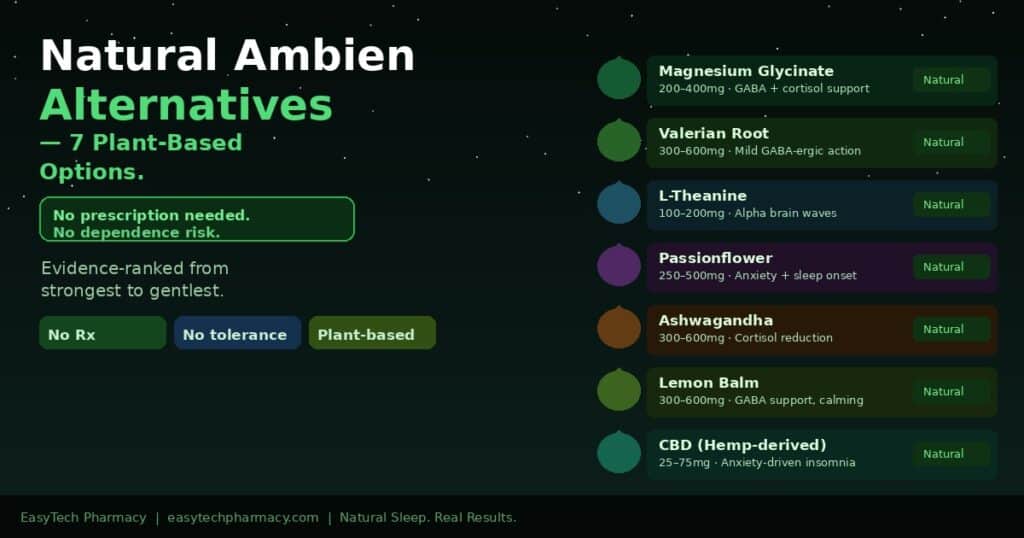
The appeal of natural sleep aids is real and reasonable. No authorization ,no pharmacy counter , no controlled substance concerns ,no risk of waking up dependent on something you took to help you sleep. For a lot of people, starting natural makes sense — both practically and philosophically.
The challenge is that the natural sleep aid category is crowded with products that overpromise and underdeliver. Melatonin gummies at 10mg doses sold as “maximum strength.” Herbal blends with ingredient lists that read more like marketing than medicine. Products that genuinely help mild sleep difficulty presented as alternatives to prescription medication for people with serious clinical insomnia.
This guide cuts through that. Seven natural Ambien alternatives — ranked by evidence, explained honestly, with the right doses and the right expectations. Because the gap between what some of these options can do and what Ambien does is real — and understanding it helps you make the right choice for your actual situation.
For anyone who has already tried natural options and needs the next step, our guide on non-benzo sleep aids covers every level from supplements through prescription options.
What “Natural” Actually Means Here
For the purposes of this guide, natural Ambien alternatives means plant-derived or mineral-based supplements available without a prescription that address sleep through recognized physiological mechanisms. This includes herbal extracts, amino acids, and minerals — all available OTC at pharmacies, health food stores, and online.
None of these replicate Ambien’s mechanism exactly. Ambien amplifies GABA-A receptors directly through a precise chemical mechanism that produces reliable, fast sedation. Natural options tend to influence the same systems more gently and indirectly — which makes them genuinely effective for mild to moderate sleep difficulty but typically insufficient for significant clinical insomnia on their own.
Setting this expectation clearly matters. The most common reason natural sleep aids disappoint people is not that they do not work — it is that they were used for a severity of insomnia that exceeded their mechanism’s capacity. Match the tool to the problem and results are meaningfully better.
Option 1 — Magnesium Glycinate (Strongest Evidence, Most Versatile)
If there is one natural sleep option that consistently overperforms expectations for people who discover it, magnesium glycinate is it. At 200 to 400mg taken 30 to 60 minutes before bed, it directly supports two physiological mechanisms that block sleep onset — GABA activity and cortisol regulation.
Magnesium is an essential mineral that many US adults consume below optimal levels. The NIH Office of Dietary Supplements notes that a significant proportion of American adults have magnesium intakes below the estimated average requirement — and low magnesium is directly associated with impaired sleep quality, more frequent nighttime waking, and reduced deep sleep time.
Supplementing to adequate levels restores these functions. For people whose deficiency is a contributing factor — which is more common than most realize — the improvement in sleep onset and quality can be striking within 5 to 7 days.
Why glycinate specifically: Magnesium oxide (most common and cheapest form) has poor absorption and primarily acts as a laxative. Magnesium citrate is better absorbed but still causes digestive discomfort at therapeutic doses for many people. Magnesium glycinate is bound to glycine — an amino acid with its own mild calming properties — and is both well-absorbed and gentle on the digestive system.
Works best for: sleep difficulty involving physical tension, nighttime muscle cramps, restless legs, stress-driven arousal, anxiety.
Honest limitation: Addresses physiological substrate rather than producing direct sedation. Does not work for everyone and is not sufficient for clinical insomnia.
Option 2 — Valerian Root (Most Studied Herbal Option)
Valerian has the longest history of use for sleep of any plant-based option and the most substantial research base — though the evidence is still considered mixed overall. At 300 to 600mg taken 30 to 60 minutes before bed, it works through mild GABA-ergic activity and possibly through serotonin receptor modulation.
Unlike most sleep aids, valerian’s effects build gradually over consistent use rather than producing immediate sedation on the first night. Two to four weeks of nightly use typically produces the most reliable results. People who try valerian once and declare it ineffective have usually not given it sufficient time to accumulate effect.
Works best for: mild ongoing insomnia, people who prefer plant-based options, and situations where a gradual building effect is acceptable.
Honest limitation: Effect magnitude is modest even at full effect. Not appropriate for significant insomnia. The distinctive smell of valerian root is noticeable but does not reflect quality.
Quality matters: Standardized extracts containing 0.3% to 0.8% valerenic acids are more reliable than unstandardized preparations. Look for standardization on the label.
Option 3 — L-Theanine (Best for Anxious Minds)
L-theanine is an amino acid found in green tea that promotes alpha brain wave activity — the relaxed, alert state associated with meditation and the physiological precursor to drowsiness. At 100 to 200mg taken before bed, it quiets cognitive hyperarousal — the racing thoughts, mental planning, and worry cycles that keep anxious people awake — without producing sedation or next-morning impairment.
Unique advantage: L-theanine is one of the few natural sleep aids that does not impair cognitive function at any typical dose. Unlike antihistamine-based sleep aids that produce grogginess, L-theanine promotes calm without dulling. It works with the brain’s natural wind-down process rather than forcing sedation.
Works best for: sleep difficulty driven by mental overactivation, anxiety, and cognitive arousal rather than physical tension. Pairs particularly well with magnesium glycinate — covering cognitive and physical arousal dimensions simultaneously.
For people whose insomnia is substantially driven by anxiety, our guide on sleeping pills that are not habit forming covers the full progression from these natural options through non-controlled prescription choices.
Option 4 — Passionflower (Underrated, Underused)
Passionflower (Passiflora incarnata) is one of the more interesting natural sleep options because its mechanism is relatively well understood for an herbal product — it works through GABA-A receptor activity, similar in direction to Ambien but significantly weaker in magnitude. At 250 to 500mg of standardized extract, it produces mild anxiolytic and sedative effects.
A small number of clinical trials have shown passionflower producing measurable improvements in sleep quality — particularly in people with mild to moderate anxiety. Its GABA-ergic activity makes it mechanistically relevant to insomnia driven by hyperarousal, though the effect is much gentler than pharmaceutical GABA options.
Works best for: mild anxiety-driven insomnia, people who want GABA-pathway support without any controlled substance, and as part of a combination approach alongside magnesium and L-theanine.
Availability: Available at health food stores and online. Look for extracts standardized to flavonoid content for most reliable dosing.
Option 5 — Ashwagandha (For Stress-Driven Insomnia)
Ashwagandha (Withania somnifera) is an adaptogenic herb with substantial evidence for reducing cortisol and physiological stress response. Several recent clinical trials have shown meaningful improvements in sleep onset time, sleep quality, and next-morning alertness at doses of 300 to 600mg of standardized root extract.
Its mechanism is different from most sleep aids — rather than producing sedation, it reduces the hyperactivation of the stress response system that prevents sleep onset. Lower cortisol, reduced sympathetic nervous system activity, and better stress regulation all support sleep quality indirectly but measurably.
Works best for: insomnia that is clearly connected to stress, work pressure, or sustained anxiety — rather than primary insomnia without an obvious stress component. Also supports daytime energy and resilience which reduces the fatigue-anxiety cycle that worsens insomnia over time.
Dose timing: Ashwagandha’s effects are cumulative — benefits build over 4 to 8 weeks of consistent use. It can be taken in the morning as well as at night without causing sedation during the day, which distinguishes it from most other sleep-focused supplements.
Option 6 — Lemon Balm (Calming, Gentle, Pairs Well)
Lemon balm (Melissa officinalis) has a long traditional use history for anxiety and insomnia and a modest evidence base supporting mild anxiolytic and calming effects. At 300 to 600mg of standardized extract, it produces gentle calming without sedation.
It is most consistently effective when combined with other calming herbs — particularly valerian root, where the combination has shown better results in clinical trials than either ingredient alone. The lemon balm / valerian combination is one of the most studied herbal sleep formulations.
Works best for: mild anxiety, nervous restlessness, and as part of a combination approach rather than as a standalone treatment for significant insomnia.
Safety: Well-tolerated with minimal side effect reports at standard doses. Safe for most adults without specific contraindications.
Option 7 — CBD (Hemp-Derived Cannabidiol)
CBD has become one of the most widely used natural sleep supplements in the US despite a research base that is still developing. The most consistent finding across existing studies is that CBD reduces anxiety — and since anxiety-driven insomnia accounts for a significant proportion of sleep difficulty, this anxiety reduction produces secondary sleep improvements.
At doses of 25 to 75mg of high-quality CBD taken 30 to 60 minutes before bed, many users report meaningful improvements in both time to sleep onset and subjective sleep quality. However, individual response varies considerably — some people find significant benefit, others notice nothing.
Critical quality note: CBD products are not regulated by the FDA with the same standards as pharmaceutical products. Product quality varies enormously. Look specifically for products with third-party certificates of analysis (COA) confirming actual CBD content and the absence of pesticides, heavy metals, and contaminants. Without a COA, you cannot be confident about what you are actually taking.
Legal status: Hemp-derived CBD with less than 0.3% THC is federally legal in the US. State-level regulations vary. Confirm your state’s current CBD regulations before purchasing.
The Most Effective Combinations
Natural sleep aids often work better in synergistic combinations than alone — covering multiple physiological mechanisms simultaneously.
- Magnesium glycinate + L-theanine: The most consistently useful pairing for stress-driven sleep difficulty. Physical and cognitive arousal both addressed. Start here for most people trying natural options for the first time.
- Valerian + lemon balm: Well-studied combination with better evidence than either ingredient alone. Good for mild ongoing insomnia with anxiety component.
- Ashwagandha + magnesium glycinate: For insomnia clearly connected to chronic stress. Ashwagandha addresses the stress response; magnesium addresses the physiological sleep substrate.
- L-theanine + low-dose melatonin (1–2mg): For people with both circadian timing issues and cognitive arousal. Theanine calms the mind; melatonin signals the body clock.
When Natural Is Not Enough — What to Do Next
Natural alternatives work reliably for mild to moderate, stress-connected, or behaviorally driven insomnia. They have clear limits for clinical insomnia — particularly when the problem has persisted for months, involves waking repeatedly through the night, or significantly impairs daytime function despite consistent natural approaches.
The most practical progression:
- Natural supplement combination (2 to 4 weeks consistent trial)
- Behavioral approaches — fixed wake time, 4-7-8 breathing, CBT-I techniques from our guide on how can I sleep quickly
- Non-controlled prescription options — trazodone, ramelteon, low-dose doxepin — covered in our guide on trazodone vs Ambien
- Z-drugs (zolpidem, zaleplon, eszopiclone) as short-term support — covered in our guide on how to buy Ambien online
For people who wake in the middle of the night specifically — a pattern that natural options address less reliably than sleep onset issues — our guide on the best sleeping pills for people who wake up at night covers which options address that pattern most effectively.
Realistic Expectations — The Honest Summary
| Option | Onset of Effect | Strength | Best Evidence For |
|---|---|---|---|
| Magnesium glycinate | 5–7 days consistent use | Moderate | Tension, restless legs, anxiety |
| Valerian root | 2–4 weeks | Mild–moderate | Mild ongoing insomnia |
| L-Theanine | 30–60 minutes (acute) | Mild | Cognitive arousal, anxiety |
| Passionflower | 30–60 minutes (acute) | Mild | Anxiety-driven insomnia |
| Ashwagandha | 4–8 weeks | Moderate (via stress) | Stress-related insomnia |
| Lemon balm | 30–60 minutes (acute) | Mild | Mild anxiety, restlessness |
| CBD | 30–60 minutes (acute) | Mild–moderate | Anxiety-driven insomnia |
Frequently Asked Questions
What natural supplement works most like Ambien?
No natural supplement replicates Ambien’s direct GABA-A amplification — that mechanism requires a pharmaceutical compound. The closest in direction are passionflower (mild GABA-ergic activity) and magnesium glycinate (indirect GABA support). However, both produce significantly gentler effects than zolpidem. For mild sleep difficulty they are often sufficient; for clinical insomnia they typically are not.
Is melatonin a good natural alternative to Ambien?
For circadian timing issues — yes. For primary hyperarousal insomnia — usually not adequate alone. Melatonin signals the body clock but does not produce sedation in the way Ambien does. At the right dose (0.5 to 3mg, not the 10mg most OTC products provide) and at the right timing (60 to 90 minutes before target bedtime), it is one of the most useful tools for jet lag and delayed sleep phase syndrome.
How long should I try natural alternatives before considering medication?
Give consistent natural approaches 2 to 4 weeks before evaluating. Most supplement effects are cumulative — single-night trials are not reliable indicators. If after 4 weeks of consistent use at appropriate doses your sleep has not meaningfully improved, that is a reasonable signal that the current approach is not sufficient for your level of insomnia.
Can I combine natural sleep aids with Ambien?
Most natural options — magnesium, L-theanine, valerian, passionflower — do not have dangerous interactions with zolpidem at standard doses. However, combining any sleep-supporting substance with Ambien adds to the overall CNS-depressant effect. Discuss any supplement use with your pharmacist before combining with prescription sleep medication.
What is the strongest natural sleep aid available without a prescription?
Magnesium glycinate consistently produces the most reliable and meaningful sleep improvement among natural options for the broadest range of patients. Valerian root combined with lemon balm is the strongest herbal combination with clinical evidence. For anxiety-driven insomnia, higher-dose CBD (50 to 75mg from a quality source with COA) produces the most meaningful acute effects among natural options for that specific pattern.
Bottom Line — Natural Options Work for the Right Problem
The best natural Ambien alternatives are not substitutes for Ambien in severe insomnia — they are appropriate tools for mild to moderate sleep difficulty that match their mechanisms to the right sleep problems. Magnesium for tension and cortisol. L-theanine for anxious minds. Ashwagandha for chronic stress. Valerian and lemon balm for mild general insomnia. CBD for anxiety-driven patterns.
Used consistently at the right doses, these options produce genuine meaningful results for the majority of people with non-severe sleep difficulty — without prescriptions, without dependence risk, and without next-morning impairment concerns.
When they are not enough, the next step is non-controlled prescription options — not an immediate jump to controlled substances. That progression is covered in full in our OTC alternatives guide and our non-benzo sleep aids guide.
At EasyTech Pharmacy, we support every level of the sleep support spectrum — from guidance on natural approaches through affordable generic prescription options when needed.
For local pharmacy access across the World, our Ambien near me guide covers options near you.