Trazodone vs Ambien for Sleep — An Honest Comparison That Actually Helps You Choose
If you have spent any time researching sleep medication online, you have almost certainly come across both of these names. Trazodone and Ambien show up constantly in sleep forums, pharmacy conversations, and telehealth consultations. And the comparison makes sense — both can help people sleep, both are widely available in the US, and both are significantly more effective than melatonin gummies for people dealing with real insomnia.
But they work through completely different mechanisms, carry completely different risk profiles, and suit completely different sleep situations. Choosing between them without understanding those differences is a bit like choosing between a hammer and a screwdriver based on which one looks more useful — the right answer depends entirely on what you are trying to do.
This guide puts trazodone vs Ambien side by side — honestly, clearly, and without skipping the parts that actually matter for your decision.
Already familiar with Ambien and just weighing up cost? Our guide on how much does Ambien cost without insurance covers real pricing for both medications at every major pharmacy.
The Fundamental Difference — Two Medications, Two Completely Different Approaches
Before comparing specifics, it helps to understand what each medication actually is — because they come from very different places.
Ambien (zolpidem) is a sedative-hypnotic — a medication specifically designed and FDA-approved for the treatment of insomnia. It works by binding to GABA-A receptors in the brain and amplifying the brain’s natural “slow down” signal. It was built specifically to make you fall asleep faster, and it is very good at doing exactly that.
Trazodone is an antidepressant — specifically a serotonin modulator — that was originally developed in the 1960s to treat depression. At the doses used for depression it has moderate effectiveness and significant side effects. However, at much lower doses it produces reliable sedation and is now prescribed far more frequently for insomnia than for depression. It was not built to be a sleep aid. It became one because of its side effect profile.
This origin story matters. Ambien’s mechanism is precise and targeted — it does one thing very well. Trazodone’s sleep effects are broader and less targeted — which gives it different advantages and different limitations.
Onset Time — How Quickly Each One Works
If speed is your priority, Ambien wins this comparison clearly.
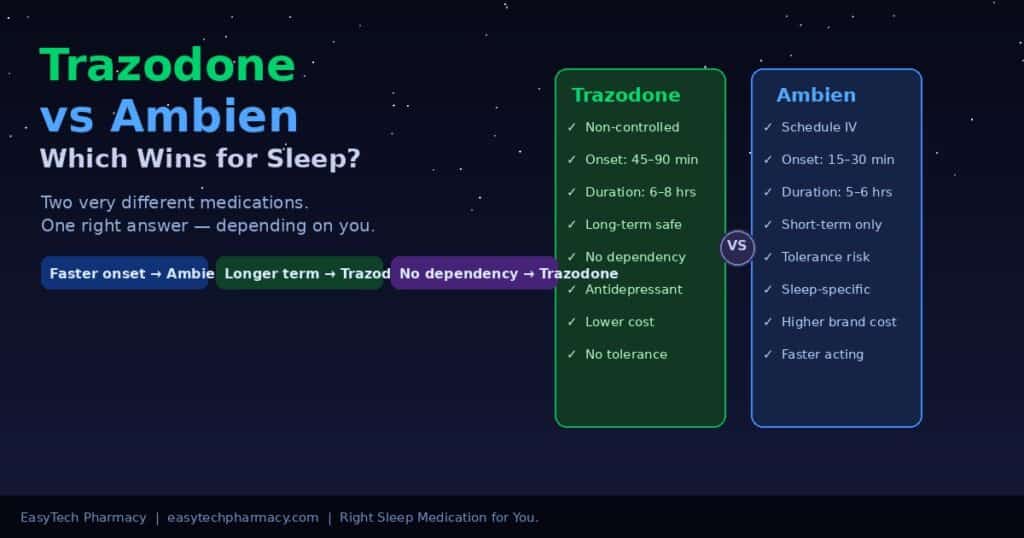
Immediate-release zolpidem typically produces noticeable drowsiness within 15 to 30 minutes of taking it. For people whose biggest problem is lying awake for hours unable to get to sleep, that fast onset is genuinely valuable. You take it, go to bed, and most people are asleep within 30 to 45 minutes total.
Trazodone works more slowly. Most people experience onset somewhere between 45 minutes and 90 minutes depending on the dose and the individual. For someone who simply wants to fall asleep faster tonight, that slower ramp-up can feel frustrating.
However, onset speed is not the whole story — and for a lot of people it is not even the most important factor. If the question is which medication produces better overall sleep quality across the full night, the comparison gets more nuanced. Our dedicated guide on how long does Ambien take to work covers the full timeline and what affects it in detail.
Duration — How Long Each One Keeps You Asleep
This is where trazodone starts to show its strengths.
Standard immediate-release Ambien has a half-life of roughly 2.5 to 3 hours. Its active effects typically cover 5 to 6 hours before tapering off. For people who need help falling asleep but sleep reasonably well once they are out, this is sufficient. For people who wake up at 3am or 4am and cannot get back to sleep, Ambien’s coverage can wear thin right at the most vulnerable window.
Trazodone at sleep doses produces a gentler but often more sustained sedative effect — typically covering 6 to 8 hours. Because of its different mechanism and longer half-life at the doses used for insomnia, many people find it does a better job of keeping them asleep through the second half of the night than Ambien does.
For people whose primary complaint is waking in the middle of the night, our guide on the best sleeping pills for people who wake up at night covers this pattern in detail — including how trazodone compares to Ambien CR and eszopiclone for sleep maintenance specifically.
Dependency and Tolerance — The Biggest Practical Difference
This is where the two medications diverge most significantly — and where the choice often becomes clearer for most people.
Ambien — Schedule IV, Tolerance Develops
Ambien is a Schedule IV controlled substance under the DEA’s classification system. This classification exists because zolpidem carries a recognized potential for physical dependence and abuse. Your brain’s GABA receptors adapt to the presence of zolpidem over time — requiring progressively more of the medication to achieve the same effect. Most people begin to notice this somewhere between two and four weeks of nightly use.
This is also why Ambien is specifically recommended for short-term use — typically two to four weeks. Using it beyond that window without breaks increases both the tolerance and dependence risk. Stopping suddenly after extended use can cause rebound insomnia that temporarily makes sleep worse than before you started. Our guide on why does Ambien stop working after a few weeks covers this mechanism and what to do about it in full detail.
Trazodone — Not Controlled, Essentially No Dependency Risk
Trazodone is not a controlled substance. It does not carry a recognized risk of physical dependence or abuse. Your brain does not develop tolerance to its sedative effects the way it does with zolpidem. People can take trazodone for sleep for months or even years without needing to increase the dose or worrying about physical dependence.
This makes it one of the most practically useful options for people with ongoing chronic insomnia who need something sustainable — not just a two-week bridge. According to MedlinePlus, trazodone’s low dependency profile is one of the primary reasons it has become one of the most commonly used medications for chronic insomnia in the US despite not having an FDA sleep indication at typical insomnia doses.
For anyone specifically concerned about dependency risk, our full guide on sleeping pills that are not habit forming covers trazodone alongside every other non-controlled sleep option available.
Side Effects — What You Actually Experience
Ambien Side Effects
Ambien’s side effect profile is well documented. The most practically significant ones:
- Next-morning grogginess — particularly common in women and older adults. The FDA specifically recommends lower starting doses for women because zolpidem clears more slowly from the female body.
- Parasomnias — the most dramatic and least commonly discussed side effect. A small percentage of Ambien users perform behaviors during sleep — sleepwalking, eating, driving — with no memory of them afterward. Risk increases significantly when Ambien is combined with alcohol.
- Memory gaps — if sleep is cut short or if the medication is taken and sleep is resisted, anterograde amnesia can occur. Activities after taking Ambien may not be remembered the next morning.
- Tolerance and rebound — as covered above, reduced effectiveness over time and temporarily worse sleep when stopping.
Trazodone Side Effects
Trazodone’s side effects at sleep doses are generally milder than Ambien’s:
- Morning grogginess — present but typically less pronounced than with Ambien, particularly at lower doses (50mg to 100mg range used for sleep)
- Dry mouth and dizziness — common in the first week or two, usually fades with continued use
- Blood pressure changes — trazodone can cause orthostatic hypotension in some people, meaning a drop in blood pressure when standing up quickly. Getting up slowly at night reduces this risk.
- Priapism — extremely rare but worth knowing about. A small number of men have experienced prolonged erection with trazodone. If this occurs it requires immediate medical attention.
Overall, trazodone’s side effect profile at sleep doses is considered more manageable than Ambien’s for most people — particularly for older adults where Ambien’s fall risk and cognitive effects are more significant concerns.
Cost — What You Actually Pay
Both medications are available in affordable generic forms — and both are significantly cheaper than many people expect once you know where to look.
| Medication | Typical Dose for Sleep | 30-Day Cost Without Insurance | With GoodRx Coupon | Controlled? |
|---|---|---|---|---|
| Trazodone (generic) | 50–100mg | $8 – $20 | $5 – $12 | No |
| Zolpidem (generic Ambien) | 5–10mg | $12 – $35 | $8 – $15 | Yes — Schedule IV |
| Brand Ambien | 5–10mg | $200 – $400 | $50 – $120 | Yes — Schedule IV |
Trazodone is consistently one of the most affordable prescription sleep medications available. Generic trazodone often costs less per month than even the cheapest generic zolpidem options — making it not just a lower dependency option but also a more affordable one. Check current pricing for both medications at GoodRx’s comparison tool before your next pharmacy visit.
Which Sleep Problem Does Each One Fit Best
Rather than declaring a single winner, the most useful way to think about trazodone vs Ambien is to match each medication to the sleep pattern it genuinely suits.
Ambien Is a Better Fit If
- Your primary problem is falling asleep — not staying asleep
- You need something that works fast — within 15 to 30 minutes
- Your insomnia is short-term — connected to a specific stressor or life event
- You have already tried trazodone and found it insufficient
- You only need a two to four week bridge while addressing the underlying cause
Trazodone Is a Better Fit If
- Your insomnia is ongoing — chronic rather than situational
- You wake up in the middle of the night or wake too early
- Dependency risk is a significant concern for you
- You have previously developed tolerance to Ambien
- You are an older adult where Ambien’s side effect profile is a more significant concern
- You want the lowest-cost sustainable option available
- Your insomnia is connected to anxiety or low mood alongside the sleep difficulty
Can You Take Both Trazodone and Ambien Together
This question comes up frequently — and the honest answer is that combining sedating medications should always involve a conversation with your pharmacist first.
Both trazodone and zolpidem have CNS depressant properties. Taking them together increases sedation and could amplify side effects — particularly next-morning impairment and the risk of respiratory depression. Some people are on both medications under careful guidance when one alone is insufficient, but this is not a combination to arrange on your own without proper oversight.
If you find that neither medication alone is solving your sleep issues, the more productive conversation is about why the insomnia persists — which often points toward underlying anxiety, sleep apnea, pain, or other factors that medication alone cannot fully address regardless of what is prescribed.
How to Access Either Medication Online
Both trazodone and zolpidem are available through online pharmacies with valid authorizations. The process is identical for both — telehealth consultation, electronic authorization, online pharmacy order, home delivery.
Trazodone, being non-controlled, is slightly easier to access in some telehealth situations because providers can sometimes prescribe it across state lines with fewer restrictions than Schedule IV medications like zolpidem. However both are routinely available through major telehealth platforms.
For the full process of accessing either medication through an online pharmacy, our guide on how to buy Ambien online covers every step. And if you are looking for local options rather than delivery, our Ambien near me guide covers pharmacy access across the US for both medications.
Frequently Asked Questions
Is trazodone or Ambien better for sleep?
Neither is universally better — they suit different sleep problems. Ambien works faster and is better for sleep onset insomnia over a short period. Trazodone is better for ongoing chronic insomnia, sleep maintenance issues, and anyone concerned about dependency risk. The right choice depends entirely on your specific sleep pattern and how long you need support.
Is trazodone safer than Ambien?
In terms of dependency and controlled substance classification — yes. Trazodone is not a controlled substance and does not carry the same tolerance and dependency risk as zolpidem. However, both medications have side effect profiles and both carry risks at incorrect doses or in combination with other substances. Neither should be taken without proper guidance.
Can trazodone replace Ambien if Ambien stops working?
Yes — this is actually one of the most common clinical scenarios where trazodone is introduced. When zolpidem tolerance has developed and the medication has lost effectiveness, switching to trazodone’s completely different mechanism often restores sleep quality without the escalating tolerance problem. Our guide on why does Ambien stop working covers this transition in detail.
Which works faster — trazodone or Ambien?
Ambien works significantly faster. Immediate-release zolpidem produces drowsiness within 15 to 30 minutes. Trazodone typically takes 45 to 90 minutes. If speed of onset is your primary concern, Ambien is the faster option.
Is trazodone cheaper than Ambien?
Yes — generic trazodone is consistently among the cheapest prescription sleep medications available, often under $12 for a 30-day supply even without a coupon. Generic zolpidem is similarly affordable at $8 to $15 with a GoodRx coupon, but trazodone tends to edge it out at the lowest price point. Brand-name Ambien is dramatically more expensive than either generic option.
Bottom Line — Trazodone and Ambien Are Not Interchangeable
The trazodone vs Ambien comparison comes down to this — they are not competing for the same job. Ambien is a fast-acting, short-term sleep onset tool. Trazodone is a slower-acting, longer-term, non-controlled sleep maintenance option. They suit different people with different sleep problems at different stages of dealing with insomnia.
If you have just started struggling to sleep and want something that works quickly for a defined short period — Ambien. If you have been dealing with insomnia for months, wake up repeatedly through the night, have concerns about dependency, or need something you can take consistently without the escalating tolerance problem — trazodone deserves serious consideration.
At EasyTech Pharmacy, we carry both FDA-approved generic zolpidem and generic trazodone at competitive pricing with fast shipping and real pharmacist support. If you have questions about which option makes more sense for your specific situation, our pharmacist team is available to help.
Visit EasyTech Pharmacy — find the right sleep medication for your situation today.