Does Ambien Cause Weight Gain? The Honest Answer and What the Research Says
Weight gain shows up on enough sleep medication side effect lists that people genuinely wonder whether Ambien is making them heavier. It is a fair concern — particularly for anyone already managing weight or noticing changes since starting the medication.
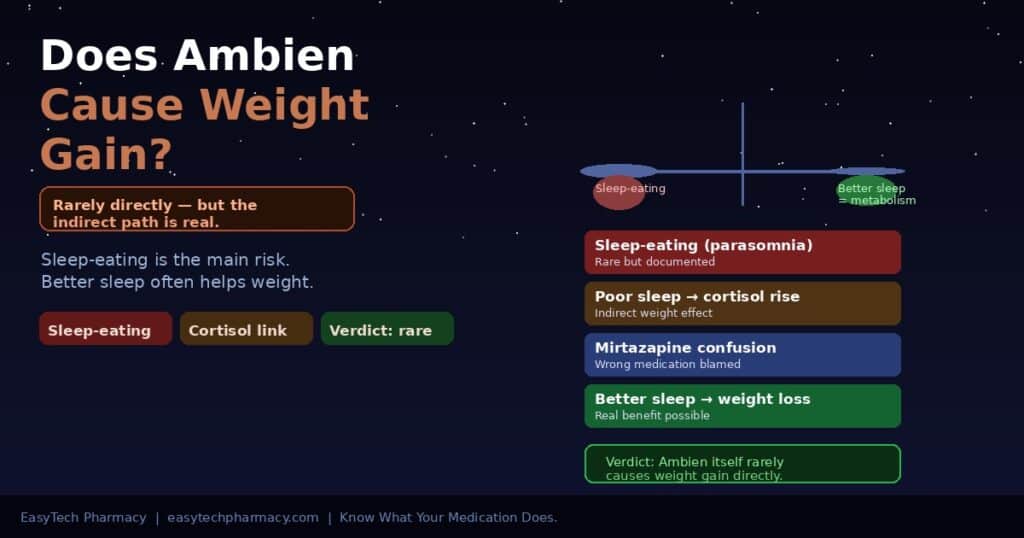
The answer is more nuanced than a simple yes or no. Ambien does not cause weight gain the way some medications do — through direct hormonal disruption, metabolic changes, or appetite stimulation in the way that mirtazapine, for example, notoriously does. However, there is a documented indirect pathway that can produce real weight changes in some Ambien users — and it is a particularly strange one.
This guide covers does Ambien cause weight gain completely — the real mechanisms, who is at risk, how to identify whether Ambien is contributing to weight changes, and what to do about it.
For the full picture of everything Ambien can and cannot do to your body, our comprehensive guide on Ambien side effects covers every documented effect.
The Direct Answer — Ambien Itself Does Not Typically Cause Weight Gain
Zolpidem is not listed as a weight-gain-causing medication in its FDA prescribing information it does not affect insulin sensitivity it does not increase appetite through ghrelin or leptin disruption it does not cause metabolic slowdown. These are the mechanisms through which medications typically produce weight gain — and none of them are part of how zolpidem works.
Furthermore, improved sleep — which is what Ambien is supposed to produce — is actually associated with better weight management rather than worse. Sleep deprivation consistently produces hormonal changes that increase appetite, reduce satiety signaling, and impair metabolic regulation. Treating insomnia effectively can produce modest improvements in these metrics over time.
So where does the weight gain concern come from? Two places.
The Real Risk — Sleep-Eating (Somnambulistic Eating)
This is the documented mechanism that can genuinely produce weight gain in Ambien users — and it is one of the more surprising side effects in all of sleep pharmacology.
Sleep-eating, also called somnambulistic eating or nocturnal sleep-related eating disorder (NS-RED) triggered by medication, involves preparing and eating food during sleep — with no conscious awareness and no memory of it the following morning. It is a form of parasomnia — the same category as sleepwalking and sleep-driving that Ambien’s FDA warnings specifically address.
According to the FDA’s complex sleep behavior warning for Ambien, sleep-eating is among the documented parasomnias that can occur with zolpidem — alongside sleepwalking and sleep-driving. These behaviors can occur even at normal therapeutic doses and with no prior history of parasomnias.
How Sleep-Eating Causes Weight Gain
The mechanism is straightforward once understood. A person takes Ambien, goes to bed, and enters the partial sedation state during which parasomnias occur. During this state they get up, go to the kitchen, prepare food — sometimes elaborate meals, sometimes just raiding the refrigerator — eat significant amounts, and return to bed. The next morning they have no memory of any of it. But the calories consumed are entirely real.
People who experience this pattern often notice unexplained weight gain without any change in their conscious eating habits. They cannot account for the weight gain. Food disappears from their kitchen without explanation. They might find evidence — dishes left out, crumbs, food wrappers — but no memory of what happened.
How Common Is Sleep-Eating With Ambien
Sleep-eating as an Ambien-triggered parasomnia is relatively rare — affecting a minority of users rather than a common experience. However, because the person has no memory of the behavior, it can go on for extended periods before being identified. A person gaining unexplained weight while taking Ambien should consider sleep-eating as a possible cause, particularly if they also take the medication and sometimes stay awake rather than going directly to sleep.
Risk Factors That Increase Sleep-Eating Likelihood
- Higher doses: Parasomnia risk increases with dose. People taking 10mg are at higher risk than those at 5mg.
- Alcohol combination: Combining Ambien with alcohol dramatically increases all parasomnia risk — see our guide on Ambien and alcohol for the full interaction picture.
- Staying awake after taking it: Fighting the drowsiness after taking Ambien creates the dissociated state where parasomnias are most likely to occur.
- Prior history of sleepwalking: People with any history of sleepwalking or other parasomnias are at higher risk for all Ambien-related parasomnia behaviors.
- Ambien CR: The extended-release version’s longer active window provides a longer potential window for nocturnal behaviors. Our guide on Ambien and Ambien CR covers the differences between formulations.
The Indirect Risk — Poor Sleep, Cortisol, and Weight
The second way Ambien-related weight gain can occur is through inadequate treatment of the underlying insomnia — where the medication is not solving the sleep problem completely, leaving the person still sleep-deprived despite taking a sleep aid.
Chronic sleep deprivation produces well-documented hormonal changes that drive weight gain:
- Ghrelin increases: Ghrelin is the primary hunger hormone. Sleep deprivation consistently raises ghrelin levels — increasing appetite, particularly for high-calorie foods.
- Leptin decreases: Leptin signals satiety — the feeling of being full. Poor sleep reduces leptin, so people feel less satisfied after eating the same amount of food.
- Cortisol remains elevated: Persistent cortisol elevation from inadequate sleep drives fat storage, particularly around the abdomen — visceral fat accumulation.
- Insulin sensitivity decreases: Sleep-deprived individuals process carbohydrates less efficiently, with more calories directed toward fat storage.
If someone takes Ambien but continues to have inadequate sleep — whether because of tolerance, insufficient dose, or underlying sleep disorder — these weight-promoting hormonal changes persist. The person may associate the weight gain with “being on Ambien” when the actual driver is the ongoing sleep deprivation that Ambien is not fully resolving.
This is one of the strongest arguments for addressing the root causes of insomnia rather than relying solely on medication. Our guide on how can I sleep quickly covers the behavioral approaches that most directly address sleep quality alongside any medication support.
The Medication Mix-Up — When Weight Gain Is Actually From Something Else
A significant proportion of Ambien-attributed weight gain actually comes from other medications being taken simultaneously — particularly when those medications are also sleep-related.
The most common source of confusion is mirtazapine. Mirtazapine is an antidepressant frequently used off-label for insomnia — and it is one of the most consistent weight-gain-causing medications available. It increases appetite significantly through histamine and serotonin receptor effects. People prescribed mirtazapine for sleep who gain weight sometimes attribute it to “my sleep medication” — which could mean Ambien if they are taking both, or could just mean mirtazapine.
Quetiapine (prescribed off-label for sleep at low doses) also causes metabolic changes and weight gain. Tricyclic antidepressants at sleep doses have some weight effects. Any of these, taken alongside Ambien, could produce weight gain that gets incorrectly attributed to the Ambien.
If you have gained weight and are taking multiple medications, working through them individually with your pharmacist — identifying which has documented weight-gain effects and which does not — is a more productive approach than assuming Ambien is the cause.
The Surprising Counter-Narrative — Better Sleep Can Help With Weight
This is the part of the Ambien-weight picture most people never hear about. When Ambien successfully treats insomnia — genuinely improving sleep quality and duration — the hormonal benefits of adequate sleep can produce modest weight management improvements rather than weight gain.
Studies consistently show that people who get adequate sleep:
- Have lower average ghrelin (appetite hormone) levels
- Have higher average leptin (satiety hormone) levels
- Make better food choices during the day — energy depletion from poor sleep drives high-calorie cravings
- Exercise more — fatigue from insomnia reduces physical activity
- Have better insulin sensitivity and more efficient calorie processing
People who move from chronic insomnia to genuinely adequate sleep — including through medication — sometimes lose weight over the following months as these metabolic benefits accumulate. This is not unique to Ambien; it is a benefit of restored sleep regardless of how it was achieved.
The net effect of Ambien on weight is therefore genuinely bidirectional — it can contribute to weight gain through sleep-eating (rare), inadequate sleep treatment (indirect), or medication confusion (misattribution), while simultaneously having potential weight-positive effects through improved sleep quality when it works well.
How to Tell If Ambien Is Contributing to Your Weight Changes
If you have noticed weight changes since starting Ambien, these questions help identify what is actually going on.
- Do you ever find food prepared, wrappers out, or dishes used that you have no memory of?
- Has anyone in your household reported you getting up and going to the kitchen during the night?
- Is your weight gain accompanied by unexplained food disappearing?
- Are you taking any other medications alongside Ambien that have documented weight effects?
- Is your sleep actually improving — do you feel more rested — or is Ambien not fully resolving the insomnia?
- Did your weight change begin at the same time as Ambien, or gradually before it?
If the first three questions point toward sleep-eating, that is an important finding — one that requires stopping Ambien and discussing alternatives with your pharmacist. Sleep-eating cannot simply be managed by willpower or dietary discipline because it occurs without conscious awareness.
What to Do If You Suspect Sleep-Eating From Ambien
Sleep-eating associated with Ambien is not a manageable side effect in the way morning grogginess is. It is a complex behavior occurring during sleep that requires medication adjustment rather than behavioral modification.
Stop taking Ambien and contact your pharmacist. Sleep-eating is one of the parasomnia behaviors specifically listed in the FDA’s warning for Ambien — it warrants discontinuation rather than dose adjustment. Continuing to take the medication and trying to secure the kitchen does not address the underlying parasomnia mechanism.
Consider switching to a different sleep medication with a lower parasomnia risk profile. Trazodone, ramelteon, and low-dose doxepin all carry significantly lower parasomnia risk than Z-drugs. Our guide on trazodone vs Ambien covers the comparison in full.
Natural alternatives without any parasomnia mechanism are covered in our guide on natural Ambien alternatives — particularly useful for people who want to avoid the Z-drug class entirely after experiencing a parasomnia.
Frequently Asked Questions
Does Ambien cause weight gain?
Not directly through metabolic or hormonal mechanisms — zolpidem does not affect insulin, appetite hormones, or metabolism in ways that cause weight gain. However, sleep-eating (a documented parasomnia risk) can cause real weight gain through unconscious nighttime eating with no memory of it. Inadequate sleep treatment leaving the person still sleep-deprived also drives the hormonal changes that promote weight gain.
What is sleep-eating from Ambien?
Sleep-eating is a parasomnia — a complex behavior performed during sleep without conscious awareness or subsequent memory. A person prepares and consumes food while in a sleep state, then has no recollection of it the following morning. It is documented as a possible side effect of zolpidem in the FDA’s prescribing information. Evidence includes unexplained weight gain, missing food, and evidence of kitchen activity with no memory of it.
Does stopping Ambien cause weight loss?
If sleep-eating was occurring, stopping Ambien typically stops the behavior — which removes the unconscious calorie source and can produce weight loss over time. If the weight gain was from other causes, stopping Ambien alone will not produce weight changes.
Can Ambien help with weight loss?
Not directly — Ambien is not a weight management medication. However, when it genuinely improves sleep quality, the hormonal benefits of adequate sleep — better appetite regulation, improved insulin sensitivity, more energy for activity — can support weight management as a secondary effect.
Which sleep medications cause weight gain?
Mirtazapine (antidepressant used for sleep) is one of the most consistent weight-gain-causing sleep-adjacent medications. Low-dose quetiapine also produces metabolic effects. OTC antihistamines like diphenhydramine can increase appetite with regular use. Zolpidem (Ambien) is not typically in the same category for direct weight gain — its weight-related concern is sleep-eating rather than metabolic effects.
Bottom Line — Ambien Is Not a Weight Gain Drug, But Watch for Sleep-Eating
The answer to does Ambien cause weight gain is nuanced. Direct metabolic weight gain from Ambien is not a documented mechanism. However, sleep-eating — a parasomnia that can occur with any Z-drug — is a genuine and sometimes significant cause of unexplained weight gain in a minority of Ambien users. When present, it requires stopping the medication rather than trying to manage around it.
For people who have gained weight since starting Ambien, the most productive approach is systematic investigation — ruling out sleep-eating, reviewing all concurrent medications for weight effects, and evaluating whether the insomnia is being genuinely treated or still leaving the person sleep-deprived.
At EasyTech Pharmacy, our pharmacist team is available to help review your medication picture, identify potential contributors to unexplained side effects, and find the most appropriate sleep option for your specific situation.
Looking for local pharmacy options near you? Our Ambien near me guide covers pharmacy access across the US.
Visit EasyTech Pharmacy — real pharmacist guidance behind every sleep medication order.