Short-Acting vs. Long-Acting Sleep Medications: The Concept That Explains Everything Else
If you’ve read through comparisons of Ambien against Lunesta, Sonata, or Restoril, one number keeps showing up as the real explanation behind every other difference: half-life. This post steps back from any single drug matchup to explain the concept itself, since understanding it changes how you read every comparison that follows.
What Half-Life Actually Means
Half-life is the time it takes for half of a drug’s active amount to clear from the body. It’s not the same as how long you feel the effect, but it’s closely related, and it’s the single best predictor of a medication’s overall duration profile. A short half-life means a drug clears quickly. A long half-life means it lingers, continuing to exert some effect well after the initial dose.
The Three Rough Categories
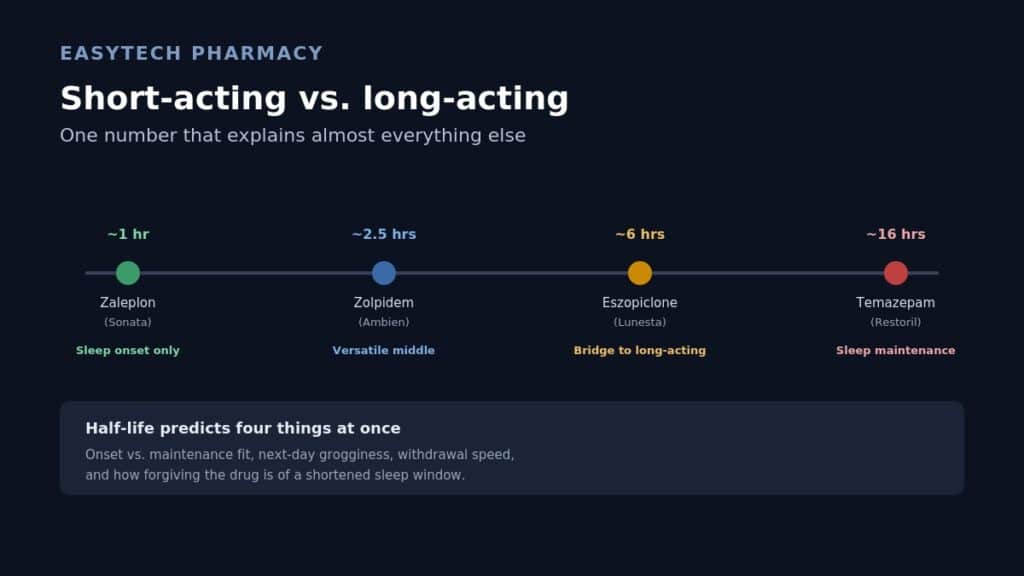
- Ultra-short-acting: half-life around 1 hour, exemplified by zaleplon (Sonata)
- Short-to-intermediate-acting: half-life roughly 2 to 6 hours, where zolpidem (Ambien) and eszopiclone (Lunesta) both sit, though at different points within that range
- Long-acting: half-life extending well beyond 6 hours, into the double digits, where temazepam (Restoril) and many traditional benzodiazepines land
These categories aren’t rigid, but they’re useful for understanding why certain medications get recommended for certain sleep patterns.
Why This Number Predicts So Much Else
Half-life shapes four practical outcomes almost by itself: how well a medication handles sleep onset versus sleep maintenance, how likely next-day grogginess becomes, how quickly withdrawal symptoms might appear if a dose is missed, and how forgiving the medication is of a shortened sleep window. Our three-way breakdown in Ambien vs. Lunesta vs. Sonata walks through exactly how this plays out across three real medications sitting at three different points on this spectrum.
Short-Acting: Built for Falling Asleep, Not Staying Asleep
Short-acting medications clear the body fast enough that they’re generally better matched to sleep-onset problems than sleep-maintenance ones. Zaleplon’s roughly one-hour half-life is the clearest example, fast enough that it’s sometimes usable even in the middle of the night, provided enough hours remain before needing to be alert. The tradeoff is straightforward: these medications tend to do less for someone who falls asleep fine but wakes up repeatedly through the night.
Intermediate-Acting: The Versatile Middle
Zolpidem’s roughly 2.5-hour half-life sits here, long enough to support a full sleep-onset effect without the extended lingering that comes with longer-acting options. This is part of why it remains one of the most commonly prescribed sleep medications: it handles a broad range of sleep-onset patterns reasonably well without carrying the heaviest next-day burden. Eszopiclone technically sits at the upper edge of this range, around 6 hours, close enough to the long-acting category that it functions more like a bridge between the two.
Long-Acting: Built for Staying Asleep, at a Real Cost
Temazepam’s roughly 16-hour half-life places it firmly in long-acting territory, and it shows in practice: this duration profile suits people who wake frequently through the night far better than it suits someone who just needs help falling asleep. The tradeoff scales directly with the extended duration. Next-day sedation risk increases, and in older adults specifically, this translates into meaningfully higher fall risk, a pattern covered in our guide on Ambien and fall risk in elderly patients, which applies even more strongly to genuinely long-acting medications.
Why This Matters More for Some People Than Others
Age changes how forgiving this whole spectrum is. Older adults clear medications more slowly across the board, which means a nominally “intermediate” half-life can behave more like a long-acting one in practice. This is part of why current geriatric guidelines favor shorter-duration, lower-impact options, covered in our guide on the best Ambien alternative for seniors. The same half-life number simply means something different depending on who’s taking it.
How This Connects to Driving and Next-Day Function
Half-life is also the mechanism behind next-day impairment risk broadly. A medication’s lingering presence, even at reduced levels, can still measurably affect coordination and reaction time the following morning, a topic covered directly in our guide on Ambien and next-day driving impairment. Longer-acting medications carry more of this risk by nature of staying active longer, which is exactly why the FDA’s dosing and timing guidance varies so much by medication.
Matching Duration to Your Actual Pattern
- Fall asleep fine, but often wake at 2 or 3 a.m.? A longer-acting option, or an intermediate one like eszopiclone, tends to fit this pattern better than an ultra-short one.
- Trouble falling asleep, but sleep through fine once you’re out? An ultra-short or short-acting option avoids unnecessary lingering effect.
- Need to function early the next morning regardless of when you took the dose? Shorter half-life options generally leave less residual effect by morning.
- Older adult, or managing multiple medications? Shorter-duration options generally carry a more favorable risk profile here, all else being equal.
The Bottom Line
Short-acting versus long-acting isn’t a strength scale, and it isn’t a simple “better or worse” comparison. It’s the single most useful lens for understanding why different sleep medications get recommended for different problems. Ultra-short options like zaleplon suit sleep onset. Intermediate options like zolpidem offer a versatile middle ground. Longer-acting options like temazepam suit sleep maintenance at the cost of more lingering next-day effect. Once you know where a medication sits on this spectrum, most of its other tradeoffs become a lot easier to predict.
For a full class-by-class breakdown of half-life and duration across current sleep medications, see this 2026 prescription sleep medication guide.
Frequently asked questions
Is a longer half-life always worse for a sleep medication?
No. Longer half-life medications suit sleep-maintenance problems better, since they stay active through more of the night. The tradeoff is increased next-day sedation risk, not an inherent flaw.
Which is safer: short-acting or long-acting sleep medications?
Neither is universally safer. Short-acting options generally carry lower next-day impairment risk, while long-acting options may better address frequent nighttime waking. The right choice depends on the specific sleep pattern.
Why do older adults need to pay more attention to half-life?
Aging slows how the body clears medications, which can make a nominally intermediate half-life behave more like a long-acting one, increasing fall and cognitive risk.
Does half-life determine how strong a medication feels?
Not directly. Half-life determines duration, not initial intensity. A short-acting medication can still feel strong initially; it simply clears the body faster afterward.
Related reading
- Generic Zolpidem Alternatives Compared: Cost, Class, and Fit
- Ambien vs. Restoril: a direct insomnia comparison
- Ambien and next-day driving impairment: risks and legal exposure
Trying to match your sleep pattern to the right duration profile? Talk to your pharmacist. EasyTech Pharmacy can help you think it through.
For local pharmacy access near you, our Ambien near me guide covers pharmacies across the world.
Visit EasyTech Pharmacy — sleep medication with real pharmacist guidance.