The Best Sleep Aid for Frequent Nighttime Waking
Waking up repeatedly through the night is a genuinely different problem than struggling to fall asleep in the first place, even though both get lumped under the same word: insomnia. Nearly half of adults report waking frequently overnight, according to National Sleep Foundation survey data, and treating this pattern with a medication built for the wrong half of the problem often falls flat.
Why Sleep-Onset and Sleep-Maintenance Are Different Problems
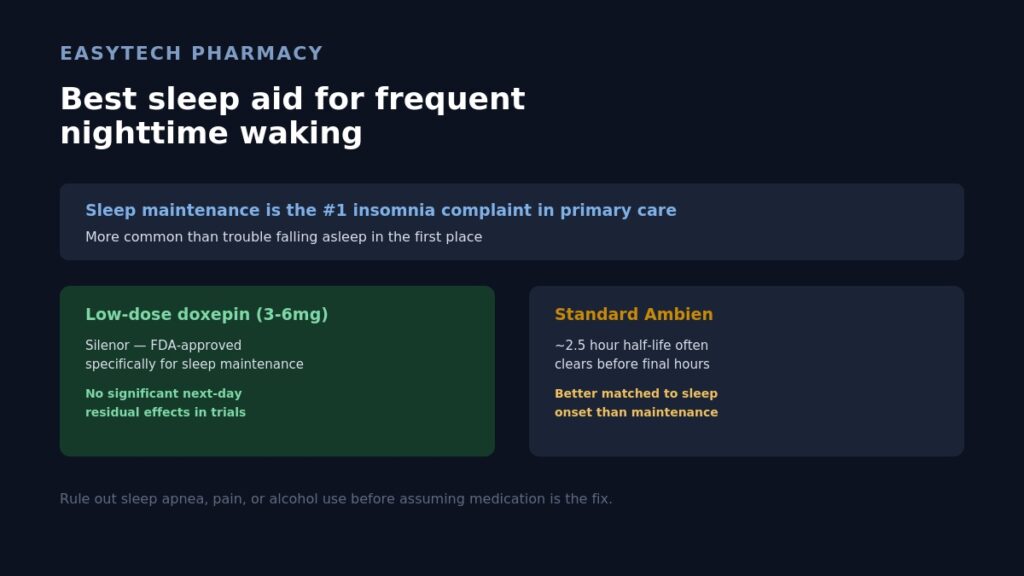
Sleep maintenance difficulty, the clinical term for frequent nighttime waking, is actually the most commonly reported insomnia symptom among primary care patients, more common than trouble falling asleep in the first place. It’s especially frequent in people managing pain, depression, or in older adults. A medication built to help you fall asleep fast doesn’t necessarily help you stay asleep, since the two processes involve different aspects of sleep architecture.
Why “Just Take More” Doesn’t Work Here
Here’s the core engineering problem this category has always faced: drugs powerful enough to induce a full eight hours of sleep often cause serious next-day effects, difficulty waking, sedation, and disorientation, while drugs that avoid those effects often don’t provide much help through the final hours of the night. This tension is exactly why the treatment landscape for frequent waking looks different from the treatment landscape for sleep onset.
Low-Dose Doxepin: Built Specifically for This Exact Pattern
This is genuinely the most targeted option available for this specific symptom. Low-dose doxepin, sold under the brand name Silenor at doses of just 3 mg or 6 mg, a fraction of the 75 to 300 mg doses used for depression, is FDA-approved specifically for sleep maintenance insomnia. It works by blocking histamine H1 receptors involved in wakefulness, rather than the direct GABA mechanism zolpidem uses.
What makes this option stand out is the precision of what it’s built for: difficulty during the eighth and final hour of a desired sleep period, meaning it specifically targets the early-morning waking pattern rather than general sleep induction. Clinical research in older adults found doxepin at 3 mg and 6 mg significantly improved and sustained sleep maintenance and duration into the last third of the night, without significant next-day residual effects or rebound symptoms after stopping.
Eszopiclone: A Longer-Acting Alternative
Lunesta’s roughly six-hour half-life, the longest among the standard Z-drugs, makes it another reasonable option for frequent waking, covered in our guide on eszopiclone vs. zolpidem. Unlike doxepin’s antihistamine mechanism, it works through the same GABA pathway as zolpidem, just with extended duration.
Temazepam: Longer Still, With a Real Tradeoff
Temazepam’s roughly 16-hour half-life, covered in our guide on Ambien vs. Restoril, offers even more extended coverage through the night. The tradeoff scales with the duration: next-day sedation risk climbs accordingly, a pattern explained more generally in our guide on short-acting vs. long-acting sleep medications.
Why Standard Ambien Often Isn’t the Right Fit Here
Immediate-release zolpidem’s roughly 2.5-hour half-life means it’s often cleared well before the final hours of an eight-hour sleep period, which is exactly why it tends to underperform for frequent waking compared to sleep onset. Ambien CR, the extended-release version, addresses this somewhat through its dual-layer design, but even this doesn’t match the sleep-maintenance-specific engineering behind low-dose doxepin.
Ruling Out Underlying Causes First
Frequent waking sometimes has a specific, addressable cause rather than being a standalone insomnia pattern. Sleep apnea, restless legs syndrome, untreated pain, and even evening alcohol use are all common drivers of fragmented sleep, and treating the underlying cause sometimes resolves the waking pattern more completely than any sleep medication would. This is worth ruling out before assuming a sleep aid is the whole answer.
CBT-I: Still Worth Considering for This Pattern Too
Cognitive behavioral therapy for insomnia, covered in depth in our comparison of CBT-I vs. Ambien, addresses sleep maintenance issues as part of its broader approach, particularly through sleep restriction and stimulus control techniques that help consolidate sleep across the whole night rather than just easing the transition into it.
How to Actually Choose
- Wake specifically in the final hours before your intended wake time? Low-dose doxepin is precision-built for exactly this pattern.
- Wake multiple times throughout the night, not just near morning? A longer-acting option like eszopiclone or temazepam may offer more consistent coverage.
- Concerned about next-day grogginess specifically? Doxepin’s research showing no significant residual effects makes it a strong candidate to discuss.
- Suspect an underlying cause like sleep apnea or pain? This is worth investigating directly before assuming a sleep medication alone will resolve the pattern.
The Bottom Line
Frequent nighttime waking differs from trouble falling asleep, so it requires a different set of tools. Low-dose doxepin stands out as the option most precisely engineered for this exact symptom. Clinical trial data shows it maintains sustained sleep without the next-day grogginess common to broader sedatives. Longer-acting Z-drugs and benzodiazepines offer alternatives, though each carries distinct tradeoffs. Before assuming medication is the answer, always rule out underlying medical causes first.
For more on doxepin’s specific research base, see the American Academy of Family Physicians’ review of low-dose doxepin for insomnia.
Frequently asked questions
What’s the best sleep medication specifically for waking up in the middle of the night?
Sold as Silenor, low-dose doxepin (3–6 mg) holds FDA approval specifically for sleep maintenance insomnia. Research demonstrates that it prevents waking during the final hours of the night. Crucially, it achieves this without significant next-day side effects.
Why doesn’t regular Ambien help with frequent waking?
Immediate-release zolpidem features a half-life of roughly 2.5 hours. Consequently, it often clears the system before the end of an eight-hour sleep period. This makes it ideal for falling asleep, but far less effective for staying asleep.
Could something other than insomnia be causing frequent waking?
Yes. Sleep apnea, restless legs syndrome, untreated pain, and alcohol use are all common causes of fragmented sleep, and identifying an underlying cause can resolve the pattern more completely than a sleep aid alone.
Does doxepin cause next-day grogginess like other sleep medications?
Research at the low 3 mg and 6 mg doses found no significant next-day residual effects, a genuinely notable difference from many other sleep medications used for maintenance.
Related reading
- Short-acting vs. long-acting sleep medications explained
- Ambien vs. Restoril: a direct insomnia comparison
- CBT-I vs. Ambien: what the research actually shows
Waking up repeatedly and not sure what’s actually causing it? Talk to your pharmacist. EasyTech Pharmacy can help you think it through.
For local pharmacy access near you, our Ambien near me guide covers pharmacies across the world.
Visit EasyTech Pharmacy — sleep medication with real pharmacist guidance.