Can You Take Ambien Long Term? What Changes When Short-Term Becomes Ongoing
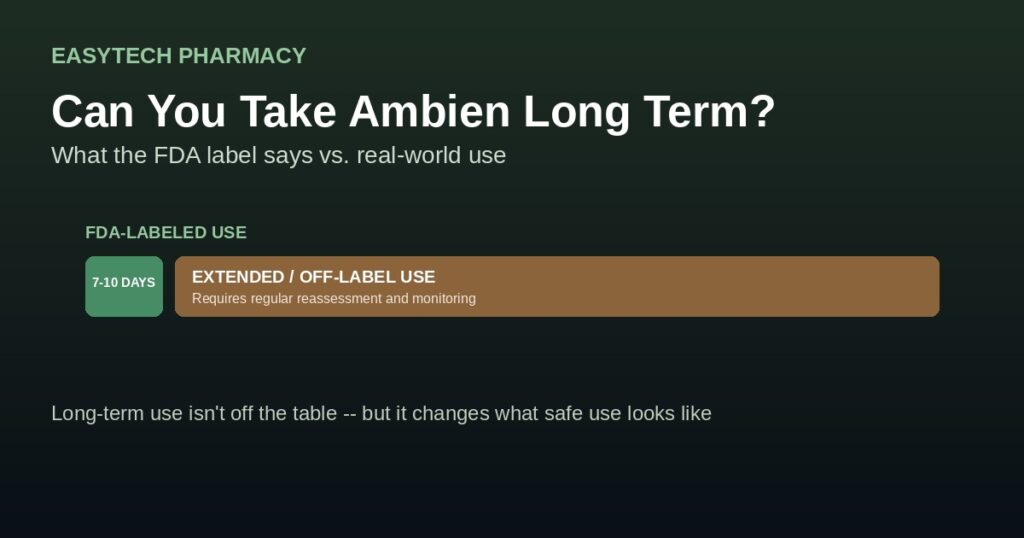
The label on a bottle of zolpidem says something most people never actually read closely: short-term use only. And yet plenty of people take it nightly for months, sometimes years. Often, they never have a conversation about what changes once “short-term” quietly becomes “just part of my routine now.”
This isn’t a black-and-white situation. Long-term Ambien use happens in real practice, sometimes reasonably, sometimes not. The difference usually comes down to one thing: is someone actively managing it, or is it just continuing by default? Here’s what actually changes with extended use and what the research says. And here’s how to think about it if you’re in this position yourself.
What “Short-Term” Actually Means on the Label
Ambien’s original clinical trials, and the FDA approval that followed, rested on short-term use. Researchers typically studied periods of 7 to 10 days, with some data extending to a few weeks. That’s the basis for the “short-term use” language that shows up in prescribing information.
This doesn’t mean the drug becomes dangerous the moment someone crosses day 11. It means the formal safety and effectiveness data supporting its use gets thinner the further out you go. The assumptions behind how doctors typically prescribe and dose it were built around a short window, not months of continuous nightly use.
The Reality — Long-Term Use Is Extremely Common
Despite the short-term labeling, real-world prescribing patterns tell a different story. Chronic insomnia is, by definition, a long-lasting condition. A meaningful portion of people who start Ambien for what’s meant to be a short course end up continuing well beyond that window. Sometimes that happens with active oversight. Often, it happens without much revisiting of the original plan at all.
This gap between label and practice isn’t unique to Ambien. It’s common across many medications originally studied for shorter windows. But it does mean anyone using Ambien long-term is, in a real sense, in territory where the evidence base is less complete. That’s exactly why deliberate management matters more here than it would with a medication designed and tested for chronic daily use.
What Actually Changes With Long-Term Use
Effectiveness Can Decline
Tolerance — the brain’s receptors becoming less responsive to the same dose over time — is a documented phenomenon with extended zolpidem use. Some people find the medication works as well at month six as it did at week one. Others notice a gradual decline in effectiveness. That decline sometimes prompts dose increases, which carry their own risks.
Dependence Risk Increases With Duration
This is one of the more consistent findings across the research: dependence risk tracks with both dose and duration. Someone using Ambien nightly for a year is meaningfully more likely to experience physical dependence than someone who used it for two weeks. Our guide on is Ambien habit forming covers this mechanism, and our companion piece on zolpidem withdrawal symptoms explains what stopping after extended use tends to look like.
Cognitive Effects May Accumulate
Some observational research has raised questions about whether long-term sedative-hypnotic use is linked to cognitive changes over time, particularly in older adults. This research area remains genuinely mixed. It doesn’t establish a definitive causal link. But it’s part of why periodic reassessment matters more the longer someone stays on the medication. Don’t assume that what was appropriate at month one remains equally appropriate indefinitely.
Fall and Fracture Risk in Older Adults
This is one of the more consistently documented long-term concerns, particularly relevant to older adults. Extended sedative use is linked to increased fall risk. Falls in older populations carry disproportionately serious consequences. This risk compounds when someone combines Ambien with blood pressure medications that also affect balance. Our guide on does Ambien lower blood pressure covers that specific interaction.
Is There a Point Where Long-Term Use Becomes Genuinely Unsafe
There’s no universal cutoff date where Ambien flips from safe to dangerous. Risk builds gradually, rather than crossing a sharp line. That said, a few patterns are worth taking seriously as signals that a long-term use situation needs active reassessment rather than passive continuation:
- Needing higher doses than when you started, to get the same effect
- Noticeable next-day cognitive fog that wasn’t present earlier in treatment
- Any fall, near-fall, or balance issue, particularly in older adults
- Taking it alongside an increasing number of other medications without a recent full medication review
- Simply not remembering the last time you and your prescriber discussed whether it’s still the right approach
None of these automatically means Ambien needs to stop. But each is a legitimate prompt for a conversation, not something to quietly work around on your own.
What Responsible Long-Term Use Looks Like
Some people genuinely need ongoing sleep support, and Ambien continues to be the right tool for them. Long-term use doesn’t have to mean unmanaged use. A few practices distinguish careful long-term use from use that’s simply continuing by inertia:
- Periodic reassessment — revisiting the plan every few months rather than treating the prescription as permanent and unexamined
- Lowest effective dose — resisting the drift toward higher doses without a clear reason, and reviewing dosing guidance in our Ambien dosage guide
- Building in nights off where possible — intermittent rather than strictly nightly use, when clinically appropriate, can reduce tolerance buildup
- Addressing the underlying insomnia in parallel. Behavioral approaches don’t lose relevance just because medication is also part of the plan. Our guide on how can I sleep quickly covers habits worth layering in
- Full medication review. This matters especially as other prescriptions get added over time — interaction risk compounds with polypharmacy in ways a single point-in-time review can miss
- Watching for effects that build slowly. Some side effects, like hair thinning tied to stress and sleep quality rather than the drug itself, only show up months into treatment. Our guide on does Ambien cause hair loss explains that mechanism if you notice unexpected changes
- Being honest about the “why.” Periodically ask whether Ambien is still solving the original problem, or whether the goal has quietly shifted to just avoiding withdrawal symptoms from stopping
When to Consider Alternatives Instead
Long-term use is also a natural point to reconsider whether Ambien remains the best tool for the job. Something with a different long-term profile might serve you better. Options worth discussing include non-habit-forming prescription alternatives, covered in our guide on sleeping pills not habit forming. Trazodone is worth considering too — it carries a different mechanism and dependence profile. See our comparison of trazodone vs Ambien.
Understanding how Ambien’s own drug class works also helps frame these alternatives. Our guide on is Ambien a benzodiazepine explains why Ambien and certain other sleep medications, like benzodiazepines sometimes used off-label for insomnia, carry meaningfully different long-term risk profiles despite acting on a similar brain target.
If you’d rather explore non-pharmaceutical options as part of a longer-term strategy, our guide on natural Ambien alternatives covers evidence-based options. These can complement medication, or in some cases, eventually replace it.
According to MedlinePlus, doctors generally intend zolpidem for short-term use. They recommend the lowest effective dose for the shortest duration consistent with treatment goals. That framework applies just as much to someone six months in as it does to someone on day one.
Frequently Asked Questions
Can you take Ambien long term?
The FDA officially labels it for short-term use, but many people take it for extended periods in practice. Long-term use isn’t automatically unsafe. But it does carry higher risks of tolerance, dependence, and other cumulative effects — which makes active management and periodic reassessment more important than with short-term use.
What happens if you take Ambien every night for years?
Outcomes vary significantly between individuals. Some people manage years of nightly use with careful, supervised dosing and few issues. Others develop tolerance requiring dose increases, physical dependence, or other cumulative effects. Duration alone doesn’t determine the outcome — how you manage the use matters just as much.
Is long-term Ambien use dangerous for older adults?
It carries somewhat higher risks in older adults specifically — primarily fall risk, balance issues, and potential cognitive effects. That’s why doctors generally recommend extra caution and more frequent reassessment in this age group.
How often should long-term Ambien use be reviewed?
There’s no single universal schedule. But many people benefit from revisiting the plan every few months, rather than letting a prescription continue indefinitely without a fresh look at whether it’s still the most appropriate option.
Can you stay on Ambien indefinitely without becoming dependent?
It’s possible for some people, particularly with careful management — lowest effective dose, periodic breaks, ongoing reassessment. But dependence risk generally rises with duration. Indefinite use without any active management carries meaningfully higher risk than a well-managed long-term plan.
Bottom Line — Long-Term Use Isn’t Off the Table, But It Isn’t Passive Either
You can use Ambien long-term, and many people do so without major problems. But the label’s short-term framing exists for a reason. The further past that original window someone goes, the more that ongoing use benefits from active attention rather than quiet continuation. Tolerance, dependence, and other cumulative risks all track with duration. That makes periodic reassessment the single most useful habit for anyone using Ambien beyond the first few weeks.
If you’ve been taking Ambien for months without a recent conversation about whether it’s still the right fit, that conversation is worth having. Not because something is necessarily wrong — but because long-term medication use deserves the same level of attention that starting it did in the first place.
For local pharmacy access, our Ambien near me guide covers options across the World.