Zolpidem Withdrawal Symptoms: The Timeline and What Actually Helps
Stopping zolpidem after weeks or months of regular use can catch people off guard. The first night without it often feels worse than the insomnia that started it all. It’s easy to assume something has gone wrong. Usually, nothing has. This is withdrawal, and it follows a pattern that’s well understood.
This guide walks through what zolpidem withdrawal actually feels like. You’ll learn how long each stage tends to last, which symptoms are common versus rare, and the practical steps that make the process easier to get through.
Why Withdrawal Happens in the First Place
Zolpidem works by boosting the activity of GABA, the brain’s main calming neurotransmitter. With nightly use over time, your brain adjusts to this extra boost. It dials down its own natural GABA activity — a compensation that keeps things balanced while the drug is present.
The problem shows up the moment you stop taking the drug. That compensation doesn’t reverse instantly. For days to weeks, your brain keeps running with reduced natural calming activity and no zolpidem to fill the gap. The result is a temporary state of heightened excitability. That’s exactly what withdrawal symptoms are.
This is a predictable, mechanical process. It’s not a sign of weakness, and it’s not a permanent change to how your brain works. It resolves on its own timeline as GABA activity recalibrates back to normal.
The Withdrawal Timeline — What to Expect and When
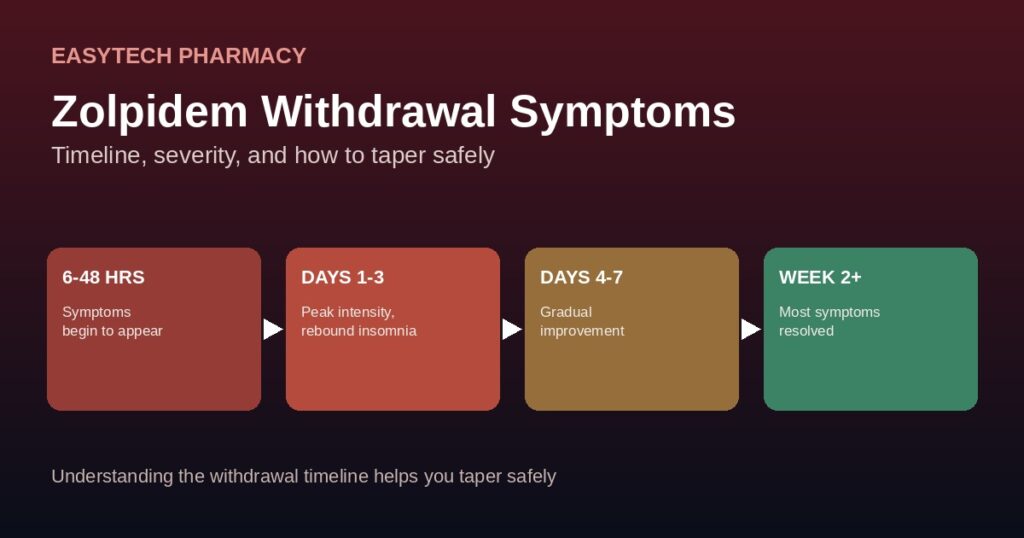
6 to 48 Hours: Symptoms Begin
Because zolpidem has a short half-life, symptoms tend to show up faster than they would with longer-acting sedatives. Some people notice early signs — restlessness, a wired feeling, trouble settling down — within just a few hours of missing a dose. For most, clearer symptoms appear within the first one to two days.
Days 1 to 3: Peak Intensity
This is typically the roughest stretch. Rebound insomnia is usually most severe here. Sleep can feel worse than the original problem that led you to take zolpidem in the first place. Anxiety, irritability, and physical discomfort tend to peak during this window too.
Days 4 to 7: Gradual Improvement
Symptoms generally start easing by the end of the first week. Sleep is still often disrupted, but less dramatically than during the peak days. Mood and physical symptoms usually follow a similar downward trend. Appetite can also fluctuate during this period as your body’s stress hormones settle — our guide on does Ambien cause weight gain covers the fuller picture of how sleep and appetite interact.
Week Two and Beyond: Resolution for Most
If you used zolpidem for a matter of weeks rather than months, most withdrawal symptoms have typically resolved by this point. Sleep may still take time to fully normalize. This is separate from acute withdrawal — it reflects your underlying insomnia reasserting itself, which is where longer-term strategies become useful.
Longer duration of use, higher doses, and combined use with alcohol or other sedatives can all extend this timeline. People in that category often benefit from a slower, supervised taper rather than expecting the same one-to-two-week arc.
Common Symptoms — What Most People Actually Experience
- Rebound insomnia: Sleep that’s noticeably worse than before starting zolpidem, usually the most prominent symptom of all
- Anxiety: A restless, on-edge feeling that can appear even in people without a prior history of anxiety
- Irritability: Short temper, low frustration tolerance, feeling “raw”
- Fatigue paired with restlessness: An uncomfortable combination of being exhausted but unable to settle
- Nausea or stomach upset: Common in the first few days
- Sweating: Particularly at night
- Mild tremor: A slight shakiness in the hands, usually subtle
- Difficulty concentrating: A foggy, unfocused feeling during the day
Vivid Dreams and Nightmares — A Related but Distinct Experience
Once sleep starts returning during withdrawal, many people notice something else: unusually vivid, strange, or disturbing dreams. This isn’t the same as rebound insomnia. It happens because your brain, freed from zolpidem’s suppression of certain sleep stages, spends more time in REM sleep than it did while medicated. That extra REM time can produce unusually intense dream activity, at least temporarily.
This tends to settle down within the first couple of weeks alongside the rest of the withdrawal timeline. Our guide on Ambien dreams and nightmares covers why this happens in more detail and what helps, both during active use and in this withdrawal window.
Less Common but Serious Symptoms
These are uncommon. They occur mainly in people who used higher doses for extended periods and stopped abruptly rather than tapering:
- Significant tremor that interferes with daily tasks
- Hallucinations: Perceptual disturbances during withdrawal are a recognized, though uncommon, phenomenon. Our guide on Ambien hallucinations covers this topic in the context of the medication itself. Similar mechanisms can appear during withdrawal.
- Seizures: The most serious potential withdrawal complication. This is rare and shows up almost exclusively with high-dose, long-term use stopped abruptly rather than tapered.
Seizure risk is the single most important reason not to stop zolpidem abruptly after extended regular use. If you experience a seizure, seek emergency medical care immediately — call 911 or go to the nearest emergency room. This is not something to manage at home.
Why Tapering Changes Everything
The difference between stopping abruptly and tapering gradually is enormous — for both symptom severity and safety. A taper gives your brain’s GABA system time to recalibrate in small increments rather than all at once. This softens the intensity of every symptom on the list above, and it reduces seizure risk to near zero in the process.
A typical taper reduces the dose in small steps over one to several weeks. The exact length depends on how long you used zolpidem and at what dose. Someone taking 10mg nightly for six months generally needs a longer, more gradual taper than someone on 5mg for three weeks.
There’s no single universal taper schedule. The right pace depends on your individual history, dose, and how symptoms respond along the way. Working through this with a pharmacist means someone tracks your progress. They can adjust the pace if withdrawal symptoms become more intense than expected, instead of you guessing at the right rate of reduction alone. Older adults often need an even more cautious approach — our guide on Ambien side effects in elderly patients covers what changes after 65 and why tapering deserves extra care in that age group.
Practical Steps That Make Withdrawal More Manageable
- Stick to a consistent wake time even when sleep is disrupted — this helps rebuild a stable circadian rhythm faster than sleeping in to compensate
- Avoid alcohol entirely during withdrawal. It interacts with the same GABA system and can intensify or extend symptoms. Our guide on Ambien and alcohol explains why this combination is particularly risky
- Reduce caffeine, especially in the afternoon — withdrawal already elevates anxiety and restlessness, and caffeine compounds it
- Use grounding techniques for anxiety spikes — slow breathing, short walks, and other calming routines can take the edge off without adding another substance to the mix
- Expect the first few nights to be rough, and plan around it. Clearing a lighter schedule for the peak withdrawal days takes some pressure off — you won’t also have to function at full capacity
- Track your symptoms day by day. A simple log makes it easier to see the overall improving trend, which is genuinely reassuring during the roughest stretch
For sleep support during and after the taper, our guide on Does Ambien Expire? covers options that don’t carry the same dependence mechanism. Our piece on how can I sleep quickly covers behavioral techniques that help rebuild sleep once withdrawal has passed.
How This Connects to Habit Formation
Withdrawal doesn’t happen in isolation. It’s the flip side of the dependence process. Understanding how tolerance and dependence build up in the first place makes the withdrawal experience make a lot more sense. It can also help prevent withdrawal from becoming a repeating cycle. Our companion guide on is Ambien habit forming walks through that full mechanism. It also covers the rebound insomnia trap that leads many people back to the medication before withdrawal has actually finished playing out.
According to MedlinePlus, stopping sedative-hypnotic medications like zolpidem suddenly after regular use can cause withdrawal symptoms. That’s why gradual dose reduction is the standard recommended approach.
Frequently Asked Questions
How long do zolpidem withdrawal symptoms last?
For most people using it short-term, symptoms peak in the first one to three days. They largely resolve within one to two weeks. Longer-term or higher-dose use can extend this timeline, sometimes requiring a taper that spans several weeks.
What is the worst withdrawal symptom?
Rebound insomnia is the most consistently reported and disruptive symptom for most people. Seizures are the most dangerous, though they’re rare and mainly occur with abrupt discontinuation after high-dose, long-term use.
Can you stop zolpidem cold turkey?
For short-term, low-dose use, some people manage without significant issues. If you’ve used it regularly for an extended period or at higher doses, a gradual taper is the safer path — it reduces both symptom severity and seizure risk.
Is rebound insomnia the same as withdrawal?
Rebound insomnia is one specific symptom within the broader withdrawal picture. It refers to sleep being temporarily worse than it was before you started the medication.
When should I seek emergency care during withdrawal?
Seek emergency medical attention immediately for any seizure, severe confusion, or distressing hallucinations. The same goes for any symptom that feels medically alarming rather than merely uncomfortable.
Bottom Line — A Predictable Process, Not a Mystery
Zolpidem withdrawal follows a recognizable arc: a rough first few days, gradual improvement over the following week, and resolution for most people within about two weeks. Knowing this timeline in advance turns what can feel alarming into something far more manageable. Tapering, rather than stopping abruptly, is the single biggest factor in how smooth that process turns out to be.
If you’re planning to stop zolpidem after regular use, work out a taper schedule with a pharmacist before you start. That conversation is worth having — it’s the difference between guessing and having an actual plan.