How Can I Sleep Quickly? 12 Methods That Actually Work Tonight
You are lying in bed. The room is dark. You are tired. And yet sleep is not coming.
You watch the minutes pass. 11:20pm. 11:35pm. 11:52pm. Your alarm is at 6:30am and you are doing the math in a way that makes everything worse. By the time midnight arrives you are no longer just tired — you are frustrated, slightly anxious, and somehow more awake than you were an hour ago.
This is one of the most common experiences in adult life. It is also one of the most solvable — once you understand what is actually keeping you awake and which specific changes produce the fastest results.
This guide covers how can I sleep quickly — 12 methods ranked by how quickly and reliably they work, with the science behind each one kept short and the practical steps kept specific. No vague advice about “reducing stress.” Actual things you can do tonight.
For people dealing with ongoing insomnia rather than an occasional bad night, our complete guide to sleeping pills covers every option at every level of intervention.
Why You Cannot Fall Asleep Quickly — The Three Real Culprits
Before going through the methods, it helps to understand why falling asleep fast is harder than it should be. Three underlying mechanisms account for the vast majority of “lying awake” situations.
Hyperarousal — Your Nervous System Is Still in Day Mode
The brain does not simply switch from alert to asleep like a light switch. It transitions through a gradual reduction in cortisol and norepinephrine — the alertness hormones — while melatonin rises and core body temperature drops. Modern life disrupts all of these signals simultaneously. Bright screens suppress melatonin. Stress keeps cortisol elevated. Temperature-controlled environments prevent the body cooling that normally signals the brain that sleep is approaching.
The result is a nervous system that is genuinely trying to sleep but receiving mixed signals. The methods in this guide work by removing those competing signals one by one.
Sleep Anxiety — The Watching-Yourself-Sleep Problem
Watching the clock and worrying about not sleeping creates what sleep researchers call sleep anxiety — a state of vigilance around sleep itself that prevents sleep from arriving. Your brain’s threat-detection system activates around the very thing you are trying to do. The frustration and monitoring that comes with lying awake makes the problem measurably worse. Methods 7 and 8 in this guide address this pattern specifically.
Circadian Misalignment — Your Clock Is Off
Your circadian rhythm — the internal 24-hour clock governing your sleep-wake cycle — is anchored by light, temperature, and timing cues. When these cues are inconsistent, the rhythm becomes unreliable. You feel alert at 11pm when you want to sleep and groggy at 7am when you need to function. Several methods below address the rhythm directly.
Method 1 — Cool the Room to 65 to 68 Degrees Fahrenheit
This is the highest-impact single environmental change most people can make immediately. Core body temperature naturally drops by about 1 to 2 degrees Fahrenheit at sleep onset — it is part of the physiological transition into sleep. A cool room supports this process. A warm room fights it.
Research from the Sleep Foundation consistently identifies 65 to 68 degrees Fahrenheit as the optimal sleep temperature range for most adults. People sleeping in warmer rooms spend more time in lighter sleep stages and wake more frequently.
If you cannot control your room temperature easily — a cool shower before bed produces a similar effect by temporarily raising skin temperature, triggering the body’s compensatory cooling response afterward. Many people find this drops them to sleep 10 to 15 minutes faster than without it.
Method 2 — The 4-7-8 Breathing Technique
This breathing pattern activates the parasympathetic nervous system — the “rest and digest” counterpart to the stress response — and consistently produces measurable reduction in heart rate and cortisol within minutes.
The technique is simple. Inhale through your nose for 4 counts. Hold for 7 counts. Exhale slowly through your mouth for 8 counts. Repeat 4 times.
The extended exhale is the key mechanism. A longer exhale than inhale signals to the vagus nerve that the body is safe — directly suppressing the fight-or-flight arousal state that keeps people awake. Most people notice a physical heaviness and mental quieting within two or three cycles.
For people whose difficulty sleeping involves anxiety specifically, our guide on does Ambien help with anxiety explains the relationship between anxiety and insomnia — and why behavioral tools like this often outperform medication for anxiety-driven sleep problems.
Method 3 — Dim All Lights One Hour Before Bed
Light is the single most powerful signal your brain uses to set its internal clock. Blue-spectrum light — emitted by LED bulbs, phone screens, tablets, and computer monitors — suppresses melatonin production more aggressively than any other light wavelength. Exposure to bright screens in the hour before bed can delay melatonin onset by 60 to 90 minutes.
The practical intervention is more powerful than most people expect. Dim every light in your home by 50% in the hour before bed. Switch overhead lights off and use lamps at lower positions. If you use screens, enable night mode or a blue-light filtering app. These changes allow melatonin to begin rising earlier — so by the time you are in bed, your brain is already preparing for sleep rather than starting the process from zero.
Method 4 — The Military Sleep Method
Developed originally for military personnel needing to fall asleep in challenging conditions, this technique trains the body to sleep on command through a specific sequence of progressive muscle relaxation combined with mental imagery.
The sequence works as follows. Relax your face completely — jaw, tongue, eyes, forehead. Drop your shoulders and let your arms fall loose. Exhale slowly and relax your chest. Release your legs from thighs down to your feet. Then hold your mind on one of three images for 10 seconds: lying in a canoe on a calm lake, swinging in a dark hammock, or repeating the phrase “don’t think” slowly.
With practice, this technique produces sleep onset in under 2 minutes for many people. Initial results take about a week of daily practice to develop — but the technique works because it systematically removes every physical tension cue the brain uses to stay alert.
Method 5 — Fix Your Wake Time First
This is counterintuitive but backed by consistent research. The most reliable anchor for the sleep-wake cycle is a fixed morning wake time — not a fixed bedtime. When you wake at the same time every day, your body naturally builds what sleep researchers call sleep pressure — the accumulated drive to sleep that makes falling asleep easier and faster.
Variable wake times — sleeping in on weekends, setting a later alarm when tired — disrupt the rhythm. Variable bedtimes are less disruptive than variable wake times. Set a fixed morning alarm and keep it regardless of what time you fell asleep the night before. Within one to two weeks, falling asleep at your target bedtime becomes significantly easier because the circadian rhythm has reanchored.
Method 6 — Progressive Muscle Relaxation
Progressive muscle relaxation (PMR) systematically tenses and releases each muscle group from feet upward — spending about 5 seconds tensing and 30 seconds releasing for each. The technique works by producing a stronger parasympathetic rebound after each tension-release cycle, leaving the body more deeply relaxed than it started.
Start with your feet. Curl your toes tightly for 5 seconds, then release completely and notice the relaxation for 30 seconds. Move to your calves, thighs, abdomen, hands, arms, shoulders, and face in sequence. Most people are asleep before reaching their face. The technique is particularly effective for people whose sleeplessness involves physical tension — tight shoulders, clenched jaw, general body tension.
Method 7 — Get Up if You Are Not Asleep in 20 Minutes
This advice feels wrong but is one of the most evidence-based recommendations in sleep medicine. The instruction is this: if you are not asleep within approximately 20 minutes of lying down, get up and go to another room. Do something calm in low light — read a physical book, listen to quiet audio — until you feel genuinely sleepy, then return to bed.
The mechanism is classical conditioning. Lying awake in bed for extended periods associates the bed with wakefulness and frustration. Breaking this association by leaving when awake and returning only when sleepy reestablishes the bed as a sleep-associated environment rather than a worry-associated one. This is one of the core techniques of CBT-I — cognitive behavioral therapy for insomnia — and produces more durable improvements than most medications for chronic sleep onset difficulty.
Method 8 — The Paradoxical Intention Technique
Sleep anxiety — worrying about not sleeping — is directly counterproductive because trying to fall asleep engages exactly the kind of active cognitive monitoring that prevents sleep. Paradoxical intention works by removing that monitoring.
The instruction is to lie in bed with your eyes open and specifically try to stay awake — without any screens or stimulation. The effort of trying to stay awake paradoxically reduces the performance anxiety around falling asleep. Most people find their eyes growing heavy within minutes. The technique works because it removes the one thing most disrupting to sleep onset — the tense, self-monitoring attempt to force sleep to happen.
Method 9 — Magnesium Glycinate Before Bed
Magnesium glycinate at 200 to 400mg taken 30 to 60 minutes before bed directly supports two of the physiological processes that allow fast sleep onset — GABA activity and cortisol reduction. Many adults are mildly deficient in magnesium without knowing it, and this deficiency measurably impairs both sleep quality and time to sleep onset.
Unlike magnesium oxide (the most common supplement form), magnesium glycinate is well-absorbed and does not cause digestive discomfort at standard doses. It is non-habit-forming, available without authorization, and safe for most adults at the doses used for sleep. Effects become noticeable for most people within 5 to 7 days of consistent nightly use.
Method 10 — Avoid Lying Awake in Bed During the Day
The bed-sleep association discussed in Method 7 requires that the bed be used predominantly for sleep. Spending extended daytime hours lying in bed — working on a laptop, watching TV, reading — weakens this association and makes falling asleep in bed at night harder. Reserve the bed for sleep only. It is a simple behavioral change that produces measurable results within two weeks for most people.
Method 11 — Strategic Caffeine Cutoff
Caffeine has a half-life of approximately 5 to 7 hours in most adults — meaning half of the caffeine from a 3pm coffee is still active at 9pm. Beyond the well-known arousal effect, caffeine specifically blocks adenosine receptors — adenosine is the primary “sleep pressure” neurotransmitter that accumulates throughout the day to make you increasingly sleepy by evening.
Blocking adenosine receptors with caffeine prevents sleep pressure from building effectively. The result is lying in bed tired but unable to cross the threshold into sleep. Moving your caffeine cutoff to noon — not 2pm, not 3pm, noon — produces the most dramatic improvement in sleep onset time for regular caffeine consumers.
Method 12 — When These Methods Are Not Enough
These 11 methods above address the most common causes of slow sleep onset. For most people dealing with occasional or situational sleep difficulty, applying three or four of them consistently produces significant improvement within two weeks.
However, insomnia is not always behavioral. When sleep difficulty persists despite consistent application of behavioral methods — particularly when it has lasted more than three months, when it affects daily function, or when it involves waking repeatedly rather than just difficulty falling asleep — a different level of support is appropriate.
This is the point where sleep medication becomes part of the conversation. Not as the first tool, but as an adjunct to behavioral approaches when behavioral approaches alone are insufficient.
For people at this stage, the options range from non-controlled supplements like magnesium and L-theanine through non-controlled prescription options like trazodone and ramelteon, to Schedule IV medications like zolpidem for cases where faster, more reliable onset is genuinely needed. Our Ambien High covers every option at every level in detail.
If medication is the right next step, our guide on Can You Take Tylenol With Ambien? covers every non-controlled option first — and our guide on how to buy Ambien online covers the full process for people who need something stronger.
Sleep Hygiene Checklist — Tonight’s Quick-Start Version
For someone who wants to start tonight with the highest-impact changes, here is the condensed version:
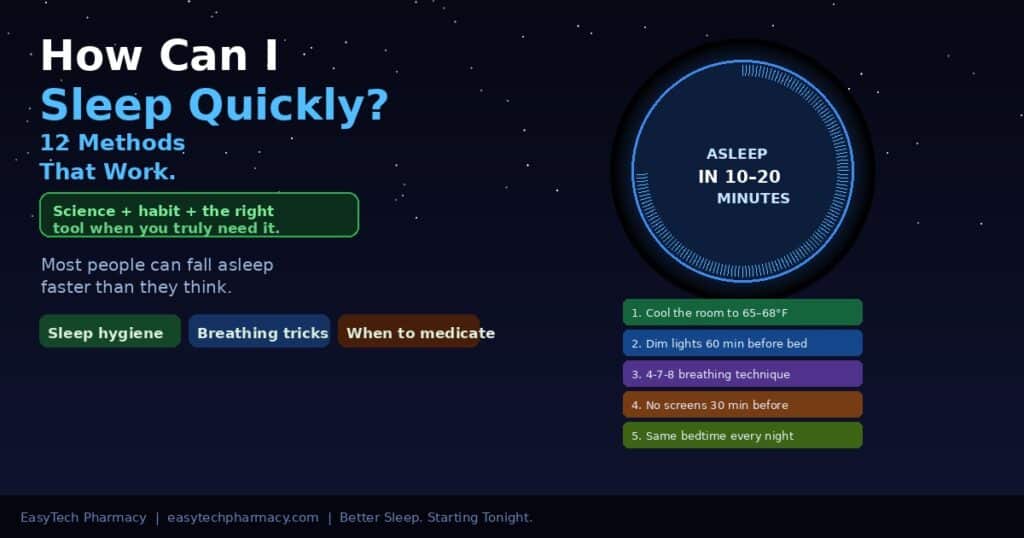
- Room temperature: Set to 65 to 68°F before getting into bed
- Lights: Dim all lights in the home 60 minutes before your target bedtime
- Screens: Phone face down, night mode on, or off completely 30 minutes before bed
- Wake time: Set tomorrow’s alarm for the same time regardless of when you fall asleep tonight
- Breathing: 4-7-8 breathing pattern as soon as your head hits the pillow
- If not asleep in 20 minutes: Get up, go somewhere dim and quiet, return when sleepy
Six changes. Most of them cost nothing. And the combination produces measurable improvement for most people on the first night of consistent application.
What Sleep Duration Is Normal — and When to Stop Worrying
One final point that affects sleep onset significantly — most adults believe they need 8 hours of sleep. The actual recommended range for adults is 7 to 9 hours, and individual variation within that range is significant. Some people genuinely function well at 7 hours. Others genuinely need 9.
The anxiety that comes from believing you are getting insufficient sleep — even when you are getting your actual individual requirement — can itself disrupt sleep. Checking your phone, doing the math, monitoring how you feel — all of these watchful behaviors increase arousal and slow sleep onset. If you wake feeling rested after 7 hours, the goal is not to stay in bed for 8.
For people who find that medication is affecting their sleep duration and timing, our guide on how long does Ambien make you sleep covers exactly what to expect from different formulations. And if anxiety is a significant part of what is keeping you awake at night.
Frequently Asked Questions
How can I fall asleep in 5 minutes?
The 4-7-8 breathing technique combined with progressive muscle relaxation produces the fastest results for most people — many report sleep onset within 5 to 10 minutes after a week of consistent practice. The military sleep method, developed specifically for fast sleep onset under difficult conditions, also targets this timeframe. No technique works for everyone on the first night — but consistent practice reliably reduces time to sleep onset over one to two weeks.
What helps you fall asleep instantly?
There is no true instant sleep trigger — but the combination of a cool room (65 to 68°F), complete darkness, the 4-7-8 breathing pattern, and avoiding screens for 30 minutes before bed produces the fastest onset for most people without medication. For nights when nothing behavioral is working, a non-habit-forming option like magnesium glycinate can provide additional support without the next-morning impairment risk of sedative medication.
Why can I never fall asleep quickly?
The three most common underlying causes are hyperarousal (nervous system still in day mode), sleep anxiety (watching yourself try to sleep), and circadian misalignment (inconsistent wake times). Each responds to specific interventions. If all behavioral approaches fail consistently for more than three months, this meets the clinical definition of insomnia — at which point a pharmacist or sleep specialist can help identify whether additional support is appropriate.
Does melatonin help you fall asleep faster?
Melatonin works best for circadian rhythm issues — jet lag, shift work, delayed sleep phase — rather than straightforward sleep onset insomnia. At appropriate doses (0.5 to 3mg, much lower than most OTC products), it can shift the timing of sleep onset rather than producing sedation directly. It is most effective taken 1 to 2 hours before your target bedtime rather than immediately before bed.
Is it normal to take a long time to fall asleep?
Sleep onset latency of 10 to 20 minutes is considered normal for most adults. Consistently taking 30 minutes or more to fall asleep is the threshold at which sleep medicine considers the sleep onset pattern problematic. If this is a regular pattern lasting more than three months and affecting daytime function, it meets clinical criteria for insomnia and warrants a conversation with a pharmacist or healthcare provider about appropriate next steps.
What sleeping pill helps you fall asleep the fastest?
Among prescription options, immediate-release zolpidem (Ambien) and zaleplon (Sonata) produce the fastest onset — typically 15 to 30 minutes Among non-controlled options, trazodone takes 45 to 90 minutes. Among supplements, nothing approaches the speed of prescription Z-drugs — magnesium and L-theanine work over days to weeks rather than minutes. Our full speed comparison is in our guide on what sleeping pill works the fastest for insomnia.
Bottom Line — Sleep Faster Starting Tonight
The answer to how can I sleep quickly is not a single trick — it is a combination of removing the things keeping you awake and giving the body the signals it needs to transition into sleep. Cool room, dimmed lights, fixed wake time, and a breathing technique to calm the nervous system address the three core culprits simultaneously.
Most people who apply these changes consistently see meaningful improvement within one to two weeks. The ones who see the fastest results are often surprised by how much difference temperature and morning wake time consistency alone can make.
For nights when behavioral approaches are not enough — whether because of a genuine sleep disorder, an acute stressor, or a pattern that has been running too long to resolve quickly — sleep medication as a short-term bridge is a legitimate and well-established tool. Our Ambien near me guide covers local pharmacy access across the US. And if you are dealing with the gut-level frustration of chronic insomnia, our guide on why does Ambien stop working after a few weeks covers what happens when medication alone cannot carry the whole load.
At EasyTech Pharmacy, we carry a full range of sleep support options — from FDA-approved generic zolpidem to non-controlled alternatives — with transparent pricing, fast delivery, and pharmacist support.
Visit EasyTech Pharmacy — the right sleep solution for your specific situation.