Vitamins for Sleeplessness: Which Nutrients Actually Have Evidence Behind Them
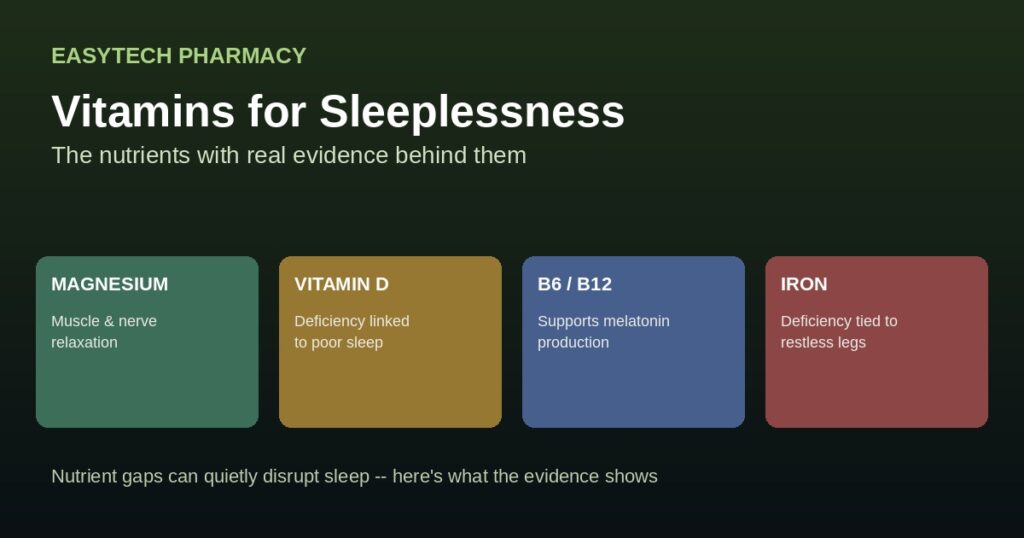
Walk down any supplement aisle and you’ll find a dozen products claiming to fix sleep. Most of that shelf is noise. But underneath the marketing, there’s a smaller set of vitamins and minerals with real research behind them. They’re not a replacement for addressing serious insomnia. But they’re a genuinely useful piece of the puzzle — especially for people whose sleep trouble is tangled up with an underlying nutrient gap they didn’t know they had.
This guide walks through which vitamins and minerals have credible evidence connecting them to sleep. You’ll learn how each one actually works, and how to think about using them sensibly rather than just adding another bottle to the cabinet.
Why Nutrients Matter for Sleep in the First Place
Sleep isn’t just a matter of willpower or a dark, quiet room. It’s a biological process built on a chain of hormones, neurotransmitters, and enzymatic reactions. Many of these depend on specific vitamins and minerals as raw materials or cofactors. When one of those nutrients runs low, it can affect the whole chain. Sometimes that shows up specifically as trouble falling or staying asleep.
This doesn’t mean every case of insomnia traces back to a vitamin deficiency — most don’t. But for a meaningful subset of people, addressing an underlying nutrient gap produces a real, noticeable improvement in sleep. No amount of “good sleep hygiene” alone would have fixed it.
Magnesium — The One With the Strongest Everyday Case
Magnesium is probably the single most talked-about mineral in the sleep-and-nutrition space. There’s good reason for that. It plays a direct role in regulating the nervous system. Magnesium supports the parasympathetic (“rest and digest”) state your body needs to shift into before sleep. It’s also involved in regulating melatonin production.
Magnesium deficiency is genuinely common in the general population. Modern diets, high in processed foods and low in leafy greens, nuts, and whole grains, often fall short of the recommended intake. Multiple studies have linked low magnesium to poorer sleep quality and increased nighttime restlessness. Correcting a deficiency has shown measurable improvement in some research, particularly in older adults.
Many consider magnesium glycinate one of the better-absorbed and gentlest forms for sleep purposes specifically. Other forms of magnesium can cause digestive upset, which itself interferes with sleep.
Vitamin D — An Underappreciated Piece of the Picture
Vitamin D’s relationship with sleep gets discussed less than magnesium’s. But the research connecting them is genuinely interesting. Vitamin D receptors sit in areas of the brain involved in sleep regulation. Several observational studies have found associations between low vitamin D levels and both shorter sleep duration and poorer sleep quality.
Vitamin D deficiency is widespread in the US. It’s particularly common among people who spend most of their time indoors, live in northern latitudes with less sun exposure, or have darker skin, which reduces natural vitamin D synthesis from sunlight. It’s also one of the few nutrients on this list where deficiency is common enough, and easy enough to check for, that it’s genuinely worth knowing your levels. Don’t just guess.
B Vitamins — The Melatonin Connection
Vitamin B6 plays a direct role in converting tryptophan into serotonin. Serotonin is itself a precursor to melatonin — the hormone most directly responsible for signaling to your body that it’s time to sleep. Without adequate B6, this conversion pathway becomes less efficient.
Vitamin B12 has a different but related connection. It’s involved in regulating circadian rhythm. Some research has linked B12 supplementation to improvements in sleep-wake timing, particularly in people with irregular sleep schedules. B12 deficiency is more common in older adults, people following strict vegetarian or vegan diets, and anyone with absorption issues related to certain digestive conditions or medications.
Folate (B9) Also Plays a Supporting Role
Folate works alongside B12 in several of the same metabolic pathways relevant to neurotransmitter production. Some studies have similarly linked folate deficiency to disrupted sleep patterns, though the research here is less extensive than for B6 and B12 individually.
Iron — The Connection Most People Miss
Iron doesn’t usually come up in sleep conversations. But its connection is well documented, particularly through one specific pathway: restless legs syndrome. Iron deficiency is one of the most consistently identified causes of restless legs. This condition produces an uncomfortable urge to move the legs, especially at night, and it directly interferes with both falling asleep and staying asleep.
This is especially relevant for women, who are more prone to iron deficiency due to menstrual blood loss, as well as anyone with a diet low in iron-rich foods. If sleeplessness comes with an uncomfortable, hard-to-describe restlessness in the legs specifically, iron status is worth looking into. Don’t just assume it’s anxiety or general insomnia.
Calcium — A Smaller but Real Piece
Calcium works alongside magnesium in regulating muscle relaxation. It’s also involved in melatonin production. Some research has found a relationship between calcium levels and sleep architecture, specifically the amount of time spent in deep, restorative sleep stages. It’s a less prominent player than magnesium or vitamin D on this list. But it’s worth including for a complete picture, especially since calcium and magnesium work together rather than independently.
What the Evidence Actually Supports — And What It Doesn’t
It’s worth being honest about the limits here. Most of the research connecting these nutrients to sleep comes from observational studies — showing an association, not proof. Large randomized controlled trials that show supplementing definitively fixes insomnia for everyone are rare. The strongest, most consistent evidence exists for magnesium and for iron’s specific connection to restless legs syndrome. Vitamin D and the B vitamins have real but somewhat less extensive supporting research.
Here’s what this means practically. These nutrients are genuinely worth knowing about, and worth correcting if you’re actually deficient. But supplementing without an actual deficiency is unlikely to meaningfully improve sleep if your nutrient levels are already adequate. This is a case where testing rather than guessing produces far better results than blanket supplementation.
A Sensible Way to Approach This
- Consider testing before supplementing heavily. Bloodwork for vitamin D, B12, and iron/ferritin is common, and it can tell you definitively whether a deficiency is actually part of your picture
- Prioritize food sources where possible — leafy greens, nuts, and seeds for magnesium; fatty fish and fortified foods for vitamin D; meat, eggs, and dairy for B12; and lean meats, beans, and dark leafy greens for iron
- Introduce one change at a time — if you start correcting several nutrient gaps simultaneously, it becomes hard to know what’s actually helping
- Give it real time — nutrient-related sleep improvements tend to build gradually over weeks, not overnight, unlike medication
- Don’t treat this as a substitute for addressing significant, ongoing sleep trouble. Nutrient correction is a meaningful piece of the puzzle, not a stand-alone fix for chronic insomnia. If your sleep trouble has gone on for weeks with real daytime impact, that’s worth a proper evaluation instead of relying on supplements alone. Our guide on when sleeplessness needs a doctor covers those specific signs
How This Fits Alongside Other Sleep Strategies
Vitamins and minerals work best as one layer within a broader approach rather than a stand-alone solution. Our guide on how can I sleep quickly covers the behavioral habits that pair well with nutrient correction. Our overview of natural Ambien alternatives places vitamins and minerals in context, alongside other non-pharmaceutical options like herbal supplements and relaxation techniques.
Some people manage more persistent insomnia using or considering Ambien alongside these nutritional strategies. It’s worth knowing that certain nutrient deficiencies can compound other issues. For instance, our guide on does Ambien cause hair loss touches on how nutritional status connects to broader stress-related effects, and iron deficiency specifically overlaps with several of those same pathways. Similarly, our guide on does Ambien cause weight gain looks at how sleep quality, stress hormones, and nutrition intersect in ways that go beyond the medication itself. And for anyone who’s been on Ambien for an extended stretch, our guide on can you take Ambien long term explains why addressing nutrition and lifestyle factors matters even more the longer medication stays part of the plan.
According to the NIH Office of Dietary Supplements, magnesium plays a role in numerous bodily functions, including muscle and nerve function. Some evidence suggests a relationship between magnesium status and sleep quality, particularly in older adults.
Frequently Asked Questions
What vitamin deficiency causes sleeplessness?
Several nutrients have documented links to poor sleep — most notably magnesium, vitamin D, B6, B12, and iron. Iron’s connection runs specifically through restless legs syndrome. No single deficiency explains every case, but any of these are worth ruling out if sleep trouble persists.
Which vitamin is best for sleeplessness?
There’s no single best option, since it depends on which nutrient, if any, you’re actually low in. Magnesium has the broadest everyday evidence base for general sleep quality, while iron specifically matters most for people experiencing restless legs.
Can taking vitamins replace sleep medication?
Not for everyone, and not automatically. Vitamins address deficiencies that may be contributing to sleep trouble. But they’re not a direct substitute for addressing significant, ongoing insomnia — especially if there’s an underlying condition involved that nutrients alone won’t resolve.
How long does it take for vitamins to improve sleep?
Unlike medication, nutrient-related improvements tend to build gradually, often over several weeks of consistent correction, rather than producing an immediate effect.
Should I get tested before taking sleep-related supplements?
It’s a sensible approach, particularly for vitamin D, B12, and iron. Blood testing tells you definitively whether you’re actually deficient. That beats supplementing blindly and hoping for an effect that may not materialize if your levels are already normal.
Bottom Line — A Real but Limited Piece of the Sleep Puzzle
Vitamins and minerals genuinely matter for sleep. Magnesium, vitamin D, B6, B12, and iron all have credible evidence connecting them to sleep quality through specific, understandable mechanisms. But they work best as one layer of a broader strategy. They’re most effective when addressing an actual deficiency, not when you supplement blindly on the assumption that more is automatically better.
For anyone dealing with persistent sleeplessness, checking nutrient levels alongside other lifestyle and, where appropriate, medical strategies gives you a more complete picture. No single approach does that alone.
For local pharmacy access if your sleep plan includes medication, our Ambien near me guide covers pharmacy options across the world.