Does Ambien Cause Hair Loss? The Real Connection Explained
Someone notices extra strands in the shower drain or on their hairbrush a few weeks after starting Ambien. Their mind connects the two almost automatically. It’s a reasonable thing to wonder about. But the actual answer involves a chain of events. It has surprisingly little to do with the drug itself, and a lot to do with what’s happening to your body underneath the insomnia.
This guide walks through what’s actually known about Ambien and hair shedding. You’ll learn the real mechanism that connects them, and what genuinely helps if you’re noticing more hair loss than usual.
The Direct Answer — Not a Recognized Side Effect
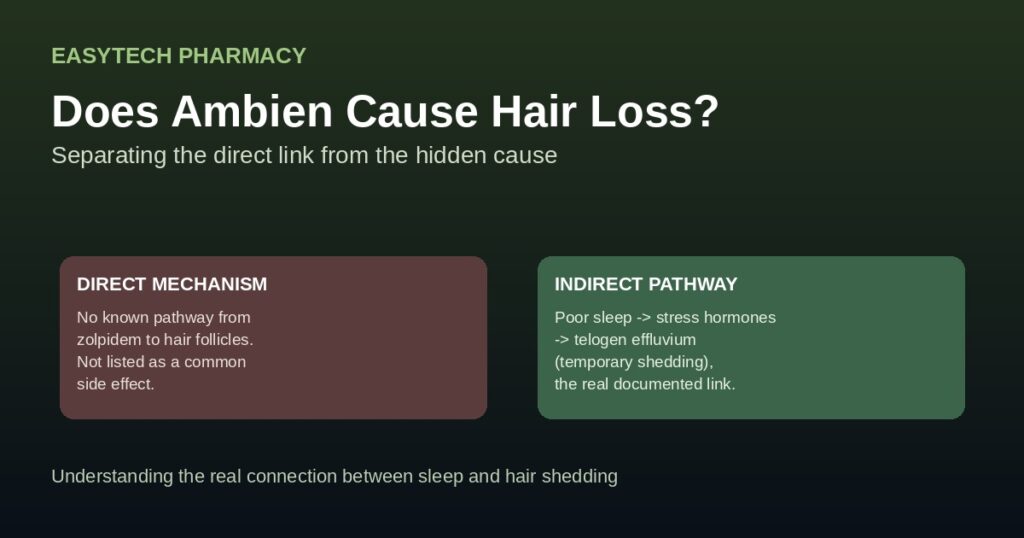
Zolpidem’s official prescribing information doesn’t list hair loss among its common or well-documented side effects. Some medications have a clear, known mechanism for hair loss — certain chemotherapy drugs, some blood thinners, isotretinoin. Zolpidem doesn’t. No established biological pathway connects zolpidem to hair follicle disruption directly.
That doesn’t mean the connection some people notice is imaginary. It usually means the actual cause is something happening around the medication, not the medication itself. Understanding that difference matters — it changes what you should actually do about it.
The Real Mechanism — Telogen Effluvium
This concept explains almost every case of “my sleep medication is making my hair fall out” that doesn’t trace back to a coincidental, unrelated cause.
Hair grows in cycles. At any given time, roughly 85 to 90 percent of your hair follicles sit in an active growth phase, called anagen. The rest sit in a resting or shedding phase, called telogen. This balance is normally stable, which is why healthy hair loss is a slow, unnoticeable background process.
Telogen effluvium happens when a significant physical or psychological stressor pushes an unusually large number of follicles into the resting phase all at once. Hair takes roughly two to three months to actually shed after entering the telogen phase. So the hair loss shows up as a delayed wave. Noticeably more shedding appears two to three months after the triggering event. That delay is a big reason people miss the connection to the actual cause.
Common triggers for telogen effluvium include:
- Significant physical illness or fever
- Major surgery
- Extreme emotional stress
- Rapid weight change
- Hormonal shifts, including pregnancy and postpartum changes
- Chronic sleep deprivation — the piece that connects most directly to this topic
How Insomnia Itself Becomes the Trigger
Here’s the mechanism that ties most directly into the Ambien question. The insomnia that led someone to start taking Ambien in the first place is very often the actual trigger for telogen effluvium. The medication that came afterward usually isn’t.
Chronic sleep deprivation raises cortisol, the body’s primary stress hormone, and keeps it elevated for extended periods. Sustained high cortisol is one of the more well-documented triggers for pushing hair follicles prematurely into the resting phase. Someone who’s had weeks or months of poor sleep before ever starting Ambien may already have telogen effluvium quietly building. The visible shedding often shows up later — sometimes right around the time they started the medication, purely by coincidence of timing.
This creates a confusing but understandable pattern. Someone struggles with insomnia for months. Cortisol stays elevated. They start Ambien to finally get some sleep. A few weeks later, they notice increased shedding. In reality, it’s the delayed telogen effluvium from the insomnia itself finally becoming visible. It just happens to arrive around the same time as the new medication — and gets blamed on it instead.
The Timing Problem — Why Correlation Misleads Here
Telogen effluvium’s two-to-three-month delay is the single biggest reason people misattribute this connection so often. The hair that’s shedding today reflects a stress event that happened roughly two to three months ago — not something happening right now.
Say someone starts Ambien and notices hair loss two weeks later. If it’s stress-related shedding, the actual trigger would have needed to occur roughly two to three months before that noticeable shedding. In most cases, that’s before they even started the medication.
If shedding appears two to three months after starting Ambien, it’s worth considering what else was happening in that window. Was sleep genuinely improving? Or was there another stressor — illness, a major life change, a different medication — that simply coincided with starting Ambien rather than being caused by it?
Could Ambien Itself Contribute — Indirectly
A couple of indirect ways Ambien use could plausibly play a role are worth mentioning honestly, even though neither is a primary mechanism.
Incomplete sleep improvement: Ambien might help someone fall asleep without actually restoring restorative sleep quality. If it isn’t fully resolving the underlying insomnia, cortisol may remain elevated even while the person believes their sleep problem is solved. This would continue driving the same telogen effluvium mechanism as the original insomnia. This pattern connects closely to why some people stay on Ambien far longer than intended — our guide on is Ambien habit forming covers that dynamic in depth.
Nutritional impact from parasomnias: In rare cases, sleep-related eating behaviors linked to Z-drugs can disrupt normal eating patterns. Significant nutritional disruption is itself a recognized trigger for telogen effluvium. This is an unusual and indirect pathway, but worth knowing about if other explanations don’t fit. Our guide on does Ambien cause weight gain covers this same sleep-eating mechanism and its effect on weight and nutrition.
Neither of these represents zolpidem directly attacking hair follicles. They’re both variations on the same stress-and-sleep-quality mechanism that drives telogen effluvium generally.
Other Things Worth Ruling Out
Before assuming Ambien is responsible, it’s worth considering other common causes that could be coinciding by chance:
- Other medications started around the same time — many drugs beyond sleep aids carry documented hair loss associations
- Thyroid changes — both an underactive and overactive thyroid are classic causes of diffuse hair thinning
- Iron deficiency — one of the most common overlooked causes of hair shedding, especially in women
- Recent illness or fever — even a bad flu can trigger telogen effluvium two to three months later
- Significant weight loss or dietary changes — rapid changes here are a well-known trigger
- Postpartum status — one of the most common and well-recognized causes of telogen effluvium
A pharmacist can help you map your full medication and health timeline against when the shedding actually started. This is often the most useful step in figuring out what’s genuinely responsible. This kind of medication review matters even more for older adults, who often take several medications at once — our guide on Ambien side effects in elderly patients covers age-related factors worth ruling out too.
What Actually Helps
Since the underlying driver in most cases is stress and sleep quality rather than the medication directly, the most effective response usually targets that root cause instead of simply stopping Ambien.
- Focus on sleep quality, not just sleep onset — falling asleep faster isn’t the same as getting deep, restorative sleep. Our guide on how can I sleep quickly covers habits that support both
- Address ongoing stress directly — since cortisol is the actual driver, stress management techniques have a real, mechanistic reason to help here, not just a general wellness benefit
- Check your nutrition — adequate iron, protein, and overall caloric intake matter more to hair health than people often realize
- Give it time — telogen effluvium is almost always temporary. Once the underlying trigger resolves, hair typically returns to its normal growth pattern within several months
- Track the timeline carefully. Note exactly when shedding started relative to any medication changes, illnesses, or major stress events — this makes it much easier to identify the actual trigger
If you’re concerned that Ambien isn’t giving you genuinely restorative sleep — which could be perpetuating the cortisol-driven cycle — it’s worth exploring alternatives. Our guide on trazodone vs Ambien and our overview of natural Ambien alternatives both cover options with different sleep-architecture profiles. Our piece on sleeping pills not habit forming rounds out the picture for anyone who’d rather avoid the dependence question entirely.
According to the American Academy of Dermatology, telogen effluvium is typically triggered by a stressful event. It usually resolves once the trigger is addressed, without any long-term treatment needed.
Frequently Asked Questions
Does Ambien cause hair loss?
Not directly. Ambien isn’t listed as a recognized cause of hair loss, and no established mechanism links it to damaged hair follicles. The hair loss some people notice is usually telogen effluvium. It’s triggered by the chronic sleep deprivation that led them to start Ambien in the first place, or by an unrelated stressor that coincided in timing.
What is telogen effluvium?
Telogen effluvium is a temporary, diffuse hair-shedding condition triggered by physical or emotional stress, illness, or major body changes. It appears roughly two to three months after the triggering event. It typically resolves on its own once the underlying cause is addressed.
Will my hair grow back after stopping Ambien?
If Ambien itself isn’t the actual cause — which is the case for most people experiencing this — stopping it won’t necessarily change anything. Identifying and addressing the real underlying trigger, usually stress or sleep quality, is what allows normal hair growth to resume. If you do decide to stop, our guide on zolpidem withdrawal symptoms covers what to expect so you can plan the process safely.
How long does stress-related hair shedding last?
Telogen effluvium typically lasts a few months once the trigger is addressed, though it can take six months or longer for hair density to fully return to normal in some cases.
Should I stop taking Ambien if I notice hair loss?
Not automatically. Ambien rarely causes hair loss directly, so stopping it without identifying the actual trigger may not resolve the shedding. It could also leave your original sleep problem unaddressed. Working through the timeline with a pharmacist is a more useful first step than stopping on your own.
Bottom Line — Look Past the Medication to the Real Trigger
The connection between Ambien and hair loss that some people notice is almost always a timing coincidence, not a direct cause-and-effect relationship. The real culprit is typically telogen effluvium, driven by chronic stress or the sleep deprivation that existed before the medication ever entered the picture. Its delayed two-to-three-month shedding pattern makes the actual timeline easy to misread.
If you’re noticing increased shedding, the most productive step is mapping your health timeline honestly — illness, stress, weight changes, other medications. Don’t assume the most recent change is automatically the cause.
For local pharmacy access and to talk through your specific situation, our Ambien near me guide covers pharmacy options across the World.