Is Ambien Habit Forming? What the Research Actually Shows
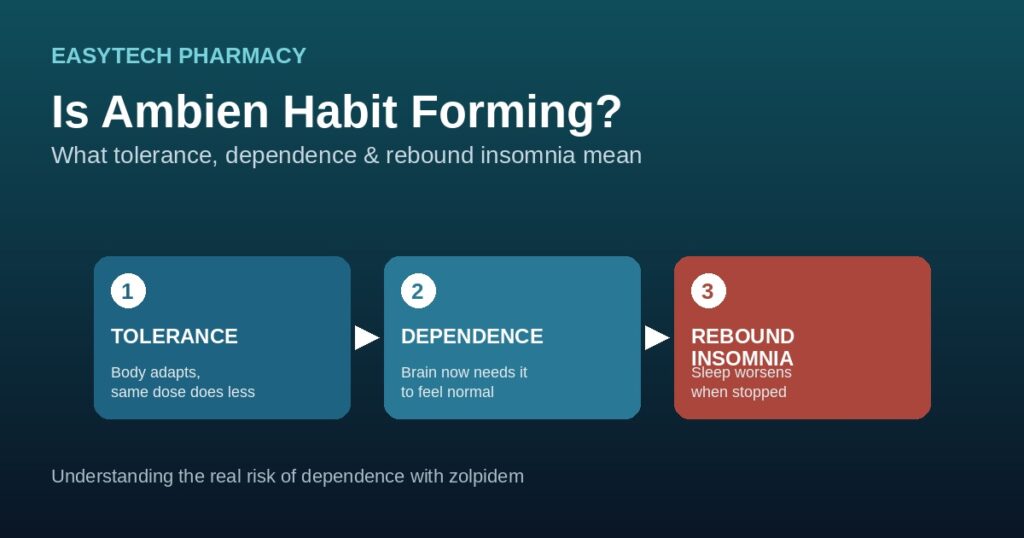
People throw around the phrase “habit forming” loosely. With Ambien, it hides more than it explains. Some people take it for years without incident. Others notice they can’t sleep without it after just a few weeks. The difference isn’t luck. It comes down to predictable factors that shape how your brain and body respond to repeated zolpidem use.
This guide breaks down what “habit forming” actually means. You’ll learn why it happens, who faces the highest risk, and which warning signs to watch for before dependence takes hold.
The Short Answer — Yes, and Here’s Why That’s Not the Whole Story
Ambien (zolpidem) is a Schedule IV controlled substance in the United States. The DEA’s drug scheduling system places Schedule IV substances in the category with documented, though comparatively lower, potential for abuse and dependence relative to more restrictive schedules. That classification exists because of documented dependence potential. Manufacturers originally marketed zolpidem as carrying a lower dependence risk than older benzodiazepine sleep aids. But decades of real-world use tell a different story. The risk isn’t zero — it’s just different in shape.
Here’s the honest picture. Physical dependence can develop with regular nightly use, typically within 2 to 6 weeks. Timelines vary widely between individuals. Psychological dependence often develops even faster. This is the sense that sleep simply isn’t possible without the pill — and in practice, it’s the more common issue people run into.
Ambien isn’t comparable to opioids in terms of euphoric reinforcement, at least not for most users at therapeutic doses. The habit-forming mechanism here works differently. Understanding that difference helps you understand your own risk.
Two Separate Mechanisms — Tolerance and Dependence Aren’t the Same Thing
People use these two words interchangeably. But they describe different processes — and untangling them explains why Ambien affects people so differently.
Tolerance
Tolerance is a pharmacological adaptation. Zolpidem binds to the brain’s GABA-A receptors to produce sedation. Over time, those receptors gradually become less responsive to the same dose. This is a receptor-level change, not a psychological one. In practice, the same 10mg that worked well in week one does noticeably less by week six.
Tolerance to the sedative effect tends to develop faster than tolerance to other effects, like next-morning impairment. That’s part of why people increase their dose without realizing they’re also raising their next-day risk.
Physical Dependence
Dependence happens once your brain adapts to the drug’s presence and needs it to maintain a new “normal.” Stop taking it, and your nervous system — no longer buffered by zolpidem’s GABA-A activity — rebounds into a state of heightened excitability. This rebound produces the withdrawal and rebound symptoms described below.
The two processes often develop together, but they aren’t strictly linked. Some people develop meaningful tolerance without significant withdrawal. Others experience the reverse.
Rebound Insomnia — The Most Common Sign People Miss
This is arguably the most important concept in this whole topic. It’s the mechanism that quietly locks people into longer-term use without them realizing what’s happening.
Rebound insomnia is a documented phenomenon. Sleep after stopping Ambien can feel worse than it did before you ever started the medication. It’s not just a return to your baseline insomnia — it’s a temporary intensification of it. Rebound insomnia typically appears the first one to three nights after you stop. It can last a week or more, depending on how long you used the medication and at what dose.
The trap this creates is almost mechanical. Someone stops Ambien, sleeps terribly for several nights, and concludes “I still need this.” So they resume. Each cycle through this pattern reinforces the physical dependence. It also reinforces a false belief: that unmedicated sleep isn’t achievable. In reality, they’re experiencing a temporary, expected pharmacological rebound — not a return of their original insomnia.
Recognizing rebound insomnia for what it is makes a real difference. It’s a time-limited withdrawal phenomenon, not a permanent verdict on your sleep. That recognition often separates someone who tapers off successfully from someone who ends up on the medication indefinitely.
Who Is More Likely to Develop Dependence
Habit-forming risk isn’t evenly distributed. Certain factors reliably increase it:
- Duration of use: The FDA labels Ambien for short-term use — typically 7 to 10 days in clinical trials. Real-world prescribing often extends further. Risk climbs meaningfully with continuous use beyond several weeks.
- Nightly use without breaks: People who take it every night, without any nights off, develop tolerance and dependence faster. Intermittent use carries lower risk.
- Higher doses: Risk scales with dose. Someone on 10mg nightly faces meaningfully higher risk than someone using 5mg a few nights a week. Our guide on Ambien dosage breaks down appropriate dosing ranges.
- History of substance use patterns: A personal or family history of alcohol or sedative dependence raises your risk for zolpidem dependence too.
- Combining with alcohol: Beyond the acute danger, regular alcohol combination speeds up both tolerance and dependence. See our guide on Ambien and alcohol for the full picture.
- Underlying anxiety about sleep itself: People who develop real anxiety about not sleeping tend to depend on the medication psychologically faster. This happens independent of the physical dependence timeline.
What Withdrawal Actually Looks Like
Not everyone who stops Ambien after short-term use experiences withdrawal. But if you’ve used it regularly for an extended period, stopping abruptly can produce a recognizable set of symptoms:
- Rebound insomnia (described above) — often the first and most noticeable symptom
- Anxiety or a sense of internal restlessness
- Irritability
- Nausea or gastrointestinal discomfort
- Sweating
- Tremor, in more significant cases
- Rarely, with high-dose long-term use stopped abruptly, seizures — this is uncommon, but it’s the reason doctors recommend tapering instead of quitting cold after extended use
For most people who’ve used Ambien for a matter of weeks — not months or years — symptoms are typically mild where they appear at all. They usually resolve within one to two weeks. Longer-term, higher-dose use calls for a supervised taper instead of stopping cold. Have this conversation directly with a pharmacist or prescriber rather than managing it alone, especially if you have a seizure history.
Signs You May Be Developing Dependence
These are practical, self-observable signals worth paying attention to. They’re not a diagnosis — think of them as prompts to talk with a pharmacist or your prescriber:
- You’ve needed to increase your dose to get the same effect as when you started
- You feel real anxiety at the thought of trying to sleep without it
- You’ve tried to stop or cut back and experienced noticeably worse sleep than your original insomnia
- You’re taking it most or every night, well past the short-term window it was intended for
- You find yourself taking it earlier in the evening “just in case,” or taking extra if you wake up during the night
- You’ve started sourcing it in ways that bypass your usual prescriber relationship
None of these alone proves dependence, and this isn’t a reason for alarm. But a pattern of several signs is a legitimate signal. Bring it up with a healthcare provider instead of managing it silently.
How Ambien’s Habit-Forming Profile Compares to Alternatives
Context matters here. Compared to older-generation benzodiazepines once used for sleep, zolpidem generally carries a somewhat lower dependence liability. Its shorter half-life and more selective receptor binding explain why it largely replaced them in prescribing patterns. That’s a meaningful difference. But “lower than benzodiazepines” isn’t the same as “not habit forming” — a distinction that gets lost in casual conversation about sleep medications.
If you’re specifically concerned about dependence risk, several options offer meaningfully different profiles. These include non-habit-forming prescription options like low-dose doxepin or ramelteon, plus non-pharmaceutical approaches entirely. Our guide on sleeping pills that aren’t habit forming covers this category in depth. Our comparison of trazodone vs Ambien looks at an alternative with a very different dependence mechanism.
Reducing Your Risk If You’re Currently Taking Ambien
For people already using Ambien as directed, a few practices meaningfully reduce habit-forming risk without requiring you to stop:
- Use the lowest effective dose rather than defaulting to the higher end — see Ambien dosage for guidance
- Build in nights off where possible, in consultation with your prescriber, rather than nightly use indefinitely
- Address the root sleep issue in parallel — stress, screen exposure, irregular schedules. Don’t rely on medication as your only intervention. Our guide on how can I sleep quickly covers the behavioral side
- Revisit the plan periodically with your prescriber rather than treating it as an indefinite, unreviewed prescription
- Watch for other documented side effects alongside dependence — our full Ambien side effects guide, and our piece on Ambien hallucinations, cover related risks worth knowing
Frequently Asked Questions
Is Ambien habit forming?
Yes. The DEA classifies it as a Schedule IV controlled substance because of documented tolerance, physical dependence, and rebound insomnia risk with regular use — especially beyond the short-term window it’s meant for.
How long does it take to become dependent on Ambien?
There’s no fixed timeline. Research documents physical dependence developing within 2 to 6 weeks of nightly use in some people. Psychological dependence — feeling unable to sleep without it — can develop even faster.
What is rebound insomnia?
Rebound insomnia is a temporary period of sleep that feels worse than your original insomnia. It occurs in the first several nights after stopping Ambien following regular use. It’s a withdrawal phenomenon, not a sign that your insomnia has returned or worsened permanently.
Can you take Ambien long-term without becoming dependent?
Some people use it long-term with careful, supervised management — periodic breaks, lowest effective dose, regular reassessment — without significant dependence issues. But risk generally rises with duration, dose, and consistency of nightly use. That’s why doctors label it for short-term use.
Is Ambien more or less habit forming than other sleep medications?
Ambien generally carries a somewhat lower dependence risk than older benzodiazepine sleep aids. But it carries a meaningfully higher risk than non-controlled options like trazodone, doxepin, or ramelteon.
Bottom Line — Real Risk, Manageable With Awareness
Ambien’s habit-forming potential is real, well-documented, and worth taking seriously. But it’s not inevitable, and it’s not the same for everyone. Understanding the actual mechanisms — tolerance, dependence, and especially rebound insomnia — helps you recognize early warning signs. You can address them before they become entrenched, instead of getting caught off guard by something that feels confusing or unexpected.
If anything here sounds familiar, take the next step: talk directly with your pharmacist or prescriber about your specific pattern of use. Skip the guesswork. Don’t manage it alone.