Ambien Dosage — The Right Amount for Your Age, Sex, and Sleep Pattern
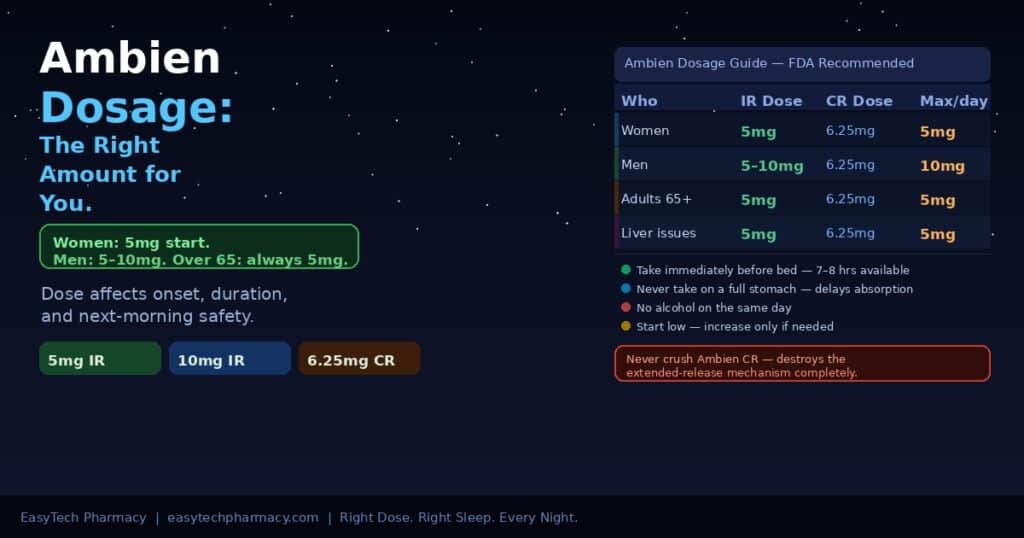
Dosage is where most Ambien mistakes happen. Not dramatic mistakes — just the quiet kind. Taking more than needed. Taking it at the wrong time relative to sleep. Not knowing that the dose that works well for your partner may be the wrong starting point for you.
Getting the dose right matters for two reasons. Too low and the medication does not do its job. Too high and the side effect risk — next-morning impairment, memory gaps, parasomnias — rises significantly without much additional sleep benefit. The sweet spot is specific to your age, sex, and which formulation you are taking.
This guide covers Ambien dosage completely — every recommended dose, why they differ by group, how the FDA changed its guidance, and what signs tell you your current dose may need adjusting.
For the broader picture on using Ambien safely from start to finish, our guide on how to buy Ambien online Without Prescription covers everything.
The Available Doses — What Exists and What Each One Is For
Ambien comes in four distinct dosage options across its two formulations.
Immediate-Release Zolpidem (Regular Ambien)
- 5mg: The lower starting dose. Recommended as the first choice for women, adults over 65, and anyone with liver impairment. Produces reliable sleep onset in most patients. Next-morning blood levels are safer at this dose than at 10mg.
- 10mg: The higher standard dose. Used when 5mg produces inadequate sleep onset. Recommended maximum daily dose for immediate-release zolpidem. Associated with greater next-morning impairment risk — particularly in women and older adults.
Extended-Release Zolpidem (Ambien CR)
- 6.25mg: The CR equivalent of the 5mg immediate-release dose. Recommended starting dose for women, adults over 65, and those with liver concerns taking CR. The bilayer mechanism delivers this amount in two phases over 7 to 8 hours.
- 12.5mg: The CR equivalent of the 10mg immediate-release dose. Used when 6.25mg provides insufficient coverage for sleep maintenance needs. Maximum recommended daily dose for extended-release zolpidem.
These four doses cover every standard clinical scenario for zolpidem use. There are no other approved doses. Taking any amount above the 10mg IR or 12.5mg CR daily maximum increases risk substantially without additional benefit.
The 2013 FDA Dosage Change — Why It Happened and What It Means
In 2013 the FDA issued a significant safety communication specifically about zolpidem dosing for women — one of the more consequential medication dosage updates of recent years.
The issue was next-morning blood levels. Studies found that a meaningful percentage of women who took 10mg zolpidem at bedtime still had blood levels above 50 ng/mL eight hours later — a level associated with impaired driving performance. The same studies in men showed most had cleared to safer levels by the 8-hour mark.
According to the FDA’s 2013 safety communication, women clear zolpidem approximately 45% more slowly than men on average. The consequence — women at the 10mg dose have meaningfully higher blood levels the next morning than men at the same dose. Morning driving impairment is significantly elevated as a result.
The FDA’s response was direct. They lowered the recommended starting dose for women from 5–10mg to 5mg for immediate-release, and from 12.5mg to 6.25mg for CR. They also added language specifying that the 10mg dose should only be used in men who do not respond adequately to 5mg — not as a standard first-choice dose for anyone.
This change was significant enough that if your current authorization predates 2013 or was written before these guidelines were widely adopted, it is worth confirming with your pharmacist that your dose reflects current recommendations for your specific situation.
Dosage by Patient Group — Specific Recommendations
Women — Start at 5mg IR or 6.25mg CR
The FDA’s updated guidance is clear and specific. Women should start Ambien at the lower dose — 5mg for immediate-release, 6.25mg for CR. The 45% slower clearance rate means a 5mg dose in a woman produces similar therapeutic blood levels to a 10mg dose in a man over the same timeframe — but with lower peak concentration and safer morning levels.
Women who find 5mg insufficient — it genuinely does not produce adequate sleep onset — can discuss moving to 10mg with their pharmacist. However, next-morning impairment risk increases significantly at 10mg for women, and the 7 to 8 hour sleep window requirement is especially important to maintain.
Men — 5mg or 10mg IR / 6.25mg or 12.5mg CR
Men have more flexibility because faster clearance reduces the next-morning impairment concern. The standard approach is to start at 5mg and only move to 10mg if 5mg does not provide adequate sleep onset after a trial period of one to two weeks. Many men find 5mg fully adequate — and staying at the lower dose means lower side effect risk and a more appropriate first step.
Starting high and stepping down if there are problems is a less desirable approach than starting low and stepping up only if genuinely needed.
Adults Over 65 — Always Start at 5mg IR or 6.25mg CR
Older adults face two compounding factors that make lower doses essential. First, liver enzyme activity that processes zolpidem slows with age — extending the medication’s active duration and increasing blood levels at any given dose. Second, age-related changes in GABA receptor sensitivity can make older adults more responsive to zolpidem’s effects at lower concentrations than younger adults.
The combination means a 5mg dose in a 70-year-old may produce an effect similar to or greater than a 10mg dose in a 35-year-old. Fall risk from next-morning dizziness and balance impairment is significantly elevated in older adults. The lower starting dose is not optional for this group — it is the standard of care.
The American Geriatrics Society’s Beers Criteria — the standard guide for medication use in older adults — classifies zolpidem as a potentially inappropriate medication for adults over 65 at higher doses due to fall and cognitive impairment risk. If you are over 65 and currently taking 10mg, discussing a dose reduction with your pharmacist is worth doing.
People With Liver Impairment — 5mg IR or 6.25mg CR Maximum
The liver is responsible for metabolizing zolpidem through CYP450 enzymes. Impaired liver function slows this process significantly — extending the medication’s active duration and raising blood levels at any given dose. People with liver disease should use the lowest available dose and may need to take it less frequently than nightly.
People Taking Other CNS-Depressing Medications
Many common medications enhance zolpidem’s CNS depressant effects when taken together. Antihistamines, certain antidepressants, muscle relaxants, anti-anxiety medications, and opioid pain relievers all fall in this category. If you take any of these, starting at the lowest possible Ambien dose is important — and discussing the combination with your pharmacist before your first dose is worth doing.
Timing — When You Take It Matters as Much as How Much
Dose timing is a component of dosage strategy that is often overlooked but significantly affects both how well the medication works and how safe it is.
Take It Immediately Before Getting Into Bed
Ambien is designed to be taken immediately before lying down for sleep — not 30 minutes before to let it “kick in” while you finish tidying up. Taking it while still upright and active means the medication reaches effective blood levels while your brain is still receiving alertness signals. This increases the chance of unusual effects — including memory gaps for activities performed during those 20 to 30 minutes — without the sleep environment to channel the sedation into actual sleep.
Take it, put everything down, go directly to bed. This is the most consistently effective approach and the one that produces the fewest side effects.
The 7 to 8 Hour Rule
Only take Ambien when you have a full 7 to 8 hours available before you need to be active. This is not about getting enough rest — it is about giving the medication enough time to clear to a level safe for driving and complex tasks. Our guide on how long does Ambien make you sleep covers the clearance timeline for both formulations in detail.
Empty or Light Stomach for Consistent Results
Food significantly delays zolpidem absorption. A high-fat meal can push peak blood concentration back by an hour or more — meaning you may still be lying awake 45 minutes after taking Ambien simply because the medication has not absorbed yet. For fastest and most consistent onset, take Ambien at least 2 hours after eating. Our guide on how long does Ambien take to work covers exactly how food timing affects the onset window.
Signs Your Current Dose May Need Adjusting
Several patterns suggest a dose review is worth having.
Signs Your Dose May Be Too High
- Feeling noticeably groggy or foggy the next morning despite 7 to 8 hours of sleep
- Dizziness when getting up that persists for more than 30 minutes after waking
- Memory gaps for activities performed after taking Ambien but before falling asleep
- Any evidence of complex nighttime behaviors — sleepwalking, sleep-eating — with no memory afterward
- Feeling sedated during the day in a way that affects function
Signs Your Dose May Be Too Low
- Consistently taking 45 minutes or longer to fall asleep after taking the medication
- Waking multiple times during the night on standard immediate-release zolpidem — this may indicate a need for CR rather than a higher IR dose
- No subjective sense that the medication is doing anything
Signs You May Have Developed Tolerance
- Medication that worked reliably for the first two to three weeks seems less effective
- You find yourself wanting to take a larger dose to get the same effect as before
- Sleep quality on medication has deteriorated from where it was initially
Tolerance is not solved by increasing dose — it typically makes the problem worse over time. Our guide on why does Ambien stop working after a few weeks covers the tolerance mechanism and the most effective approaches to manage it.
What Not to Do With Your Ambien Dose
These are the most common dosage mistakes — and each one meaningfully increases risk.
- Do not double up if the first dose seems not to work. If you take Ambien and 45 minutes later feel like it is not working, the most likely explanation is food timing or staying awake and active after taking it — not an insufficient dose. A second dose in the same night significantly increases overdose and parasomnia risk.
- Do not crush or chew Ambien CR. Crushing destroys the controlled-release mechanism, releasing the entire extended dose immediately. This converts it into an unpredictably high immediate-release exposure.
- Do not adjust your own dose upward without discussion. Moving from 5mg to 10mg, or from 6.25mg to 12.5mg, is a meaningful clinical decision — not just taking an extra pill. The side effect risk profile changes significantly with the dose increase.
- Do not share doses. The dose appropriate for you based on your age, sex, weight, and other medications is not appropriate for someone else with different characteristics. Zolpidem sharing is illegal and potentially dangerous.
- Do not combine with alcohol. Even at the 5mg dose, alcohol amplifies zolpidem’s effects unpredictably and significantly. This combination at any dose increases parasomnia risk, respiratory depression risk, and next-morning impairment.
Ambien Dosage and Side Effects — The Direct Connection
Almost every significant Ambien side effect is dose-dependent. The frequency and severity of next-morning impairment, parasomnias, memory effects, dizziness, and hallucinations all increase with dose. This is the most important practical reason to start at the lowest effective dose and resist moving higher unless genuinely necessary.
For the complete breakdown of every Ambien side effect — what is common, what is serious, and what to do about each one — our dedicated guide on Ambien side effects covers the full picture. And for how CR and IR compare specifically on side effect risk, our guide on Ambien and Ambien CR differences has the detailed comparison.
Frequently Asked Questions
What is the standard Ambien dosage?
For women: 5mg immediate-release or 6.25mg CR. For men: 5mg to 10mg immediate-release or 6.25mg to 12.5mg CR. For adults over 65: 5mg IR or 6.25mg CR regardless of sex. The FDA recommends starting at the lowest effective dose and increasing only if needed. Maximum daily dose is 10mg IR or 12.5mg CR.
Why is the Ambien dose different for women than men?
Women metabolize zolpidem approximately 45% more slowly than men. This means the same dose produces higher blood levels that persist longer in women than in men. The FDA updated its dosing guidance in 2013 specifically because of this difference — higher blood levels in women at the standard 10mg dose were found to impair morning driving performance at an unacceptable rate.
Is 10mg Ambien too much?
For women — the FDA now considers 10mg a dose that should only be used if 5mg is genuinely insufficient, not a standard starting dose. For men without other complicating factors, 10mg is within the approved range but carries higher next-morning impairment risk than 5mg. For anyone over 65 or with liver impairment, 10mg is above what current guidelines recommend as appropriate.
Can I take Ambien every night?
Ambien is approved for short-term use — typically two to four weeks. Nightly use beyond this window increases tolerance and dependence risk without continuing to improve sleep quality. Many people who use it beyond this period find diminishing effectiveness over time. For managing longer-term sleep difficulties, discussing alternatives with a pharmacist is a more sustainable approach than ongoing nightly zolpidem use.
What happens if I take too much Ambien?
Doses above the daily maximum significantly increase the risk of severe CNS depression, respiratory difficulties, loss of coordination, profound memory loss, and potential overdose — particularly when combined with alcohol or other sedating medications. If you suspect you or someone else has taken too much Ambien, call Poison Control at 1-800-222-1222 immediately. If breathing is affected or the person cannot be roused, call 911.
Can I split an Ambien 10mg tablet to get a 5mg dose?
Immediate-release Ambien tablets can generally be split — splitting a 10mg tablet gives approximately 5mg. However, Ambien CR tablets should never be split, crushed, or chewed — doing so destroys the bilayer controlled-release mechanism and releases the full dose immediately. If you need 6.25mg CR rather than 12.5mg CR, the lower-dose tablet should be obtained separately.
Bottom Line — Start Low, Time It Right, Stay Within the Window
The most important principles around Ambien dosage come down to three things. Start at the lowest recommended dose for your age and sex. Take it on an empty stomach immediately before going to bed. Only take it when you have 7 to 8 full hours available.
These three principles together produce the safest possible experience with the medication at any dose level. They minimize next-morning impairment. They reduce parasomnia risk. They produce more consistent and predictable onset and duration.
If your current dose is not working adequately — or if you are experiencing side effects that suggest the dose is too high — that is a conversation for your pharmacist. Dose adjustments within the approved range are common and straightforward. What matters is making that adjustment based on what is actually happening rather than guessing.
At EasyTech Pharmacy, we carry FDA-approved generic zolpidem in all four standard doses — 5mg IR, 10mg IR, 6.25mg CR, and 12.5mg CR — with transparent pricing, fast delivery, and pharmacist support when you need it.
Looking for local options near you? Our Ambien near me guide covers pharmacy access across the US for every available dose and formulation.
Visit EasyTech Pharmacy — the right dose, the right price, delivered to your door.