Who Should Not Take Ambien: A Clear Guide to the Contraindications
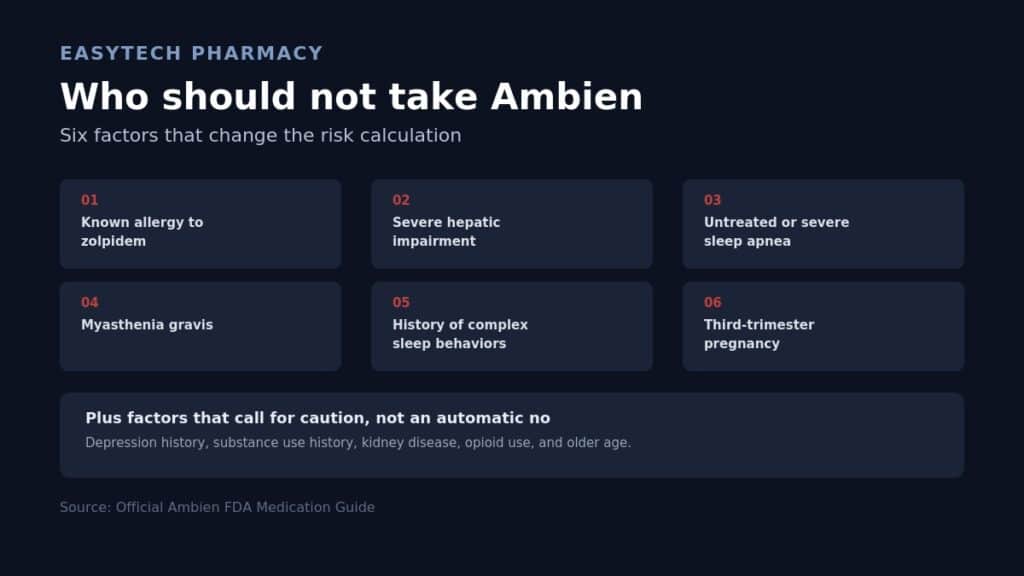
Ambien works well for a lot of people. That’s exactly why it’s one of the most prescribed sleep medications in the country. But “works well for a lot of people” isn’t the same as “works well for everyone.” A specific set of conditions and histories genuinely changes the risk calculation, sometimes enough to rule the medication out entirely. Here’s a clear, sourced walk-through of who that includes.
Known Allergy to Zolpidem or Its Ingredients
This is the most straightforward contraindication. Anyone with a documented allergic reaction to zolpidem or any inactive ingredient in Ambien tablets shouldn’t take this medication. Reactions can include rash, itching, swelling, or difficulty breathing. Any of these deserve immediate medical attention rather than a wait-and-see approach.
Severe Hepatic Impairment
The liver clears almost the entire dose of zolpidem. Severe liver disease changes that picture dramatically. The FDA’s prescribing information specifically advises against using Ambien in patients with severe hepatic impairment. It may contribute to hepatic encephalopathy, a serious condition involving confusion and altered mental status. Our guide on Ambien and kidney or liver function covers the underlying pharmacology in more depth.
Untreated or Severe Sleep Apnea
Sedative-hypnotics like Ambien can depress respiratory drive. That’s a genuine concern for anyone with compromised breathing during sleep. Clinical data has shown that zolpidem reduces oxygen saturation and increases the time spent below safe oxygen levels in patients with mild to moderate sleep apnea, compared to placebo. This risk compounds further with any lung or breathing disease.
Myasthenia Gravis
This autoimmune condition causes muscle weakness. International prescribing information specifically lists it as a contraindication. Zolpidem’s muscle-relaxing and sedating effects can worsen the underlying weakness myasthenia gravis already causes. That combination can affect breathing and movement in ways that carry real risk.
History of Complex Sleep Behaviors
Anyone who has experienced sleepwalking, sleep-driving, or a similar episode while taking Ambien or a related medication generally shouldn’t continue or restart it. This reflects the FDA’s contraindication following the 2019 boxed warning. Our guide on Ambien and Next-Day Driving Impairment covers it in full.
Pregnancy, Particularly the Third Trimester
The official medication guide specifically flags third-trimester use as a risk to the unborn baby. Babies born to mothers taking Ambien during this window may show symptoms of breathing difficulty or withdrawal after birth. Our guide on Ambien and pregnancy safety walks through the fuller picture, including more recent research on earlier-pregnancy risk.
Conditions That Call for Extra Caution, Not Necessarily a Hard Stop
A few other factors don’t automatically rule Ambien out. They consistently show up on official screening questions because they meaningfully change the risk-benefit picture:
- History of depression, mental illness, or suicidal thoughts. Our guide on Ambien and depression risk covers why this connection deserves real attention.
- History of drug or alcohol use disorder. This raises the risk of both dependence and dangerous interactions.
- Kidney disease. Generally less pharmacologically significant than liver disease, but still worth disclosing.
- Frequent alcohol use. Combining Ambien with alcohol significantly increases sedation and respiratory risk.
- Concurrent opioid use. This combination raises respiratory depression risk substantially.
- Older age. Our guide on fall risk in elderly patients covers why age alone shifts this calculation.
Why a Full Medical History Matters So Much Here
Ambien’s risk profile gets tricky because several of these conditions aren’t visible from the outside. They’re not always top of mind when someone’s simply trying to solve a sleep problem. A history of depression from years ago, an undiagnosed breathing issue, a family member’s addiction history: none of these show up on a symptom checklist for insomnia. Each one genuinely changes how this medication should be approached.
What This List Doesn’t Cover
This is a general overview based on the FDA’s official Ambien labeling and medication guide, not a substitute for a full individual risk assessment. Some people with one of these factors may still be appropriate candidates under close monitoring. Others without any of them may still experience unexpected reactions. This list exists to make the conversation about your specific situation more informed, not to replace it.
The Bottom Line
Ambien isn’t automatically wrong for anyone on this list. But each of these factors changes the risk calculation enough to deserve real attention before starting or continuing the medication. A known allergy, severe liver disease, untreated sleep apnea, myasthenia gravis, a prior complex sleep behavior, and third-trimester pregnancy stand out as the clearest reasons to avoid it altogether. Several other factors call for real caution rather than an automatic no. Knowing this list ahead of time makes for a much more informed conversation.
For the complete official contraindications and warnings, see the official Ambien Medication Guide.
Frequently asked questions
Can I take Ambien if I have sleep apnea?
Untreated or severe sleep apnea is a significant concern, since zolpidem can worsen oxygen desaturation during sleep. This deserves real discussion around your specific severity and treatment status.
Is Ambien contraindicated for everyone with liver disease?
No. Mild to moderate impairment typically calls for a reduced dose. Clinicians generally avoid Ambien entirely for severe hepatic impairment, due to encephalopathy risk.
Can I take Ambien again after a sleepwalking episode?
Generally, no. Current FDA guidance treats a documented complex sleep behavior as a contraindication. Providers typically don’t restart the medication after a confirmed episode.
Does a history of depression rule out Ambien entirely?
Not automatically, but it’s a factor that deserves real disclosure and monitoring. Research has found a documented association between zolpidem use and mood changes in some people with existing depression.
For local pharmacy access near you, our Ambien near me guide covers pharmacies across the world.
Visit EasyTech Pharmacy — sleep medication with real pharmacist guidance.