Ambien and Fall Risk in Elderly Patients: What the Data Shows
Ambien’s most talked-about risks tend to be the dramatic ones, sleepwalking, memory gaps, dependence. For older adults, though, one of the most serious risks is quieter and far more common: a middle-of-the-night trip to the bathroom that ends in a fall. Here’s what the research actually shows about Ambien and fall risk in elderly patients, and why it’s taken seriously enough to appear on a formal medical guideline.
Why the Risk Is Higher for Older Adults
Zolpidem impairs balance and coordination for everyone, but the effect lands harder in older adults for a few compounding reasons. The body metabolizes the drug more slowly with age, so it lingers longer in the system. Impairment from a given dose also tends to be more pronounced. And older adults are simply more likely to get up during the night, whether to use the bathroom, respond to a sound, or because sleep itself is lighter and more fragmented at that stage of life.
What the Research Actually Found
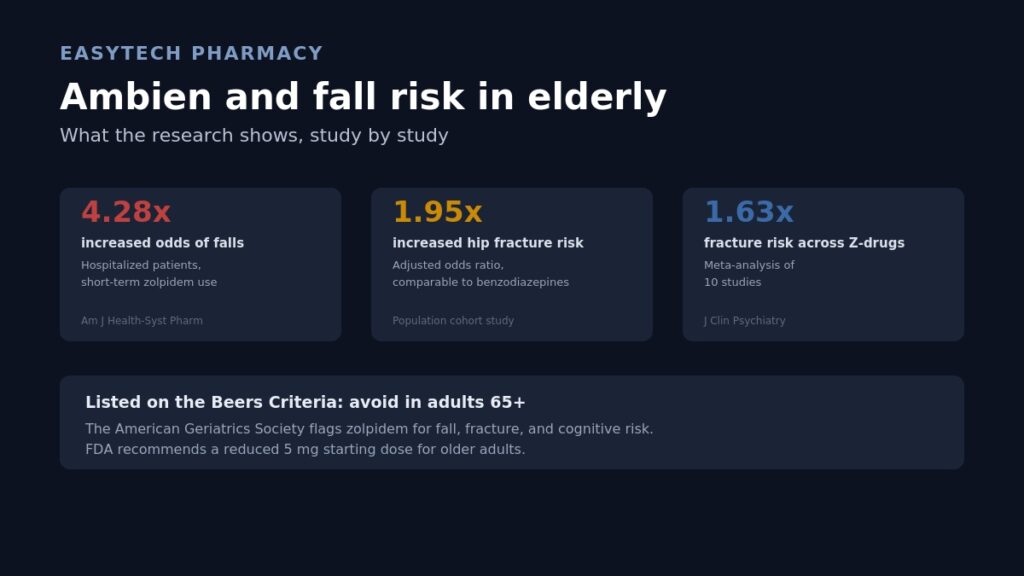
The numbers here are consistent across multiple studies, even though the exact figures vary. One hospital-based study found a 4.28-fold increase in the odds of falls among patients prescribed zolpidem short-term. A separate analysis found zolpidem nearly doubles the risk of hip fracture specifically, with an adjusted odds ratio of 1.95, a risk comparable to or exceeding that of traditional benzodiazepines. A broader meta-analysis covering multiple “Z-drugs,” the medication class that includes zolpidem, found a fracture risk increase with an odds ratio of 1.63 across the majority of studies reviewed.
These aren’t small, borderline effects. Hip fractures in adults over 70 carry a mortality rate of roughly 20 to 30% within a year, which is part of why this particular side effect gets so much clinical attention.
Why It’s on the Beers Criteria
The American Geriatrics Society maintains the Beers Criteria, a widely used, evidence-based list of medications considered potentially inappropriate for adults over 65. Zolpidem appears on this list specifically because of fall and fracture risk, along with cognitive side effects and a higher rate of paradoxical reactions like sleepwalking and agitation in older users. The 2023 update lists zolpidem under the recommendation to avoid in this age group.
This doesn’t mean zolpidem is never appropriate for an older adult. It means the risk-benefit calculation looks different than it does for a younger person, and that calculation deserves a real conversation rather than an automatic prescription.
Dosing Adjustments That Matter
The FDA recommends a reduced starting dose of 5 mg for older adults, regardless of sex, compared to the standard 10 mg dose. Even at this lower dose, risk doesn’t disappear entirely, but it’s meaningfully reduced compared to standard dosing. Our guide on Ambien Dosage covers more of the regulatory framework behind dosing and prescribing controls generally.
Practical Steps That Actually Reduce Risk
- Keep a clear, obstacle-free path from the bed to the bathroom, with a nightlight or motion-sensor light along the way
- Avoid getting up quickly after taking the medication, since impairment often peaks in the hours right after dosing
- Never combine Ambien with alcohol or other sedating medications, which compounds the balance and coordination effects our guide on Ambien and Alcohol that also help
- Review the full medication list with a pharmacist, since polypharmacy, taking multiple medications together, is independently linked to higher fracture risk
- Consider a bedside commode for anyone with frequent nighttime bathroom trips, reducing the distance and obstacles involved
Safer Alternatives Worth Discussing
Cognitive behavioral therapy for insomnia, known as CBT-I, is considered a first-line treatment for chronic insomnia in older adults and carries none of the fall-risk profile associated with zolpidem. For some people, addressing an underlying issue, pain, restless legs, sleep apnea, works better than medicating the resulting insomnia directly. These options are worth raising directly, especially for anyone already on the medication long-term.
The Bottom Line
Ambien’s fall risk in elderly patients isn’t a minor footnote. It’s substantial enough to earn a place on a formal national guideline, backed by consistent findings across multiple studies and meta-analyses. That doesn’t mean the medication is off the table for every older adult, but it does mean the conversation about whether to use it, at what dose, and with what precautions deserves real weight, not routine automatic prescribing our guide on Ambien Side Effects in Elderly Patients that also help.
For the full clinical review, see Sedative Hypnotics and the Risk of Falls and Fractures in the Elderly, published in The Journal of Clinical Psychiatry.
Frequently asked questions
How much does Ambien increase fall risk in older adults?
Research findings vary by study design, but figures range from roughly a 1.6-fold to over 4-fold increase in fall or fracture odds, depending on the population and setting studied our guide on Ambien and Depression Risk that also help.
Why is zolpidem on the Beers Criteria?
The American Geriatrics Society lists it due to documented fall and fracture risk, cognitive side effects, and a higher rate of paradoxical reactions like sleepwalking in older adults.
Does a lower dose eliminate the fall risk?
No, though it does reduce it. The FDA-recommended 5 mg starting dose for older adults lowers risk compared to the standard 10 mg dose, but doesn’t remove it entirely.
What’s a safer alternative to Ambien for older adults with insomnia?
Cognitive behavioral therapy for insomnia is considered a first-line option for older adults and doesn’t carry the same fall-risk profile as zolpidem.
At EasyTech Pharmacy, our pharmacist team is available to review sleep medication options specifically for elderly patients — helping identify the safest effective choice for each individual situation.
For local pharmacy access near you, our Ambien near me guide covers pharmacies across the world.
Visit EasyTech Pharmacy — age-appropriate sleep medication with real pharmacist guidance.