Ambien and Alcohol — What Happens Inside Your Body When You Mix Them
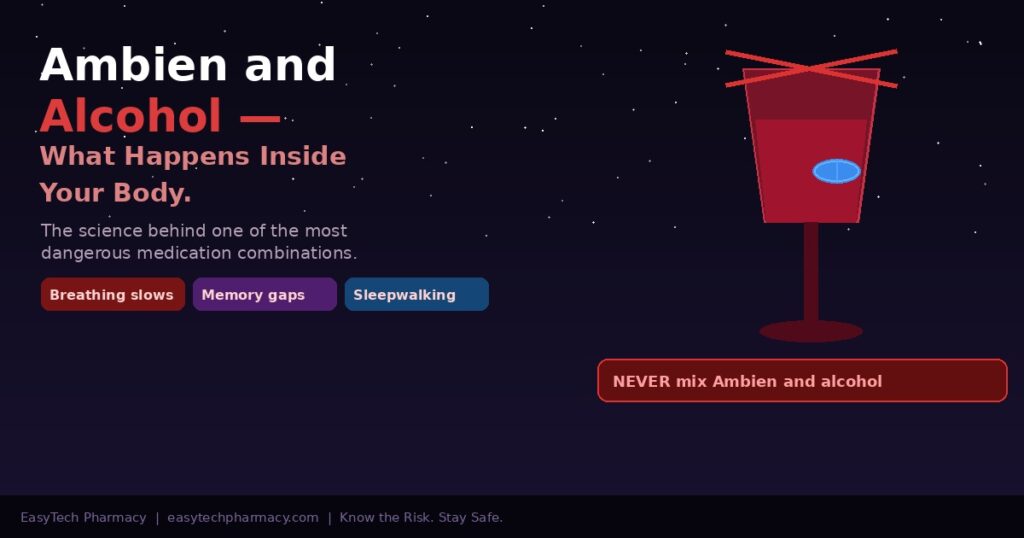
Most people understand that mixing medications and alcohol is generally a bad idea. But with Ambien specifically, the risk is not just a general caution — it is a documented, mechanistically understood interaction with consequences that go well beyond feeling more drowsy than expected.
And here is what makes it particularly relevant to so many people: the combination happens more often than anyone talks about. Not because people are reckless — but because the scenario plays out so naturally. A glass of wine at dinner. Ambien taken a few hours later. What could go wrong?
Quite a lot, actually. And understanding exactly what and why makes a genuine difference in the decisions you make on any given evening. This is not a repeat of the standard “do not mix medications and alcohol” warning. This is the actual science of what Ambien and alcohol do to each other inside your body — and why the stakes are higher than most people realize.
If you are also considering whether Ambien is the right sleep medication for your situation, our comparison of trazodone vs Ambien covers alternative options with lower risk profiles.
Two Depressants Entering the Same System
To understand why Ambien and alcohol are such a problematic combination, it helps to understand what each one does individually.
Ambien works by binding to GABA-A receptors in the brain — the receptors responsible for slowing neural activity. When zolpidem binds to these receptors it amplifies the brain’s natural braking signal dramatically, producing the sedation that allows sleep to happen.
Alcohol works through a remarkably similar pathway. It also enhances GABA activity — and simultaneously suppresses glutamate, the brain’s primary excitatory neurotransmitter. The combined effect is a general slowing of brain activity, which is why alcohol produces the familiar relaxing and disinhibiting effects most people know well.
When you take both together, you are hitting the same braking system with two separate inputs at the same time. The effects do not simply add up. They interact and amplify each other in ways that produce a level of central nervous system depression significantly greater than either substance would achieve alone. According to the FDA, this kind of drug-drug-alcohol interaction with sedative-hypnotics is one of the most commonly flagged medication safety concerns in the US.
What Actually Happens — The Five Real Risks
These are not theoretical concerns. They are documented, mechanistically understood consequences of combining zolpidem with alcohol.
Risk 1 — Respiratory Depression
The most serious risk — and the one that makes this combination potentially life-threatening rather than just uncomfortable. Both Ambien and alcohol independently suppress the brain’s respiratory drive — the automatic system that keeps you breathing during sleep. Together they can slow breathing to a degree that becomes dangerously inadequate, particularly during deep sleep when you are not consciously aware of your breathing rate.
This risk is significantly higher in people who already have any degree of sleep apnea — which affects an estimated 22 million Americans, many of them undiagnosed. For someone with even mild sleep apnea, the combination of Ambien and alcohol can turn normal sleep into a medical emergency. According to the Sleep Foundation, alcohol dramatically worsens sleep apnea symptoms by relaxing the throat muscles that keep the airway open — and Ambien adds additional respiratory suppression on top of that.
Risk 2 — Parasomnias Become Far More Likely
Ambien already carries a small but documented risk of parasomnias — complex behaviors performed during sleep with no conscious awareness and no memory afterward. Sleepwalking, sleep-eating, sleep-driving, and having full conversations are all documented. These occur in a minority of Ambien users at standard doses under normal circumstances.
Alcohol changes that equation dramatically. The combination of alcohol and zolpidem significantly increases both the frequency and severity of parasomnias. There are documented cases — including several that ended in legal proceedings — of people driving cars, cooking meals, and engaging in other complex activities while on the Ambien-alcohol combination, with zero memory of any of it afterward.
The mechanism is specific: alcohol disrupts the sleep architecture in ways that push the brain toward the particular stage transitions where parasomnias most commonly occur. Zolpidem amplifies the depth of sedation during these transitions. The result is a much higher likelihood of the brain entering the dissociated state where behaviors occur without conscious awareness.
Risk 3 — Anterograde Amnesia
Both Ambien and alcohol independently impair the formation of new memories. Zolpidem affects hippocampal consolidation — the process by which short-term experiences become stored memories. Alcohol does the same through different mechanisms.
Together, the memory-impairing effects compound substantially. People who combine Ambien and alcohol can have extensive interactions — phone conversations, text exchanges, getting up and moving around the house — with complete absence of memory the following morning. This is not the normal “I was so tired I do not remember much” kind of haziness. It is complete absence of any memory trace for periods that can last hours.
Risk 4 — Falls and Physical Injury
Ambien at therapeutic doses already impairs balance, coordination, and reaction time — particularly in the early hours after taking it. Alcohol produces identical impairments through its own mechanisms. Combined, the motor control deficits are substantially greater than either alone.
This is particularly significant because parasomnias — as described above — can result in people moving around their homes while under this combined influence. Getting up to use the bathroom, navigating stairs, or simply standing up from bed becomes meaningfully more dangerous when both substances are present. Fall injuries associated with the Ambien-alcohol combination are documented in emergency department data across the US.
Risk 5 — Next-Day Impairment Is Dramatically Worse
Even if nothing acute happens during the night, the morning after combining Ambien and alcohol is consistently associated with greater cognitive impairment than either substance alone. Reaction time, decision-making, and alertness are all affected — sometimes to a degree that makes driving genuinely unsafe even when you feel subjectively functional.
The FDA has specifically flagged next-morning driving impairment as a significant concern even with Ambien alone. Adding alcohol to the equation extends and deepens that impairment window considerably.
Why “Just One Drink Earlier in the Evening” Is Not as Safe as It Sounds
This is the question most people actually want answered. If you had a glass of wine at 7pm and take Ambien at 10pm — is that really a problem?
The honest answer is: it depends, and not always in predictable ways.
Alcohol metabolism varies significantly between individuals based on body weight, sex, age, liver health, and what you ate. A rough guideline is that the liver metabolizes approximately one standard drink per hour — but that is an average with wide individual variation. For many people, one glass of wine at 7pm does result in negligible blood alcohol levels by 10pm. For others — particularly women, older adults, and people with reduced liver function — meaningful alcohol levels can persist for several hours longer than expected.
Furthermore, even trace amounts of alcohol can meaningfully alter zolpidem’s pharmacokinetics — affecting how quickly it is absorbed and how strongly it binds to receptors. The interaction is not purely additive at the blood alcohol level. Some research suggests that even sub-intoxicating alcohol levels can amplify zolpidem’s sedative effects by 30 to 50% beyond what the dose alone would produce.
The safest approach is straightforward — do not drink alcohol on any day you plan to take Ambien. Not hours before. Not a glass with dinner. The timeline is simply too variable and the consequences too significant to navigate by guesswork.
The Irony — Alcohol Is Making Your Sleep Worse Anyway
Here is the part that often surprises people most. The reason many people have a drink before taking Ambien — or instead of Ambien — is that alcohol feels like it helps with sleep. And in a narrow sense it does. Alcohol reduces the time it takes to fall asleep.
However, what it does to the second half of your night is the opposite of helpful. As your body metabolizes the alcohol in the early morning hours, sleep becomes lighter, more fragmented, and REM-disrupted. You wake more easily. You feel less rested even after a full night in bed. The relaxing effect at the start of the night comes at the cost of the restorative sleep quality in the hours that follow.
This means the scenario where someone takes a drink to help them wind down and then takes Ambien when that is not enough — is a scenario where they are compounding both the risk of the combination and the sleep disruption that alcohol independently causes in the second half of the night. Both problems, not just one.
Safer Alternatives for Winding Down Before Bed
If alcohol has become part of your pre-sleep routine — deliberately or just by habit — replacing it with something that genuinely supports sleep rather than undermining it makes a real difference. These are approaches that work with sleep rather than against it:
- Magnesium glycinate (200mg to 400mg): Calms the nervous system through a completely different pathway than sedative medications. Non-habit-forming, widely available, and particularly helpful for people whose sleeplessness involves physical tension or rumination.
- Warm herbal tea: Chamomile, passionflower, and valerian root all have mild evidence for sleep support. The ritual itself — warm drink, dim light, winding down — is part of what makes it effective.
- A consistent wind-down routine: Your brain is extremely good at forming associations. A consistent 30-minute sequence of the same calming activities at the same time trains the nervous system to begin preparing for sleep automatically.
- Progressive muscle relaxation: A simple and well-researched technique for releasing the physical tension that keeps many people wired at bedtime — systematically tensing and releasing muscle groups from feet upward.
For a full breakdown of non-habit-forming sleep options that address the underlying need without the risks, our guide on sleeping pills that are not habit forming covers every option at every level.
What to Do If You Have Already Mixed Ambien and Alcohol
If you have already taken Ambien after drinking and are concerned, the most important immediate steps are:
- Stay in bed — do not get up, drive, or operate anything
- Have someone check on you if possible, particularly in the first few hours
- If you feel that your breathing is unusually slow, labored, or you feel extremely unwell — call 911 immediately. Do not wait to see if it passes.
- Do not take any additional medication to counteract the effects
For most healthy adults who have had a modest amount of alcohol and a standard dose of Ambien, the night will pass without acute crisis — but it is still not a risk worth taking knowingly. And the next morning, do not drive until you are certain the combined impairment has fully cleared.
Frequently Asked Questions
Can I have one drink and then take Ambien later?
The FDA’s guidance is clear — alcohol should be avoided entirely while taking Ambien, not just limited. The interaction risk exists at low alcohol levels and the timing variability in metabolism makes it genuinely difficult to know when it is safe. The practical recommendation is to choose one or the other on any given evening, not both.
What happens if you mix Ambien and alcohol accidentally?
Stay in bed immediately, do not drive or move around unnecessarily, and have someone aware of your situation if possible. Monitor your breathing. If you experience unusual difficulty breathing, extreme confusion, or feel very unwell — seek medical help immediately. For most otherwise healthy people the combination causes excessive sedation and amnesia rather than acute crisis, but it is not something to take lightly.
Does alcohol make Ambien work faster?
It can make the perceived onset faster — but not in a beneficial way. The amplification of sedation from the combination produces a deeper and less predictable effect than Ambien alone, with significantly higher risk of memory gaps, parasomnias, and respiratory concerns. Using alcohol to boost Ambien’s speed is genuinely dangerous, not just inadvisable.
How long after drinking is it safe to take Ambien?
There is no universally safe timeframe because alcohol metabolism varies so widely between individuals. The safest approach is to not drink at all on days when you plan to take Ambien. If you must have a drink, waiting a minimum of 4 to 6 hours and consuming only one standard drink gives your body more time to clear alcohol — but this is still not a guarantee of safety and is not officially recommended.
Is trazodone safer than Ambien when it comes to alcohol interaction?
Both trazodone and alcohol carry CNS depressant properties, so mixing trazodone with alcohol also carries risk and should be avoided. However, trazodone’s interaction with alcohol is generally considered less severe than zolpidem’s — partly because trazodone’s mechanism is broader and less targeted. Our full comparison of trazodone vs Ambien covers the full risk profile of both medications.
Bottom Line — The Combination Is Not Worth It
The risks of Ambien and alcohol together are specific, documented, and serious enough that the guidance is clear and unambiguous — avoid the combination entirely. Not because a single glass of wine is guaranteed to send you to the emergency room, but because the interaction is unpredictable, the consequences range from unpleasant to dangerous, and the potential upside of having both on the same evening is zero.
If you need help sleeping and you also drink socially — that is worth a direct conversation with your pharmacist about whether Ambien is the right tool for your situation, or whether an alternative with a different risk profile makes more sense. Our guide on buy Ambien online covers how to access sleep medication and have that conversation efficiently.
And if you are currently looking for local options near you, our Ambien near me guide covers pharmacy access across the US.
At EasyTech Pharmacy, our pharmacist team is available to answer questions about any medication we dispense — including interactions, timing, and whether your current setup is as safe as it can be.
Visit EasyTech Pharmacy — safe sleep medication with real pharmacist support.