Ambien Hallucinations — What Is Real, What Is Normal, and When to Pay Attention
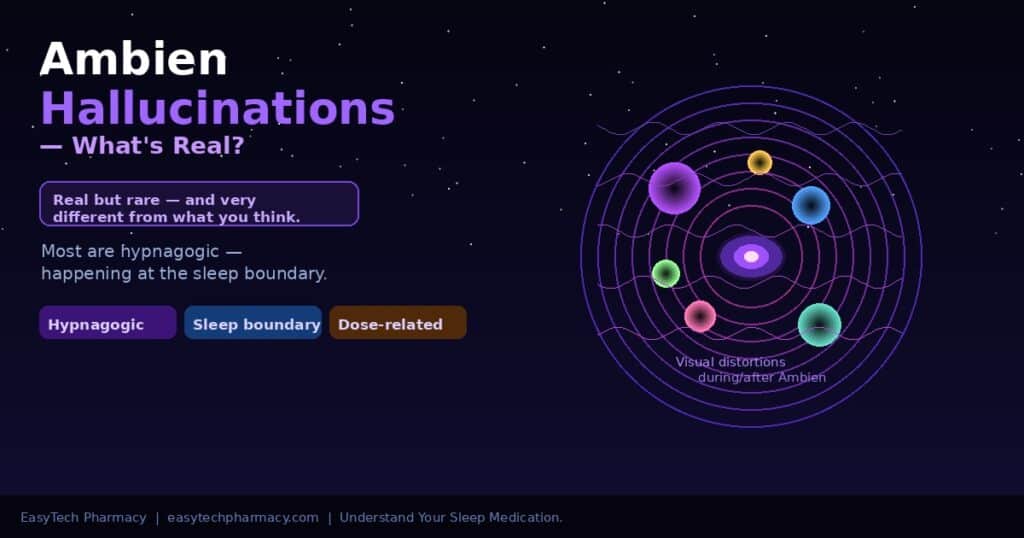
You take Ambien. You get into bed. And somewhere in that strange floating space between awake and asleep, you see something. Maybe shapes moving on the ceiling. Maybe a figure at the edge of the room. Maybe a conversation that feels completely real until you suddenly realize you are alone.
Then you wake up — or maybe you never fully fell asleep — and you wonder: was that real? Did Ambien cause that? Should you be worried?
These experiences are more common than most people realize. They have a specific name, a specific cause, and a specific set of conditions that make them more or less likely. This guide covers Ambien hallucinations completely — what they actually are, why they happen, who is more likely to experience them, and what to do if they occur.
Already weighing your medication options? Our comparison of trazodone vs Ambien covers alternatives with different side effect profiles.
What Are Ambien Hallucinations — The Honest Definition
Ambien hallucinations are perceptual experiences — seeing, hearing, or sensing things that are not actually present — that occur as a side effect of zolpidem use. They are a real and documented side effect. However, they are significantly more nuanced than the alarming term “hallucinations” might suggest.
Most Ambien-related hallucinations fall into one of two categories. Understanding which category applies to an experience is the most important step in evaluating whether it is a normal, manageable side effect or something that needs medical attention.
Category 1 — Hypnagogic Hallucinations (Most Common)
The vast majority of hallucinations associated with Ambien are hypnagogic — occurring at the boundary between wakefulness and sleep.
Hypnagogic hallucinations are actually a normal human experience. They happen to many people without any medication at all. The brain, in the process of transitioning from wakefulness to sleep, can produce vivid perceptual experiences — visual, auditory, or tactile — while some level of conscious awareness is still present.
What Ambien does is accelerate and deepen this transition. The brain moves through the sleep boundary faster and more intensely than it normally would. For some people this means the hypnagogic hallucination window — which would normally be brief and mild — becomes more vivid, more prolonged, or more memorable.
Common hypnagogic experiences on Ambien include:
- Seeing patterns, shapes, or figures moving on walls or ceilings
- Hearing voices, music, or sounds that fade on waking
- Feeling a physical presence in the room
- Brief conversations with people who are not there
- Seeing faces — sometimes recognizable, sometimes not
- Feeling like you are falling or floating
These experiences almost always occur in the first 30 to 60 minutes after taking Ambien — during the descent into sleep. They do not persist once full sleep is achieved. Many people have no memory of them at all. They are not a sign of psychosis. They are not a sign that something has gone medically wrong. They are an intensified version of a normal neurological process.
According to the Sleep Foundation, hypnagogic hallucinations are experienced by approximately 25% of adults at some point — with or without medication. Ambien increases the frequency and vividness for susceptible individuals.
Category 2 — Parasomnia-Related Hallucinations (Less Common, More Serious)
The second category is distinct from hypnagogic experiences. These are hallucinations that occur during full sleep — part of the complex behaviors sometimes called parasomnias.
In parasomnia episodes, a person may be apparently awake and active — having conversations, moving around, even leaving the home — while actually in a sleep state with no conscious awareness. During these episodes, the person may perceive their environment in distorted ways. They may see things that are not there. They may respond to hallucinated stimuli.
This type of experience is more concerning than hypnagogic hallucinations because it involves behavior during sleep that the person has no memory of and no control over. Sleep-driving — one of the most documented Ambien parasomnia cases — involves complex motor behavior performed while hallucinating a waking state.
Parasomnia-related hallucinations are significantly more likely when:
- Ambien is taken at higher doses than recommended
- Alcohol is consumed on the same day as Ambien
- Other CNS depressants are combined with Ambien
- The person has a history of sleepwalking before starting Ambien
- Sleep is interrupted or the person resists the drowsiness after taking the medication
Our guide on Ambien and alcohol covers why that specific combination so dramatically increases parasomnia and hallucination risk.
Why Does Ambien Specifically Trigger These Experiences
Understanding the mechanism helps contextualize why this happens and who is more at risk.
Ambien amplifies GABA-A receptor activity across the brain. This produces sedation. However, the brain does not simply switch off uniformly. Different regions lose activity at different rates. The visual cortex, auditory processing areas, and emotional centers can retain partial activity during the early stages of sedation — while the prefrontal cortex (responsible for reality-checking and logical assessment) is already significantly suppressed.
The result is a state where the brain can generate perceptual experiences — images, sounds, sensations — without the normal oversight system that would flag them as internally generated rather than real. This is the neurological basis for both hypnagogic hallucinations and some parasomnia experiences.
According to MedlinePlus, abnormal thinking and behavior changes — including hallucinations — are listed among the possible side effects of zolpidem. They are more likely at higher doses and in combination with other CNS-depressing substances.
Who Is More Likely to Experience Ambien Hallucinations
Hallucinations from Ambien do not occur equally across all users. Several factors meaningfully increase the likelihood.
Higher Doses
The 10mg dose produces more pronounced GABA amplification than the 5mg dose. The deeper the initial sedation, the more pronounced the hypnagogic transition and the higher the parasomnia risk. Starting at the lowest effective dose and only increasing under guidance is part of why dosing guidelines exist.
Staying Awake After Taking It
This is one of the most consistently reported risk factors. Taking Ambien and then resisting sleep — watching TV, talking, working — puts the brain in an unusual state. The sedation has begun but waking stimulation continues. This combination creates the exact conditions where the unmonitored perceptual experiences of early sedation are most likely to occur in strange or disturbing ways.
The guidance to go directly to bed immediately after taking Ambien is not arbitrary. It directly reduces hallucination risk by allowing the medication to produce uniform sedation rather than partial sedation while the person remains situationally active.
Alcohol Combination
Alcohol significantly amplifies GABA activity on its own. Combined with Ambien, the GABA amplification is multiplicative. The deeper, less regulated state of sedation this produces dramatically increases the likelihood of both hypnagogic and parasomnia-related hallucinations — as well as memory loss for whatever occurs.
Sleep Deprivation Before Taking Ambien
Paradoxically, taking Ambien when already severely sleep-deprived can increase hallucination risk. Extreme sleep deprivation itself can produce hypnagogic intrusions during waking — perceptual experiences bleeding from the sleep state into wakefulness. Ambien taken in this state can amplify rather than simply initiate the process.
Individual Sensitivity
Some people are simply more prone to vivid hypnagogic experiences than others. This sensitivity appears to be related to factors including genetics, baseline sleep architecture, and how rapidly their brains transition between sleep stages. People who already experience frequent vivid dreams or hypnagogic experiences without medication are more likely to have pronounced versions with Ambien.
Older Adults
Older adults process zolpidem more slowly. Higher peak blood concentrations persist for longer periods. This extended presence of the medication during lighter sleep stages increases the window during which hallucinations can occur.
Are Ambien Hallucinations Dangerous
The answer depends on which type is occurring.
Hypnagogic hallucinations — the most common type — are not inherently dangerous. They are unsettling when they occur. However, they are temporary, they resolve as full sleep arrives, and they leave no lasting effect. Many people who experience them never report them at all because they fade quickly and are filed away as vivid dreams.
Parasomnia-related hallucinations are a different matter. When someone is experiencing complex behaviors during sleep — moving through a house, leaving in a car — while perceiving a distorted or hallucinated version of their environment, the risk of physical injury is real. Sleep-driving is the most dramatic documented example. Falls, burns from cooking while asleep, and accidental self-harm during parasomnia episodes are all documented.
If hallucinations are occurring alongside complex behaviors — any evidence of getting up, moving around, interacting with objects, or leaving the home — this requires immediate attention. Stop taking Ambien and speak with your pharmacist about next steps. This is not a “wait and see” situation.
What to Do If You Experience Hallucinations on Ambien
The appropriate response depends on what type of hallucination is occurring and how significant it is.
For Mild Hypnagogic Experiences
- Make sure you are going directly to bed after taking Ambien — do not stay up
- Ensure the room is dark and quiet — sensory input during the transition amplifies the experience
- Do not take Ambien with any alcohol or other sedating substances
- Ask your pharmacist whether your current dose is appropriate or whether stepping down to 5mg would reduce the experiences
- Consider whether a non-GABA sleep alternative might suit you better — our guide on sleeping pills that are not habit forming covers options like trazodone and ramelteon that do not produce the same hypnagogic amplification
For More Concerning Experiences
- If you or your household notice evidence of complex nighttime activity you have no memory of — do not take another dose until you have spoken with your pharmacist
- Have a household member aware that they should check on you if they hear movement during the night
- Remove car keys from easy access if sleep-driving is a concern
- Discuss switching to a non-GABA sleep medication or to a lower dose formulation
Ambien CR vs Regular Ambien — Does the Form Make a Difference
There is some evidence that Ambien CR — the extended-release version — may produce slightly higher rates of hallucination and parasomnia than the immediate-release version for some people. The slower sustained release keeps zolpidem blood levels higher for longer into the night. This extended presence during lighter sleep stages — including early morning REM — can produce more hallucination risk in susceptible individuals.
This is worth discussing with a pharmacist if you are on Ambien CR and experiencing vivid perceptual experiences. Switching to immediate-release at an appropriate dose may reduce the experience frequency while maintaining adequate sleep support.
Frequently Asked Questions
Are Ambien hallucinations common?
Mild hypnagogic hallucinations at the sleep boundary are relatively common — experienced by a notable minority of Ambien users, more frequently at higher doses and when the medication is not taken appropriately (i.e., staying awake after taking it). More concerning parasomnia-type hallucinations are less common but more significant when they occur.
How long do Ambien hallucinations last?
Hypnagogic hallucinations typically last minutes — fading as full sleep is achieved. Parasomnia episodes can last longer. Most people have no memory of either type the following morning. The duration and memorability varies significantly between individuals.
Can I prevent hallucinations from Ambien?
Yes — several steps meaningfully reduce the risk. Take the lowest effective dose. Go directly to bed immediately after taking it. Never combine with alcohol. Keep the room dark and stimulus-free. Discuss dose reduction with your pharmacist if you are currently on 10mg and experiencing these effects.
Should I stop taking Ambien if I have hallucinations?
For mild hypnagogic experiences — not necessarily. Adjust your dose and timing first. For complex behaviors during sleep or frightening persistent experiences — stop the medication and contact your pharmacist. Do not restart without guidance on whether a dose change or medication switch is more appropriate.
Do Ambien hallucinations go away after stopping the medication?
Yes. Ambien hallucinations are caused by the medication’s effect on GABA receptors during sleep transitions. Once the medication is stopped and cleared from your system, the experiences stop. They are not a sign of a persistent neurological condition.
Is trazodone a safer alternative for people who experience Ambien hallucinations?
For many people — yes. Trazodone works through serotonin and histamine pathways rather than GABA amplification. It does not produce the same sleep boundary disruption that causes hypnagogic hallucinations. Additionally, it does not carry the parasomnia risk associated with Z-drugs. Our full comparison of trazodone vs Ambien covers whether it is the right switch for your situation.
Bottom Line — Real, Understandable, and Manageable
Ambien hallucinations are a real side effect. They are not a sign of mental illness. They are not random. They are a predictable consequence of GABA amplification affecting the brain’s perceptual systems during the sleep transition — and in some cases during sleep itself when parasomnias are triggered.
Mild hypnagogic experiences are manageable through dose adjustment and proper use timing. More significant parasomnia-type hallucinations require immediate attention and a medication review. In both cases, understanding what is happening removes a significant amount of the fear that comes with experiencing them.
At EasyTech Pharmacy, we carry both generic zolpidem and alternatives like generic trazodone with transparent pricing. Our pharmacist team is available to help you assess whether your current medication and dose are appropriate — or whether a switch makes more sense for your specific experience.
Looking for local options near you? Our Ambien near me guide covers pharmacy access across the US. And for the full picture on how to access Ambien safely, our guide on buy Ambien online covers everything from start to finish.