The Best Over-the-Counter Sleep Aid Compared to Ambien
Standing in the sleep-aid aisle, every box seems to promise the same thing. They don’t deliver it the same way. We’ve compared Ambien directly against each major over-the-counter option individually. This post pulls those comparisons together into one place, so you can see how they actually stack up against each other, not just against Ambien alone.
The Four Real Contenders
Four ingredients make up nearly every OTC sleep product on the shelf: diphenhydramine, doxylamine, melatonin, and valerian root. Each works through a different mechanism, and each has a different real relationship to how Ambien performs.
Diphenhydramine (Benadryl, ZzzQuil): Fast Tolerance, Real Anticholinergic Risk
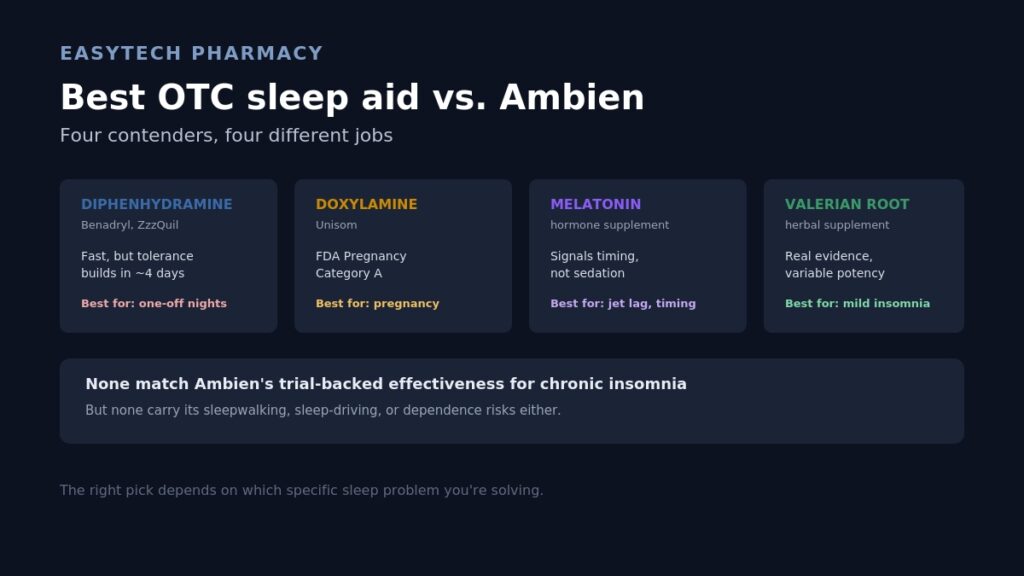
This is the most common OTC sleep aid by far, mostly because it’s marketed heavily under “PM” branding. It’s also the one with the most surprising drawback: tolerance to its sedative effect can become complete within four days of regular use. It also carries real anticholinergic risk, a concern that compounds with age. Our full comparison in Ambien vs. Benadryl covers the clinical data behind this in depth.
Doxylamine (Unisom): The Pregnancy Exception
Chemically related to diphenhydramine but distinct enough to carry its own profile, doxylamine’s standout feature isn’t its sleep effectiveness. It’s its FDA Pregnancy Category A rating, making it a genuinely different choice for anyone pregnant or trying to conceive, a scenario where Ambien carries real documented concerns instead. Our guide on Ambien vs. Unisom covers this distinction, along with the dosing and mechanism differences, in full.
Melatonin: Different Job Entirely
Melatonin doesn’t compete with Ambien so much as solve a different problem. It signals timing to your circadian system rather than chemically forcing sedation, which is why it tends to help circadian issues like jet lag far more than it helps straightforward sleep-onset insomnia. Our guide on Ambien vs. melatonin covers the mechanism gap and the surprising fact that most commercial doses run far higher than what research actually supports.
Valerian Root: Real Evidence, Real Regulatory Gap
Valerian has genuine clinical support for reducing time to fall asleep, more than casual “herbal remedy” framing suggests. But as a supplement, it isn’t held to the same manufacturing consistency or premarket effectiveness standards as a regulated drug, so potency can vary between brands and batches. Our guide on Ambien vs. valerian root covers this regulatory gap and what the research actually shows.
Side-by-Side: All Four at a Glance
- Fastest, most predictable onset: None of the four match Ambien’s speed and consistency, but melatonin and diphenhydramine tend to act fastest among OTC options.
- Best for occasional, mild disruption: Diphenhydramine or doxylamine, used briefly rather than nightly.
- Best for circadian or timing issues specifically: Melatonin, and only melatonin, since it’s solving a genuinely different problem.
- Best evidence base among true OTC options: Valerian root has real, if thinner, clinical support for the specific goal of falling asleep faster.
- Best choice during pregnancy: Doxylamine, given its Category A rating and common use in pregnancy-related products.
- Lowest dependence and misuse concern overall: Melatonin and valerian root, neither of which carries controlled-substance status.
What None of Them Do as Well as Ambien
None of these four options match Ambien’s demonstrated effectiveness for genuine, persistent insomnia. Zolpidem earned FDA approval specifically because clinical trials showed it reduces time to sleep onset, reduces nighttime awakenings, and increases total sleep time, a bar none of the four OTC options have been held to in the same way. This isn’t a knock on any of them individually. It’s a reflection of what each was actually designed and tested to do.
What Ambien Doesn’t Do as Well as Some of Them
Ambien carries meaningfully more serious risk in a few specific areas: complex sleep behaviors, covered in our guide on Ambien’s black box warning, dependence potential, and pregnancy-specific concerns. None of the four OTC options carry the sleepwalking or sleep-driving risk associated with Ambien, and several offer a meaningfully lower dependence profile.
How to Actually Decide
- Occasional bad night, otherwise sleeping fine? Start with an OTC option before considering anything stronger.
- Pregnant or planning to be? Doxylamine’s safety data specifically favors it in this scenario.
- Struggling with jet lag or shift work, not general insomnia? Melatonin fits this specific problem better than any of the others, including Ambien.
- Persistent, chronic insomnia that OTC options haven’t touched? This is the scenario where Ambien’s clinical trial data and targeted mechanism become genuinely relevant to discuss.
The Bottom Line
There’s no single “best” OTC sleep aid compared to Ambien, because the four real contenders aren’t interchangeable with each other, let alone with Ambien itself. Diphenhydramine works fast but loses effectiveness within days. Doxylamine shares that mechanism but carries a real pregnancy advantage. Melatonin solves a timing problem, not a sedation problem. Valerian root has genuine evidence behind it, wrapped in a looser regulatory framework. Ambien outperforms all four for genuine chronic insomnia, but carries risks none of them share. The right pick depends entirely on which specific problem you’re solving.
For a broader overview of prescription and non-prescription options together, see our guide on Ambien alternatives.
Frequently asked questions
What’s the closest OTC option to how Ambien works?
None work identically, but diphenhydramine and doxylamine cause drowsiness most directly, even though their mechanism, blocking histamine, is completely different from Ambien’s targeted GABA receptor action.
Which OTC sleep aid is best during pregnancy?
Doxylamine (Unisom) carries an FDA Pregnancy Category A rating and is commonly recommended by obstetricians, making it the clearest choice among the four in this specific scenario.
Is melatonin a good substitute for Ambien?
It depends on the problem. Melatonin fits circadian and timing-related sleep issues well but isn’t built to replace Ambien for straightforward, chronic sleep-onset insomnia.
Does any OTC sleep aid match Ambien’s effectiveness for chronic insomnia?
Not based on current evidence. All four OTC options have weaker or more limited clinical support for genuine, persistent insomnia compared to Ambien’s FDA-approved trial data.
Not sure which option actually fits your sleep pattern? Talk to your pharmacist. EasyTech Pharmacy can help you think it through.
For local pharmacy access near you, our Ambien near me guide covers pharmacies across the world.
Visit EasyTech Pharmacy — sleep medication with real pharmacist guidance.