Prescription Sleep Aids Compared: Ambien vs. Lunesta vs. Sonata
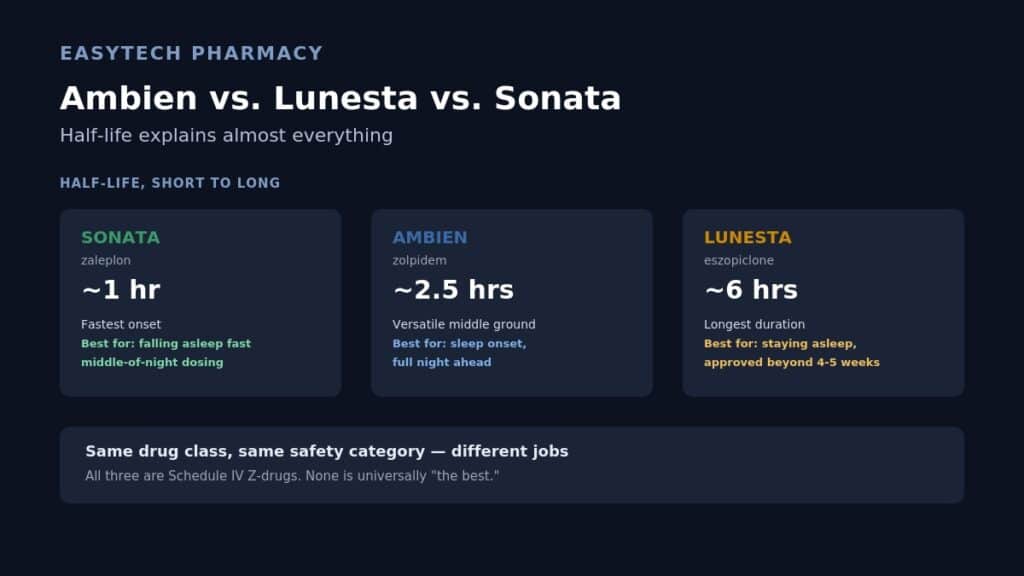
These three medications get grouped together constantly, and for good reason: they’re all “Z-drugs,” a class built specifically to replace older benzodiazepine sleep aids with something more targeted. But lumping them together obscures a genuinely useful fact. Each one is built around a different half-life, and that single number does more to explain which one fits your situation than almost anything else.
The Same Family, Three Different Personalities
Ambien (zolpidem), Lunesta (eszopiclone), and Sonata (zaleplon) are all non-benzodiazepine sedative-hypnotics, developed specifically to offer fewer side effects and lower dependence potential than traditional benzodiazepines. All three act on GABA receptors to produce a calming, hypnotic effect. Beyond that shared foundation, they diverge sharply.
Half-Life: The Number That Explains Everything Else
- Sonata (zaleplon): roughly 1 hour, the shortest of the three by a wide margin
- Ambien (zolpidem): roughly 2.5 hours for immediate-release
- Lunesta (eszopiclone): roughly 6 hours, the longest of the three
This single number predicts almost everything about how each drug behaves. Sonata clears fast enough that some people can take it in the middle of the night and still function that morning, provided enough hours remain before they need to be up. Ambien sits in the middle. Lunesta lasts long enough to help with staying asleep but carries the highest risk of lingering next-morning effects among the three.
What Each One Is Actually Best At
Research backs up a clear pattern here. Zaleplon shows better performance than zolpidem specifically for sleep latency, meaning how fast you actually fall asleep, while zolpidem outperforms zaleplon for sleep duration and overall sleep quality. The American Academy of Sleep Medicine specifically recommends zaleplon as a treatment option for sleep-onset insomnia, the kind where falling asleep is the whole problem and staying asleep isn’t.
Lunesta occupies the opposite end. Clinical trials have shown it improves sleep maintenance meaningfully, including in older adults, and it’s the only one of the three with real trial data supporting use beyond four to five weeks. Our full comparison in eszopiclone vs. zolpidem covers this specific pairing in depth.
Dosing Across All Three
- Ambien: 5 mg for women, 10 mg for men, immediate-release
- Lunesta: starting at 1 mg, up to 2 or 3 mg if needed, with the lowest effective dose generally recommended
- Sonata: available in 5 mg and 10 mg capsules
None of these numbers translate directly across drugs, since each one works at a different potency for its own receptor binding profile.
Next-Day Effects: Where the Half-Life Gap Really Shows Up
All three carry a documented risk of next-day drowsiness, and experts recommend a full 7 to 8 hours of sleep before driving or engaging in other alertness-dependent activities regardless of which one you take. But the risk isn’t distributed equally. Zaleplon’s short half-life generally means the lowest next-morning impairment risk of the three, provided it’s taken with enough time left before waking. Lunesta’s longer half-life means a comparatively higher chance of lingering effects the next day, a concern related to what we’ve covered in our guide on Ambien and next-day driving impairment.
Safety Profile: Genuinely Similar Across the Board
All three fall under Schedule IV controlled substances with real dependence and misuse potential, and all three carry warnings around complex sleep behaviors. However, researchers have most extensively documented and studied this risk specifically for zolpidem—a topic our guide on Ambien’s black box warning covers in detail. Anyone with a history of complex sleep behaviors on similar medications, untreated sleep apnea, significant breathing disorders, or severe liver disease must avoid all three drugs.
Side-by-Side: Which One Fits Which Pattern
- Trouble falling asleep, wake up needing to function within a few hours? Sonata’s ultra-short half-life is specifically built for this scenario.
- Straightforward difficulty falling asleep, full night ahead? Ambien’s moderate half-life and strong sleep-onset data fit this pattern well.
- Waking frequently through the night, or older adult needing sustained coverage? Lunesta’s longer duration and trial data supporting extended use make it the strongest fit among the three.
- Most concerned about minimizing next-day impairment? Sonata generally carries the lowest risk here, assuming enough sleep time remains after dosing.
The Bottom Line
Ambien, Lunesta, and Sonata share a drug class and a general mechanism, but they’re not interchangeable. Half-life is the single most useful number for understanding the practical differences: Sonata’s ultra-short duration suits sleep onset and middle-of-the-night dosing, Ambien sits in a versatile middle ground, and Lunesta’s longer duration suits sleep maintenance at the cost of higher next-day impairment risk. None is universally “the best.” Each is built around a different part of the insomnia problem.
For a full three-way clinical breakdown, see GoodRx’s comparison of Lunesta, Ambien, and Sonata.
Frequently asked questions
Which is fastest-acting: Ambien, Lunesta, or Sonata?
Sonata (zaleplon) generally shows the fastest sleep onset among the three, with research indicating better sleep-latency performance than zolpidem specifically.
Which lasts the longest: Ambien, Lunesta, or Sonata?
Lunesta (eszopiclone) has the longest half-life of the three, around 6 hours, making it the most suited for sleep maintenance through the night.
Can you take Sonata in the middle of the night?
Its ultra-short half-life allows patients to use it this way, provided enough hours remain before they need to be fully alert. However, you should plan this approach with a doctor rather than trying it casually.
Are all three equally likely to cause dependence?
All three fall under Schedule IV controlled substances with real dependence potential; pharmaceutical companies specifically developed them to carry less dependence potential than benzodiazepines, though none of them is risk-free.
Related reading
- Best Over-the-Counter Sleep Aid Compared to Ambien
- Ambien CR vs. Lunesta: two long-acting options compared
- Ambien and next-day driving impairment: risks and legal exposure
- Ambien complex sleep behaviors: sleepwalking, sleep-driving, and the black box warning
Not sure which Z-drug actually fits your sleep pattern? Talk to your pharmacist or prescriber. EasyTech Pharmacy can help you think it through.
For local pharmacy access near you, our Ambien near me guide covers pharmacies across the world.
Visit EasyTech Pharmacy — sleep medication with real pharmacist guidance.