Sonata vs Ambien — Which Z-Drug Is Actually Right for Your Sleep Pattern
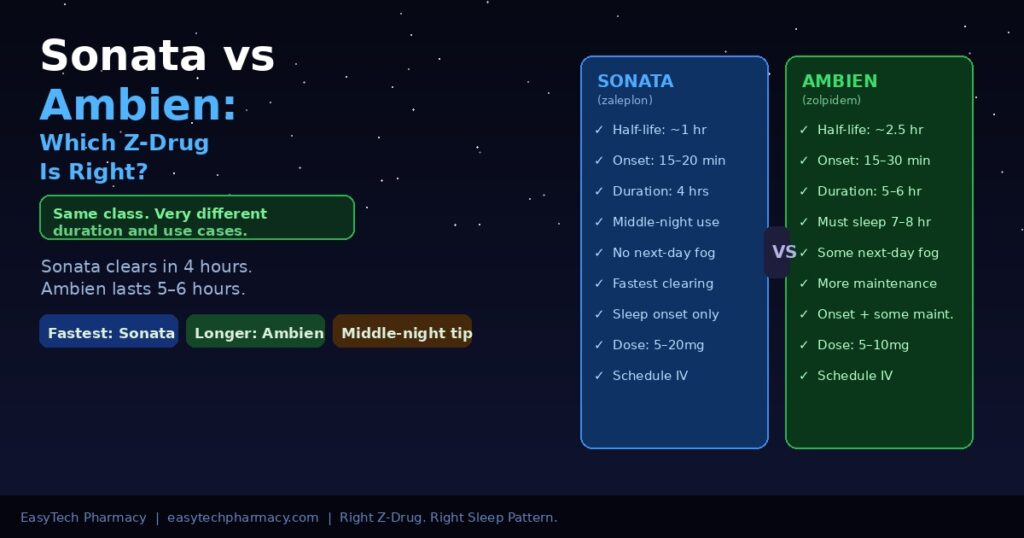
Both are Z-drugs Both hit the same GABA receptors in the same way to produce the same basic effect — sedation and sleep onset. So why does it matter which one you take?
It matters because the single most important difference between Sonata and Ambien — how long each one lasts — completely changes which sleep problem each medication is appropriate for. Getting this wrong means either running out of medication coverage before your sleep is done, or carrying so much residual drug in your system the next morning that you are impaired while thinking you are fine.
This is the clear, complete breakdown of Sonata vs Ambien — what makes them different, what makes each one better for specific situations, and how to decide which one actually fits your sleep pattern.
For the bigger picture on how these fit into the full range of sleep medication options,How Can I Sleep Quickly? compares every option across all classes.
What They Share — The Common Ground
Sonata (zaleplon) and Ambien (zolpidem) belong to the same drug class — Z-drugs, also called sedative-hypnotics — and work through essentially the same mechanism both amplify GABA-A receptor activity in the brain, producing the central nervous system suppression that allows sleep onset to occur.
Both carry the same general safety considerations — no alcohol combination, next-morning awareness before driving, pregnancy caution. Both are widely available as generics at significantly lower cost than their brand-name versions.
The active ingredients are different chemicals — zaleplon vs zolpidem — but their mechanism of action is so similar that the distinction is largely academic for most patients. What is not academic is their half-life. And that is where everything diverges.
According to the FDA, approximately 70 million Americans experience sleep difficulties — and the majority of cases involve sleep problems that respond to non-prescription interventions before pharmaceutical sleep aids become necessary.
The Core Difference — Half-Life and What It Changes
Sonata (Zaleplon) — Half-Life of Approximately 1 Hour
Zaleplon has the shortest half-life of any prescription sleep medication available in the US. Approximately 1 hour. This is not a limitation — it is the entire point of the medication’s design.
With a 1-hour half-life, zaleplon clears from the system fast enough that most of its effects are gone within 3 to 4 hours of taking it. This produces two clinically useful properties that no other prescription sleep medication can match:
- It can be taken in the middle of the night — if you wake at 2am or 3am with at least 4 hours remaining before you need to get up, you can take Sonata and go back to sleep without significant next-morning impairment
- It produces virtually no next-morning impairment when taken at a normal bedtime of 10pm to 11pm — the medication has largely cleared by morning regardless of when you wake
Ambien (Zolpidem) — Half-Life of Approximately 2.5 Hours
Zolpidem’s longer half-life produces therapeutic sleep coverage of 5 to 6 hours for immediate-release and 7 to 8 hours for the extended-release CR version. This is appropriate for sleep onset insomnia where the person needs sedation support for a meaningful portion of the night.
However, it also means meaningful residual blood levels are still present at the 6 to 7 hour mark. The FDA’s next-morning driving warnings are specifically connected to this residual — the reason women are recommended to start at 5mg is precisely because their slower metabolism extends this residual further. Our detailed guide on how long does Ambien take to work covers the full timeline.
Side-by-Side Comparison — Every Key Difference
| Feature | Sonata (Zaleplon) | Ambien (Zolpidem IR) | Ambien CR (Zolpidem ER) |
|---|---|---|---|
| Half-life | ~1 hour | ~2.5 hours | ~2.8 hours |
| Onset time | 15–20 minutes | 15–30 minutes | 15–30 minutes |
| Effective sleep coverage | 3–4 hours | 5–6 hours | 7–8 hours |
| Minimum hours needed before waking | 4 hours | 7–8 hours | 7–8 hours |
| Can take middle of night? | Yes — if 4+ hrs remain | No | No |
| Next-morning impairment | Minimal | Moderate | Moderate to higher |
| Available doses | 5mg, 10mg, 20mg | 5mg, 10mg | 6.25mg, 12.5mg |
| Generic available? | Yes | Yes | Yes |
| 30-day generic cost (GoodRx) | $18–$35 | $8–$15 | $14–$28 |
| Best for | Sleep onset, middle-night waking | Sleep onset | Onset + maintenance |
| Schedule | IV | IV | IV |
Which Sleep Problem Does Each One Fit
Sonata Is the Right Choice If
- Your main problem is falling asleep but once asleep you stay asleep
- You work early mornings and cannot afford next-morning sedation
- You take medication only occasionally and want the fastest clearance
- You wake in the middle of the night and want to be able to take something even at 2am or 3am
- You have previously found Ambien’s next-morning effects problematic
- You drive early and need to know the medication has cleared
Ambien Is the Right Choice If
- You need 5 to 6 hours of uninterrupted sleep support — not just onset
- You have difficulty falling asleep and staying asleep together (use CR for this)
- You prefer the widest generic availability and lowest cost option
- Your sleep window is consistent at 7 to 8 hours
- Previous trials with shorter-acting options have not provided adequate coverage
For people specifically struggling with waking in the middle of the night, our guide on the best sleeping pills for people who wake up at night covers the middle-of-night waking pattern in detail — including exactly when Sonata’s middle-night dosing option becomes relevant.
The Middle-of-Night Option — Sonata’s Unique Advantage
This is Sonata’s most clinically distinctive feature and one that most people are not aware of when they first hear about it.
Standard Ambien cannot be taken in the middle of the night. If you wake at 2am after taking Ambien at bedtime, you should not take another dose — there is not enough time before you need to wake for it to clear safely. The same applies to Ambien CR.
Sonata’s 1-hour half-life changes this entirely. Because it clears the system within 3 to 4 hours of a dose, it can safely be taken as late as 3am or 4am as long as you have at least 4 hours remaining before you need to function. This is specifically mentioned in the FDA’s approval language for zaleplon — it is one of the few sleep medications with explicit guidance allowing middle-of-night dosing.
This makes Sonata particularly useful for a specific pattern: people who fall asleep reasonably well at bedtime but wake consistently at 1am to 3am and cannot get back to sleep. Rather than lying awake for 2 to 3 hours in the middle of the night, a Sonata dose at the time of waking returns them to sleep and clears before morning.
For people whose pattern this matches, it is genuinely a different solution to a different problem than what Ambien addresses. For more on how long various formulations last, our guide on how long does Ambien make you sleep covers the coverage windows of every formulation in detail.
Dose Comparison — The Numbers That Matter
Sonata has a wider dose range than Ambien. Available in 5mg, 10mg, and 20mg — versus Ambien’s 5mg and 10mg for immediate-release. The standard starting dose for most adults is 10mg. Women and older adults typically start at 5mg.
The 20mg Sonata dose exists specifically for patients who find 10mg inadequate. However, at 20mg the next-morning impairment risk increases significantly — the larger dose takes longer to clear even given zaleplon’s short half-life. Starting at 5mg or 10mg and using the lowest effective dose is the consistent recommendation for both medications.
For the complete dosing guidance across all Z-drugs including age and sex-specific recommendations, our guide on Ambien dosage covers the FDA framework in full — the same principles apply to Sonata dosing.
Cost — Is Sonata More Expensive Than Ambien
Yes — generic zaleplon is somewhat more expensive than generic zolpidem, primarily because zolpidem is produced in higher volume with more generic manufacturers competing on price.
Typical pricing with a GoodRx coupon in 2025:
- Generic zaleplon (Sonata) 10mg, 30ct: $18 to $35
- Generic zolpidem (Ambien) 10mg, 30ct: $8 to $15
The cost difference — approximately $10 to $20 per month — is modest enough that if Sonata’s shorter duration is genuinely what you need, the price premium is not a meaningful barrier. Choosing the wrong medication based on price is more costly in terms of outcomes than paying slightly more for the appropriate one.
For anyone managing the cost side of sleep medication, our guide on Ambien over the counter alternatives covers whether a supplement-based approach might be appropriate before moving to prescription options.
Side Effects — Does Sonata Have Fewer
Because zaleplon clears significantly faster than zolpidem, it produces fewer next-morning side effects in most patients — particularly next-morning driving impairment and residual grogginess. This is its most practically significant advantage over Ambien for many users.
However, the acute side effect profile during the active window is similar. Both can produce dizziness, memory effects during the window of activity, and in higher doses parasomnias. The faster clearance of zaleplon means these effects have a shorter window — but they exist at comparable rates to zolpidem during that window.
Both medications carry the same alcohol interaction warning. Combining either with alcohol amplifies CNS depression in dangerous and unpredictable ways. Our guide on Ambien and alcohol covers this interaction fully — the same warnings apply identically to Sonata.
How to Access Either Medication
Both Sonata and Ambien require a valid authorization from a licensed healthcare provider. The process is identical for both — telehealth consultation, electronic authorization, online or local pharmacy fulfillment.
Generic zaleplon is available at most major US pharmacies. Stock availability is slightly less consistent than generic zolpidem given the lower overall volume — calling ahead to confirm your specific dose is in stock before making a trip is a useful precaution.
For home delivery, both are available through online pharmacies. Our guide on buy Ambien online covers the full online pharmacy process — the same steps apply to ordering generic zaleplon. And for finding local availability, our Ambien near me guide covers pharmacies near you across the US.
For refill management and auto-refill setup — covered in detail for zolpidem in our guide on can Ambien be refilled online — zaleplon follows identical processes at most online pharmacies.
Frequently Asked Questions
Is Sonata stronger than Ambien?
Not stronger — faster and shorter. Sonata’s onset is slightly faster (15 to 20 minutes vs 15 to 30 minutes for Ambien) and it clears significantly faster (4 hours vs 5 to 6 hours). Its peak sedative effect is comparable to Ambien at similar doses — but the duration is substantially shorter. For most people “stronger” is not the relevant variable — duration is.
Can I take Sonata if I wake up in the middle of the night?
Yes — this is one of Sonata’s defining advantages over Ambien. If you wake during the night and have at least 4 hours remaining before you need to get up, Sonata can be taken at that point. It will clear sufficiently in 3 to 4 hours to allow normal morning function. This middle-of-night dosing option is explicitly recognized in zaleplon’s FDA labeling. Ambien cannot be used this way.
Which is safer — Sonata or Ambien?
Both are Schedule IV medications with similar safety profiles during their active window. Sonata’s faster clearance makes it meaningfully safer from a next-morning driving impairment standpoint — blood levels are lower at the 6 to 8 hour mark after a Sonata dose than after an equivalent Ambien dose. For people who drive early or need full morning cognitive function, Sonata’s safety advantage is real and clinically meaningful.
Why would someone choose Ambien over Sonata?
Longer sleep coverage. Someone who needs 5 to 6 hours of sedation support — not just help falling asleep — benefits from Ambien’s longer active window. Ambien is also more widely available generically and typically costs less. For straightforward sleep onset insomnia with a 7 to 8 hour sleep window, Ambien is the more commonly chosen option precisely because its duration covers more of the night.
Can you take both Sonata and Ambien?
No — combining two Z-drugs or taking one after the other on the same night significantly increases CNS depression and overdose risk. This combination is not medically recommended. The clinical scenarios where middle-of-night dosing is appropriate use Sonata alone — taken at bedtime or at the time of waking, not both.
Bottom Line — Duration Decides Everything
The choice between Sonata vs Ambien comes down almost entirely to how long you need sleep support. Sonata clears fast — ideal for pure sleep onset, middle-of-night waking, or anyone who needs no next-morning residue. Ambien lasts longer — ideal for sleep onset with some maintenance coverage and a consistent 7 to 8 hour sleep window.
Neither is universally superior. They solve different versions of the same problem. Matching the right one to your sleep pattern produces better outcomes than simply defaulting to the more commonly prescribed option.
At EasyTech Pharmacy, we carry both generic zaleplon and generic zolpidem in all standard dosages — with transparent pricing, fast delivery, and pharmacist support to help identify which option fits your specific situation best.
Visit EasyTech Pharmacy — the right Z-drug for your sleep pattern, at the right price.