Ambien vs. Klonopin: A Narrow Tool Against a Broad One
People search “Ambien vs. Klonopin” expecting a fairly simple sleep-medication comparison, similar to Ambien vs. Xanax. The actual answer is more interesting than that. Klonopin isn’t primarily a sleep drug at all. The receptor-level reason why explains a lot about how these two medications actually behave in practice.
What Each One Is Actually Built For
The FDA approved Ambien, zolpidem, specifically for short-term insomnia. That’s its entire job.
Klonopin, clonazepam, is a benzodiazepine. The FDA approved it for panic disorder, certain seizure disorders including Lennox-Gastaut syndrome, and short-term anxiety relief. Sleep isn’t on that list. Any use for insomnia is off-label. Prescribers sometimes use it this way for people whose sleep trouble is tangled up with anxiety or a seizure condition, not as a primary insomnia treatment.
The Receptor Science That Explains Everything Else
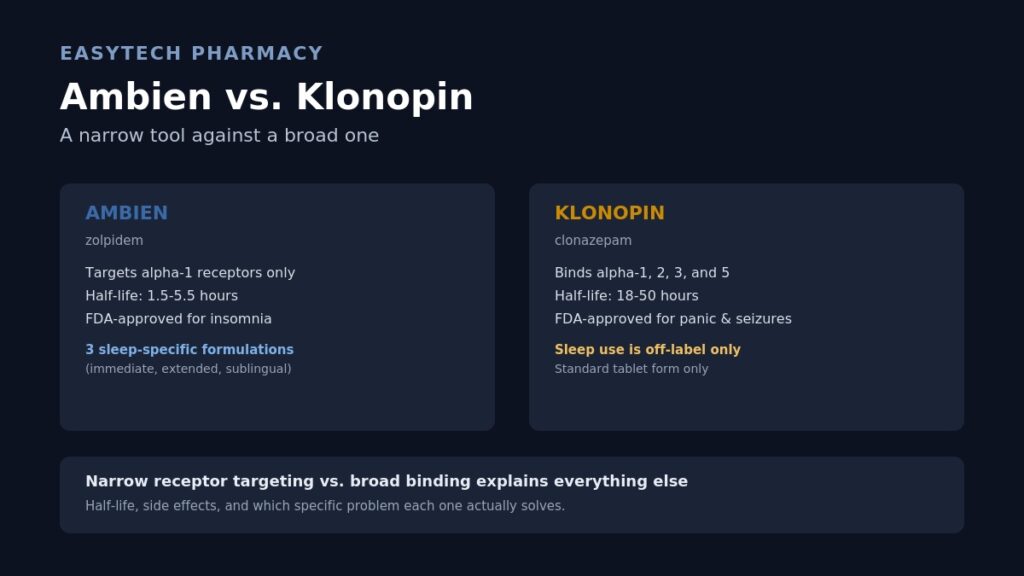
This is genuinely the most useful thing to understand about this comparison. Both drugs act on GABA-A receptors, but with very different precision. Zolpidem selectively targets receptors containing the alpha-1 subunit, the specific receptor type most responsible for sedation. Clonazepam binds much more broadly, across alpha-1, alpha-2, alpha-3, and alpha-5 subunits. That broader reach is exactly why it produces anti-anxiety, anti-seizure, and sedative effects all at once.
Think of it as a narrow tool versus a broad one. Ambien’s narrow targeting produces a more specific hypnotic effect with comparatively fewer side effects than a traditional benzodiazepine. Klonopin’s broad targeting lets it treat several different conditions, but it also carries a wider range of effects on the body overall.
Half-Life: A Genuinely Large Gap
Zolpidem’s half-life sits in a short-to-intermediate range, roughly 1.5 to 5.5 hours depending on the source and formulation. Clonazepam’s half-life is dramatically longer, generally cited in the range of 18 to 50 hours. That gap has real practical consequences. Ambien acts and clears relatively quickly, minimizing residual next-day sedation for straightforward sleep-onset problems. Klonopin stays active in the system far longer. That makes it useful for sustained anxiety or seizure control throughout the day, but it also raises the risk of daytime sedation and impairment if used for sleep.
Formulation Options: Ambien Has More Sleep-Specific Tools
Manufacturers built Ambien specifically for insomnia, so it comes in several targeted formulations: immediate-release for sleep onset, extended-release (Ambien CR) for sleep maintenance, and a low-dose sublingual form for middle-of-the-night awakenings. Klonopin comes only as a standard oral tablet, with no specialized formulation aimed at any particular sleep pattern. That tracks, since it wasn’t designed around sleep in the first place.our guide on Ambien vs Ambien CR.
Side Effects: Overlapping, but Genuinely Different in Character
Both drugs share some side effects: drowsiness, dizziness, confusion, and balance problems. Beyond that overlap, the differences reflect each drug’s broader or narrower action:
- Klonopin-specific effects include loss of orientation, reduced inhibition, fatigue, changes in sexual desire, and irritability, a wider net consistent with its broader receptor binding.
- Ambien-specific effects include a distinct “drugged” feeling, dry mouth, and less commonly, euphoria or vision changes.our guide on Ambien Side Effects
- Clonazepam causes sedation in roughly half of patients and dizziness in about a third, figures that reflect its broader systemic action.
Dependence and Withdrawal: Both Real, Differently Shaped
Both are controlled substances with genuine dependence potential. Zolpidem withdrawal, covered in depth in our guide on the zolpidem withdrawal timeline, tends to center on rebound insomnia and related sleep disruption. Clonazepam’s long half-life changes the withdrawal picture. Symptoms may appear later than they would with a shorter-acting benzodiazepine. The underlying dependence risk from regular use is well documented either way, and abrupt discontinuation after sustained use carries real risk. That risk generally calls for a gradual, supervised taper.
Which One Actually Fits a Given Situation
- Straightforward sleep-onset insomnia, no significant anxiety or seizure history? Ambien is purpose-built for exactly this and carries FDA approval specifically for it.
- Sleep trouble tangled up with panic disorder or a seizure condition? Klonopin may address the underlying condition directly, which can improve sleep as a secondary effect rather than treating sleep in isolation.
- Concerned about next-day sedation specifically? Ambien’s shorter half-life and targeted receptor action generally carry a lower risk here than Klonopin’s long-acting, broad-spectrum profile.
- Need daytime symptom coverage, not just nighttime relief? Klonopin’s long half-life is actually an advantage in this context, the opposite of what you’d want from a pure sleep aid.
The Bottom Line
Ambien and Klonopin aren’t really competing for the same job. Ambien is a narrow, purpose-built sleep tool. Klonopin is a broader medication for anxiety and seizure disorders that happens to cause sedation as part of a wider effect profile. The receptor science behind that difference, narrow alpha-1 targeting versus broad multi-subunit binding, explains almost everything else that separates them: half-life, side effects, and which specific problem each one is actually suited to solve.
For a detailed side-by-side breakdown, see Drugs.com’s comparison of Ambien and Klonopin.
Frequently asked questions
Is Klonopin ever prescribed for sleep instead of Ambien?
Prescribers can use it off-label for sleep, typically when a person also has a coexisting anxiety or seizure condition, but it isn’t FDA-approved specifically for insomnia the way Ambien is.
Why does Klonopin stay in your system so much longer than Ambien?
Clonazepam’s half-life runs roughly 18 to 50 hours, dramatically longer than zolpidem’s 1.5-to-5.5-hour range. This gap largely comes down to how each drug is metabolized and its broader receptor binding profile.
Does Klonopin carry the same sleepwalking risk as Ambien?
No. Complex sleep behaviors are far more specifically associated with Ambien and other Z-drugs. Klonopin carries a different risk profile centered more on broad sedation and daytime impairment.
Can Ambien and Klonopin be taken together?
Combining two GABA-acting medications compounds sedation and central nervous system depression risk substantially. This isn’t a combination to manage without direct medical guidance.
Related reading
- Ambien vs. Xanax: what actually separates them
- Ambien tolerance: why it happens and what to do
- Who should not take Ambien: full contraindications list
- Is Ambien a controlled substance? Schedule IV explained
Managing sleep trouble alongside anxiety or another condition? Talk to your pharmacist or prescriber about which approach actually fits. EasyTech Pharmacy can help you think it through.
For local pharmacy access near you, our Ambien near me guide covers pharmacies across the world.
Visit EasyTech Pharmacy — sleep medication with real pharmacist guidance.