Herbal Sleep Aids vs. Ambien: Which Plants Actually Have Evidence
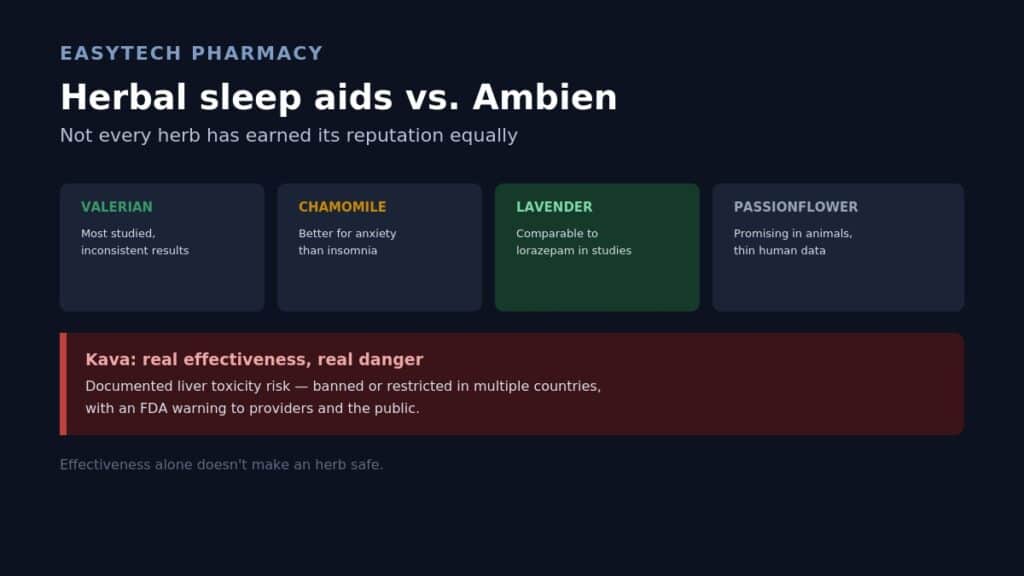
“Herbal sleep aid” gets used as one broad category, but the plants inside it don’t share a single evidence level. Some have real, if modest, clinical support. Others have essentially none, despite widespread marketing. One even carries a genuine safety warning most people never hear about. Here’s an honest, plant-by-plant comparison against what Ambien has already proven in trials.
Why Lumping All Herbs Together Is Misleading
The most commonly studied plants for insomnia are valerian, chamomile, and lavender, but a systematic review of the research found that many studies are limited by small sample sizes and inconsistent designs, and that objective, quantifiable measures often show no significant improvement even when subjective reports feel better. That gap between what people report and what gets objectively measured is exactly why treating “herbal” as one uniform category misses a lot of important nuance.
Valerian: The Most Studied, With Real Caveats
Valerian remains the most extensively researched sleep herb, with genuine evidence for reducing time to fall asleep, covered in full in our dedicated guide on Ambien vs. valerian root. One trial combining valerian with passionflower and hops found the combination performed comparably to zolpidem itself for treating primary insomnia, a genuinely notable finding, though it involved a specific herbal blend rather than valerian alone.
Chamomile: Better for Anxiety Than for Insomnia Specifically
Chamomile has picked up a reputation as a bedtime staple, but the research tells a more specific story. A systematic review and meta-analysis found chamomile effective and safe for improving general sleep quality and generalized anxiety, but noted a scarce specific effect on insomnia itself. A head-to-head trial comparing chamomile against passionflower found chamomile significantly more effective, also reducing daytime dysfunction and stress hormone levels. This suggests chamomile’s real strength may be calming and de-stressing rather than treating insomnia directly.
Lavender: A Surprising Comparison Worth Knowing
Lavender has some of the more encouraging data in this category. Research has found lavender’s efficacy for sleep disorders across a range of populations, with one notable comparison describing it as roughly as effective as lorazepam, a prescription benzodiazepine, for adults dealing with anxiety and sleep problems together. Studies using an 80 mg dose found reductions in nighttime awakenings and improvements in overall sleep duration and quality. This makes lavender one of the more genuinely evidence-backed options in this entire category, particularly for sleep trouble tangled up with anxiety.
Passionflower: Promising, But Thinner Human Data
Passionflower shows sedative effects in animal studies, but researchers note that human studies are still needed to confirm real efficacy. In the head-to-head trial against chamomile, passionflower underperformed, showing no significant reduction in stress hormone levels the way chamomile did. It’s not without support, particularly in combination formulas, but it stands on weaker footing alone than valerian, chamomile, or lavender.
Kava: Real Effectiveness, Real Danger
This is the herb that deserves the most caution on this entire list, and it rarely gets the attention it should. Kava has shown genuine effectiveness for reducing sleep latency and improving sleep quality in both animal and human research. But it also carries a documented risk of serious liver toxicity, hepatotoxicity severe enough that its use has been banned or restricted in multiple countries, and the FDA has specifically warned providers and the public about this risk. Effectiveness alone doesn’t make an herb safe, and kava is the clearest example of that gap in this entire comparison.
Where the Evidence Actually Stacks Up Against Placebo
One of the more sobering findings in recent research came from a high-quality study that found several popular herbal OTC therapies, including kava, valerian, and chamomile, ineffective for treating chronic insomnia disorder specifically, with no meaningful difference from placebo on daytime functioning, insomnia severity, or sleep quality. This doesn’t erase the more encouraging findings elsewhere, but it’s an important, honest counterweight: herbal evidence for insomnia is genuinely mixed, not uniformly positive.
Side-by-Side: What Actually Separates Them
- Most researched overall: Valerian, though results are inconsistent across individual trials
- Best fit for anxiety-linked sleep trouble: Chamomile and lavender both show stronger anxiety-related benefit than pure insomnia benefit
- Most surprising comparison: Lavender’s data suggesting effectiveness comparable to a prescription benzodiazepine in some studies
- Weakest solo human evidence: Passionflower, though it performs better in combination formulas
- Genuine safety concern: Kava, despite real effectiveness data, due to documented liver toxicity risk
Where This Leaves the Comparison to Ambien
None of these herbs have been held to the same clinical trial standard zolpidem cleared for FDA approval, and the best available research shows genuinely mixed results, strong for some outcomes, absent for others, herb by herb. For occasional or mild sleep trouble, particularly when anxiety is part of the picture, lavender and chamomile have real, if modest, support worth trying. For genuine chronic insomnia, the evidence gap with Ambien remains real, and it’s covered more broadly in our guide on Ambien alternatives.
The Bottom Line
“Herbal sleep aid” isn’t one category with one evidence level. Valerian has the most research behind it, though results are inconsistent. Chamomile and lavender show real promise, particularly for anxiety-linked sleep trouble, with lavender’s data being genuinely surprising. Passionflower’s human evidence remains thin. Kava, despite real effectiveness, carries a documented liver toxicity risk serious enough to warrant real caution. None of them matches Ambien’s trial-proven effectiveness for chronic insomnia, but several offer genuine, evidence-backed support for milder, more occasional sleep trouble.
For the full systematic review referenced throughout, see “Plant Extracts for Sleep Disturbances: A Systematic Review” published in Evidence-Based Complementary and Alternative Medicine.
Frequently asked questions
Which herbal sleep aid has the strongest evidence?
Valerian is the most extensively researched, though results vary across individual trials. Lavender has shown particularly notable results, with one comparison suggesting effectiveness similar to a prescription benzodiazepine in specific studies.
Is kava safe to use for sleep?
Despite real effectiveness data, kava carries a documented risk of serious liver toxicity, leading to bans or restrictions in multiple countries and an FDA warning. This risk deserves serious consideration before use.
Does chamomile actually help with insomnia?
Research suggests chamomile is more effective for general sleep quality and anxiety than for insomnia specifically, with one head-to-head trial finding it outperformed passionflower for reducing stress and improving sleep.
Can herbal sleep aids replace Ambien for chronic insomnia?
Not reliably. None have been held to the same clinical trial standard as zolpidem, and high-quality research has found several popular herbs, including kava, valerian, and chamomile, ineffective for chronic insomnia disorder specifically.
Related reading
- Ambien vs. valerian root: what the evidence actually shows
- Best Ambien alternative for anxiety-related insomnia
- OTC vs. prescription sleep aids: the real difference
- Best non-habit-forming sleep aids: ranked and compared
Curious which herbal option, if any, actually fits your situation? Talk to your pharmacist. EasyTech Pharmacy can help you think it through.
For local pharmacy access near you, our Ambien near me guide covers pharmacies across the world.
Visit EasyTech Pharmacy — sleep medication with real pharmacist guidance.