Dayvigo vs. Ambien: Which Sleep Aid Is Right for You?
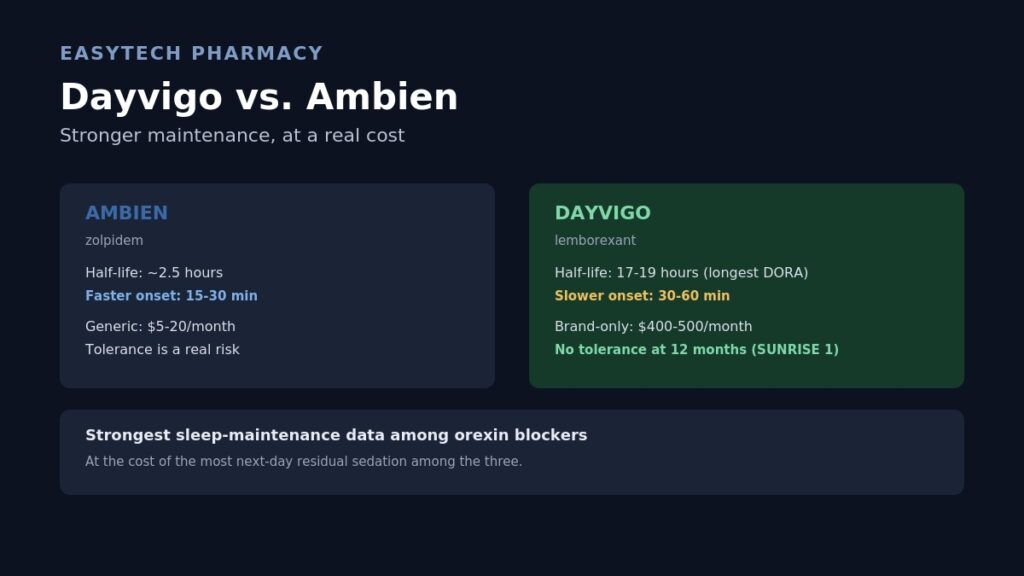
Dayvigo carries the longest half-life among the three orexin blockers now on the market, and that single fact shapes its entire comparison against Ambien. It offers real, trial-backed strength for staying asleep through the night, at a cost that shows up specifically the next morning.
The Third Orexin Blocker, With Its Own Profile
Dayvigo, generic name lemborexant, gained FDA approval in December 2019, making it the second dual orexin receptor antagonist to reach market, after Belsomra and before Quviviq, both covered in our guides on Belsomra vs. Ambien and Quviviq vs. Ambien. Like both, it blocks orexin, the brain chemical promoting wakefulness, rather than sedating the brain the way Ambien’s GABA-enhancing mechanism does.
The Half-Life Difference That Explains Everything Else
Dayvigo’s half-life runs 17 to 19 hours, dramatically longer than Quviviq’s roughly 8 hours and even longer than Belsomra’s 15 hours. Among all three DORAs, Dayvigo has the longest half-life and strongest sleep-maintenance effect, but also the most next-day residual sedation. This pattern echoes what we’ve covered more generally in our guide on short-acting vs. long-acting sleep medications: longer duration tends to trade sleep-maintenance strength for more lingering next-day effect, and Dayvigo sits at the far end of that spectrum among orexin blockers specifically.
Real Trial Data Behind the Sleep-Maintenance Claim
This isn’t just a theoretical half-life advantage. The SUNRISE 1 phase 3 clinical trial found lemborexant produced statistically significant improvements in both sleep onset and sleep maintenance compared with both placebo and extended-release zolpidem, measured objectively through polysomnography and subjectively through sleep diaries. This head-to-head trial design, tested directly against zolpidem rather than just placebo, gives Dayvigo’s sleep-maintenance claim real weight.
A Genuinely Notable Long-Term Finding
Dayvigo has accumulated 12-month efficacy data without evidence of tolerance developing, a meaningful claim given how central tolerance is to the conversation around Ambien, covered in depth in our guide on Ambien tolerance. Sustained effectiveness over a full year, without the dose needing to climb to maintain the same benefit, is a genuinely different pattern than what tends to happen with GABA-based sedatives over extended use.
Speed: Ambien Still Wins
Zolpidem’s onset runs 15 to 30 minutes, compared to lemborexant’s 30 to 60 minutes, a gap that patients accustomed to Ambien’s rapid sedation tend to notice directly when switching. For anyone whose primary complaint is simply falling asleep quickly, this timing difference is real and worth weighing.
Where Dayvigo Shows a Real Advantage: Older Adults
Dayvigo offers a cleaner next-morning profile in older adults specifically, alongside its stronger sleep-maintenance data, making it a genuinely relevant option in the population we’ve covered in our guide on the best Ambien alternative for seniors. This combination, less next-day impairment risk in a fall-vulnerable population plus stronger overnight coverage, is a meaningful point in Dayvigo’s favor for this specific group, even with its long half-life working against it in the general population.
Cost: A Significant, Current Gap
Generic zolpidem runs $5 to $20 per month. Dayvigo, brand-only with no generic currently available and patent protection extending to at least 2035, runs $400 to $500 per month. This is a considerably larger gap than the one we’ve covered for Quviviq, and it’s worth factoring directly into any real comparison, alongside the insurance step-therapy requirements that often require trying generic zolpidem first before Dayvigo gets approved.
Switching From Ambien to Dayvigo: What the Transition Looks Like
For anyone considering a switch, the typical approach involves tapering zolpidem over three to seven days before starting lemborexant at 5 mg the first night off zolpidem, expecting one to three nights of potentially disrupted sleep during that transition window. This mirrors the tapering caution covered in our guide on the zolpidem withdrawal timeline, since stopping abruptly carries its own risks independent of which medication comes next.
Side-by-Side: What Actually Separates Them
- Half-life: Ambien roughly 2.5 hours. Dayvigo 17 to 19 hours, the longest of the three DORAs.
- Onset speed: Ambien faster, 15-30 minutes versus 30-60 minutes.
- Sleep maintenance: Dayvigo shows the strongest trial-backed effect among orexin blockers, at the cost of the most next-day residual sedation.
- Tolerance: Dayvigo has 12-month data showing no tolerance development, a genuinely different pattern than Ambien’s documented tolerance risk.
- Cost: Generic zolpidem runs $5-20/month. Dayvigo runs $400-500/month with no generic.
The Bottom Line
Dayvigo and Ambien aren’t close competitors on cost or speed, but the comparison isn’t really about those two factors alone. Dayvigo’s long half-life, the longest among all three orexin blockers, delivers real, trial-backed sleep-maintenance strength and a notable absence of tolerance over a full year of data, particularly relevant for older adults managing fall risk. Ambien remains faster and dramatically cheaper as a long-standing generic. The right fit depends on whether sustained overnight coverage and tolerance-free long-term use outweigh speed and cost for your specific situation.
For a detailed clinical comparison, see this head-to-head efficacy comparison of Ambien and Dayvigo.
Frequently asked questions
Does Dayvigo work better than Ambien for staying asleep?
Clinical trial data from the SUNRISE 1 study found lemborexant produced statistically significant improvements in sleep maintenance compared to both placebo and extended-release zolpidem, backed by objective polysomnography measurement.
Why does Dayvigo cause more next-day grogginess than Quviviq or Belsomra?
Its half-life, 17 to 19 hours, is the longest among the three orexin blockers, and longer-acting medications generally carry more residual next-day sedation.
Is there a generic version of Dayvigo?
Not currently, and patent protections extend to at least 2035, meaning the significant cost gap with generic zolpidem is likely to persist for years.
How do I switch from Ambien to Dayvigo safely?
The typical approach involves tapering zolpidem over three to seven days, then starting lemborexant at 5 mg the first night off zolpidem, with one to three nights of possible sleep disruption during the transition, planned with medical guidance.
Considering a switch to an orexin blocker and want to think through the transition safely? Talk to your pharmacist. EasyTech Pharmacy can help you plan it out.
For local pharmacy access near you, our Ambien near me guide covers pharmacies across the world.
Visit EasyTech Pharmacy — sleep medication with real pharmacist guidance.