Ambien vs. Zolpidem: They’re Not Actually Different Drugs
This question trips people up more than almost any other on this topic, and the confusion is completely understandable. Ambien vs. zolpidem sounds like it should be a comparison between two different medications. It isn’t. Here’s the actual relationship, and the real, more interesting question hiding underneath it.
The Short Answer
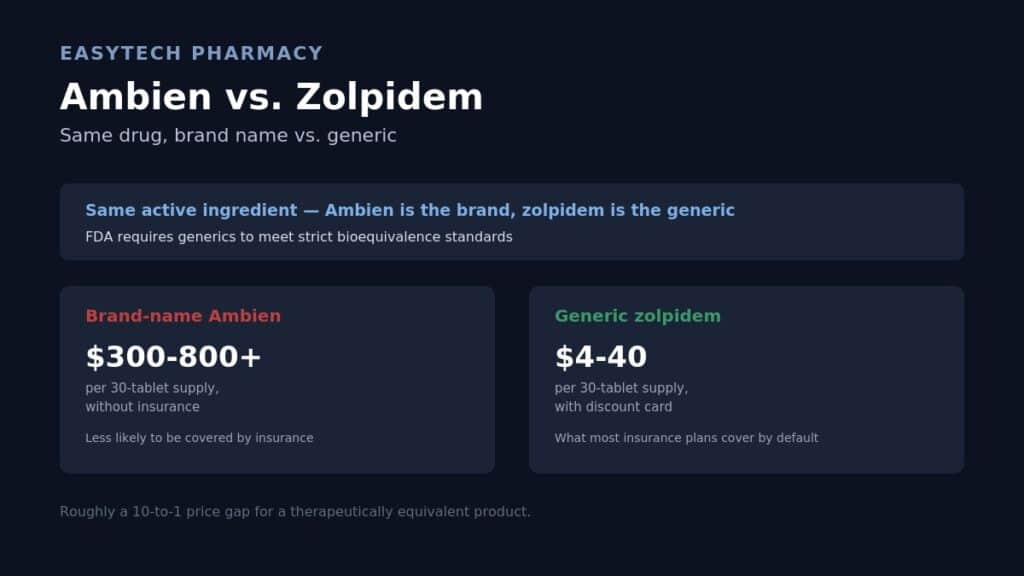
Ambien is the brand name. Zolpidem is the generic name for the exact same active ingredient. When a prescription says “Ambien,” the pharmacy typically fills it with generic zolpidem unless the prescriber specifically indicates otherwise. This isn’t a workaround or a downgrade. It’s standard pharmacy practice, and it happens with the vast majority of brand-name prescriptions once a generic version exists.
Why Two Names Exist for One Drug
Sanofi brought zolpidem to market under the brand name Ambien in 1992, holding exclusive rights through patent protection. When that patent expired in April 2007, other manufacturers gained the ability to produce and sell the same active ingredient under its generic chemical name, zolpidem. Multiple generic manufacturers entered the market within weeks of patent expiration, and that’s the version most people have been taking ever since, often without realizing “zolpidem” and “Ambien” refer to the same thing.
What “Bioequivalent” Actually Means
The FDA requires generic zolpidem to meet strict bioequivalence standards before approval. In practice, that means a 10 mg generic tablet has to deliver essentially the same amount of active ingredient, at essentially the same rate, as a 10 mg brand-name Ambien tablet. The active ingredient itself doesn’t change. What can differ are inactive ingredients, fillers, coatings, dyes, which don’t affect the drug’s core therapeutic action but can technically vary slightly between manufacturers.
The Price Gap Is Real, and It’s Large
This is where the comparison actually gets interesting. Brand-name Ambien can retail for several hundred dollars for a 30-tablet supply without insurance, sometimes reported as high as $800 or more depending on dose and pharmacy. Generic zolpidem, for the identical dose and quantity, commonly runs somewhere between $10 and $40, occasionally as low as $4 to $15 with a discount card. That’s not a small difference. It’s often a 10-to-1 price ratio for what the FDA considers a therapeutically equivalent product.
Why Some People Insist They Notice a Difference
Here’s the part worth being honest about rather than glossing over: some people report that generic zolpidem feels less effective than brand-name Ambien, describing different sleep quality or side effects between the two. This shows up regularly in patient forums and pharmacy complaint records. The FDA’s bioequivalence standards are real and rigorously enforced, but a small subset of people do seem to notice a difference, possibly tied to individual sensitivity to inactive ingredients, or occasionally traced to specific manufacturing batches that faced scrutiny for equivalence issues in other drug classes.
This doesn’t mean generic zolpidem is unreliable as a rule. It means individual response can genuinely vary, and if you’ve had a specific negative experience switching from brand to generic, that’s worth raising directly with your pharmacist rather than assuming it’s purely psychological.
Does Insurance Prefer One Over the Other?
Almost universally, yes, and it favors generic zolpidem. Most insurance plans and Medicare Part D formularies cover generic zolpidem readily, while brand-name Ambien is less likely to be covered, and when it is, it usually comes with a significantly higher copay. Unless a prescriber specifically writes “dispense as written” or notes a documented reason brand-name is medically necessary, most prescriptions default to generic automatically at the pharmacy counter.
What About Other Zolpidem Brand Names?
Ambien isn’t the only brand name zolpidem has appeared under. Ambien CR is the extended-release brand version. Zolpimist is a cherry-flavored oral spray form, priced similarly high compared to its generic equivalent, intended for people who have difficulty swallowing tablets. Edluar and Intermezzo were sublingual tablet brands that have since been discontinued. All of these share the same active ingredient story as standard Ambien and zolpidem.
If You’re Concerned About Misuse of Either
Whether the concern involves Ambien, opioids, or both, the response is similar: an honest conversation with a pharmacist or prescriber, rather than managing it alone. Our guide on Ambien abuse covers the warning signs specific to zolpidem misuse, and our overview of Ambien addiction treatment options covers what real help looks like if things have gone further than simple misuse.
According to the National Institute on Drug Abuse, opioids work by binding to specific receptors in the brain and body that block pain signals and can produce a sense of euphoria, a mechanism entirely distinct from how sedative-hypnotics like zolpidem work.
So Which Should You Actually Ask For?
- For most people, generic zolpidem delivers the same clinical effect at a fraction of the cost, and it’s what your pharmacy will fill by default
- If you’ve had a specific negative experience with a generic switch, mention it to your pharmacist, since manufacturer-specific inactive ingredient differences occasionally do matter for sensitive individuals
- If cost isn’t a barrier and you strongly prefer brand-name, you can ask your prescriber to note “dispense as written,” though be aware many insurance plans will charge significantly more for this choice
The Bottom Line
Ambien and zolpidem aren’t competing medications. They’re the same drug under two different names, brand and generic, separated mainly by price rather than clinical substance. The FDA’s bioequivalence standards mean generic zolpidem should perform identically for the overwhelming majority of people, even though a documented minority report noticing a difference. For most people, the real question isn’t “which one is better.” It’s simply “why pay ten times more for the brand name.”
For more on FDA generic drug standards, see the FDA’s official generic drug facts page.
Frequently asked questions
Is Ambien stronger than zolpidem?
No. They contain the exact same active ingredient at the same dose strength. Any perceived difference in strength isn’t supported by the FDA’s bioequivalence data, though a small number of people report noticing a difference.
Why is brand-name Ambien so much more expensive than zolpidem?
The price gap reflects branding, marketing, and how insurance formularies classify the two, not a difference in the core medication. Generic manufacturers don’t carry the same development and marketing costs as the original brand.
Will my pharmacy automatically give me generic zolpidem for an Ambien prescription?
In most cases, yes, unless your prescriber specifically indicates the brand name should be dispensed as written.
Are all generic zolpidem tablets from different manufacturers identical?
They must all meet the same FDA bioequivalence standard for the active ingredient, though inactive ingredients like fillers and coatings can vary slightly between manufacturers.
Related reading
- Zolpidem over the counter: why it isn’t, and what actually is
- Is Ambien a controlled substance? Schedule IV explained
- Eszopiclone vs. zolpidem: is Lunesta stronger than Ambien?
- Ambien CR vs. Lunesta: two long-acting options compared
Questions about brand versus generic coverage under your insurance plan? Talk to your pharmacist. EasyTech Pharmacy can help you check your formulary and pricing.
For local pharmacy access near you, our Ambien near me guide covers pharmacies across the world.
Visit EasyTech Pharmacy — sleep medication with real pharmacist guidance.