Substitutes for Ambien: A Full Overview of Your Options
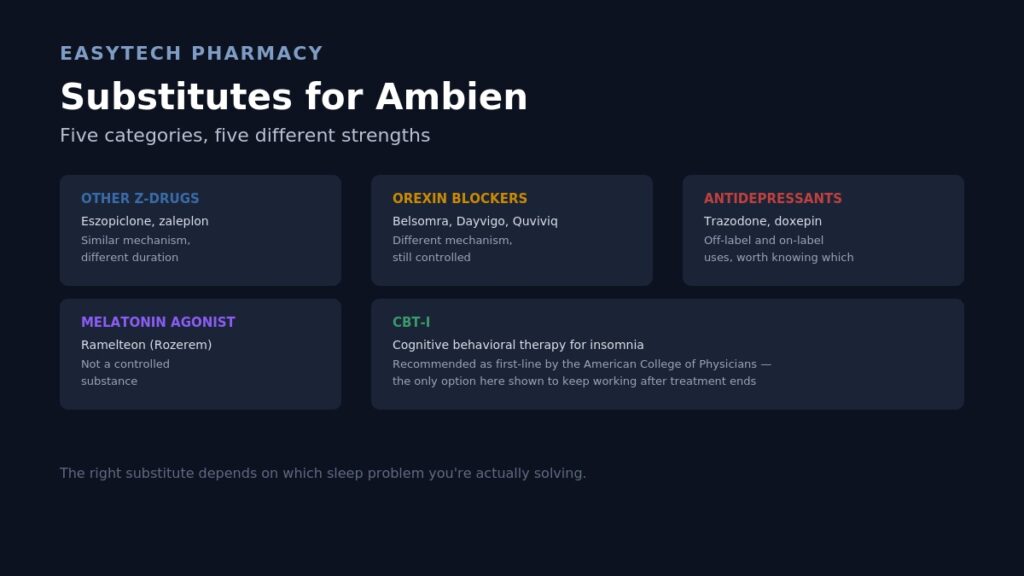
Whether Ambien stopped working the way it used to, side effects became too much, or you’re just curious what else is out there, “what else can I take” is a genuinely reasonable question. The honest answer is: quite a lot, spread across a few very different categories. Here’s the full landscape, organized by what each option actually does well.
Other Non-Benzodiazepine Hypnotics (“Z-Drugs”)
This is the category Ambien itself belongs to, and it’s the most direct substitute family.
- Eszopiclone (Lunesta). Works through a similar mechanism to zolpidem but has a longer half-life, making it better suited for staying asleep rather than just falling asleep. Our guide on eszopiclone vs. zolpidem covers the full comparison.
- Zaleplon (Sonata). The fastest-acting and shortest-duration option in this class, useful for falling asleep quickly but not for staying asleep through the night.
These share Ambien’s general risk profile: Schedule IV status, dependence potential, and similar warnings around complex sleep behaviors.
Orexin Receptor Antagonists (A Genuinely Different Mechanism)
This newer drug class works completely differently from Ambien. Instead of sedating the brain directly, these medications block orexin, a chemical that promotes wakefulness, essentially turning down the “stay awake” signal rather than turning up a “go to sleep” one.
- Suvorexant (Belsomra). The first drug in this class, shown to cut time to fall asleep roughly in half in clinical trials, with total sleep time increasing by 39 to 43 minutes per night compared to placebo.
- Lemborexant (Dayvigo) and daridorexant (Quviviq), newer entries in the same class, with daridorexant showing a modest but real effect size in a 2022 meta-analysis, generally smaller than Ambien’s short-term effect but with a different safety profile.
These are still controlled substances, but many prescribers consider them a reasonable next step for people who’ve had trouble with Z-drugs specifically.
Off-Label Antidepressants
This is a genuinely common substitution in practice, even though it comes with its own caveat.
- Trazodone. Prescribed off-label for insomnia far more often in recent years as zolpidem prescribing has declined. It’s worth knowing this use isn’t FDA-approved specifically for insomnia, and some prescribers are cautious about it for that reason. Our guide on trazodone vs. Ambien covers this comparison directly.
- Low-dose doxepin (Silenor). Unlike trazodone, doxepin at low doses is FDA-approved specifically for sleep maintenance, making it a more clinically established antidepressant-based option.
Melatonin Receptor Agonists
Ramelteon (Rozerem) works by mimicking melatonin’s action on sleep-wake regulation rather than sedating the brain directly. It’s not a controlled substance, carries a notably different side effect profile than Z-drugs, and tends to suit people whose main issue is a shifted or irregular sleep schedule rather than general insomnia.
Genuine Over-the-Counter Options
For milder or occasional sleep trouble, real OTC choices exist, covered in more depth in our guide on zolpidem over the counter:
- Diphenhydramine and doxylamine, antihistamines that cause drowsiness as a side effect
- Melatonin, a hormone supplement supporting the body’s natural sleep-wake cycle
These generally work best for occasional disruption rather than the kind of persistent insomnia Ambien is typically prescribed for.
The Non-Drug Option With the Strongest Evidence
Here’s what tends to get buried under all the medication options: cognitive behavioral therapy for insomnia, known as CBT-I, has some of the strongest evidence of any approach on this list. The American College of Physicians recommends it as the first-line treatment for chronic insomnia, ahead of medication. A 2015 meta-analysis of 20 randomized controlled trials found CBT-I produced meaningful, sustained improvements in sleep onset and sleep efficiency, improvements that held up well after treatment ended, unlike medication effects, which typically fade once the drug stops.
The core difference is what each approach actually treats. Medication manages symptoms while you’re taking it. CBT-I addresses the underlying thought patterns and habits driving the insomnia itself, which is why its effects tend to persist.
How to Actually Choose
- Trouble falling asleep specifically? Zaleplon, ramelteon, or an orexin antagonist tend to fit better than options built for sleep maintenance.
- Trouble staying asleep? Eszopiclone, low-dose doxepin, or an orexin antagonist are generally better matched to this pattern than fast-acting, short-duration options.
- Concerned about dependence or controlled-substance status? Ramelteon and CBT-I are the two options on this list that aren’t controlled substances at all.
- Want the option with the most durable, long-term evidence? CBT-I is the only approach here shown to keep working after treatment ends.
The Bottom Line
Ambien has real company. Other Z-drugs, a newer orexin-blocking drug class, off-label and on-label antidepressants, melatonin receptor agonists, genuine OTC options, and CBT-I all offer different paths toward the same goal, and each one fits a different piece of the insomnia puzzle. The right substitute depends less on which drug sounds most familiar and more on which specific sleep problem you’re actually trying to solve.
For a detailed comparison of prescription alternatives, see ChoosingTherapy’s overview of Ambien alternatives.
Frequently asked questions
What’s the closest prescription substitute to Ambien?
Eszopiclone (Lunesta) works through the most similar mechanism, though it has a longer half-life better suited to staying asleep rather than just falling asleep.
Is there a substitute for Ambien that isn’t a controlled substance?
Ramelteon (Rozerem) is not a controlled substance and works through melatonin receptor activity rather than direct sedation, making it a genuinely different option in this respect.
What’s the most effective long-term alternative to Ambien?
Cognitive behavioral therapy for insomnia (CBT-I) has the strongest evidence for durable, long-term improvement, since it addresses the underlying patterns driving insomnia rather than just managing symptoms.
Can I switch from Ambien to one of these options on my own?
Switching sleep medications should be planned with your prescriber, since factors like half-life, interactions, and your specific sleep pattern all affect which option actually fits your situation.
Related reading
- Eszopiclone vs. zolpidem: is Lunesta stronger than Ambien?
- Ambien CR vs. Lunesta: two long-acting options compared
- Zolpidem over the counter: why it isn’t, and what actually is
- Ambien tolerance: why it happens and what to do
Not sure which substitute actually fits your sleep pattern? Talk to your pharmacist or prescriber. EasyTech Pharmacy can help you think through your options.
For local pharmacy access near you, our Ambien near me guide covers pharmacies across the world.
Visit EasyTech Pharmacy — sleep medication with real pharmacist guidance.