Ambien vs. Restoril: Two True Sleep Drugs, Different Mechanisms
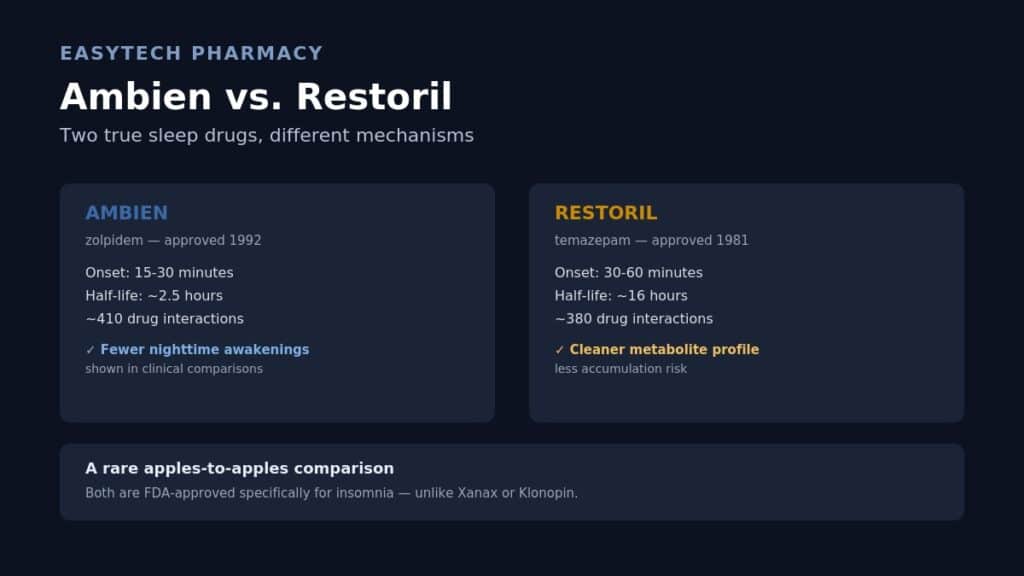
This comparison is different from Ambien vs. Xanax or Ambien vs. Klonopin in one important way: Restoril is actually FDA-approved for insomnia, the same as Ambien. This isn’t a sleep drug measured against a repurposed anxiety medication. It’s two purpose-built insomnia treatments from different drug generations, and the differences between them are genuinely instructive.
Same Job, Different Drug Class
Restoril, temazepam, is a benzodiazepine. Chemists first synthesized it in 1964, and the FDA approved it in 1981. Ambien, zolpidem, belongs to the newer non-benzodiazepine “Z-drug” class. The FDA approved it in 1992. Both treat short-term insomnia specifically, which makes this one of the more directly comparable matchups in the sleep medication world.
The Receptor Difference That Shapes Everything
Temazepam works through broad, non-specific binding across GABA-A receptors with multiple omega subunits. That produces sedation alongside muscle relaxation and anti-anxiety effects, the fuller benzodiazepine profile. Zolpidem selectively targets the alpha-1 subunit, the part specifically associated with sedation. That gives it a narrower, more sleep-focused action. It skips the muscle-relaxing and anti-anxiety side effects that come with temazepam’s broader reach.
Speed and Duration: A Real, Measurable Gap
Ambien acts faster, typically within 15 to 30 minutes, and clears faster too, with a half-life around 2.5 to 2.6 hours. Restoril takes slightly longer to kick in, generally 30 to 60 minutes, and stays active far longer, with a half-life around 16 hours. That’s roughly six times longer than Ambien’s.
This gap has real consequences. Ambien’s shorter action suits sleep onset well but does less for staying asleep through the night. Restoril’s longer duration can help with sleep maintenance. It also carries a correspondingly higher risk of next-day drowsiness and, notably, an increased fall risk in elderly patients. Our guide on Ambien and fall risk in elderly patients covers that concern in more general terms.
Effectiveness: A Real Documented Difference
This is a meaningful point of separation. Clinical comparisons have found Ambien more effective than Restoril specifically at reducing the number of awakenings after sleep onset. That means fewer middle-of-the-night wake-ups for many patients. That specific edge is part of why Ambien has become the more commonly prescribed option of the two, despite Restoril’s longer track record.
Interaction Profiles: Ambien Has More to Track
This is a detail that rarely comes up but matters practically. Databases list roughly 410 medications with documented interactions with Ambien, compared to around 380 for Restoril. Neither number is small, and both drugs carry serious interaction risk with other CNS depressants, opioids, and alcohol specifically. Ambien’s broader interaction footprint is still worth factoring in for anyone managing multiple medications.
The Metabolite Advantage Restoril Actually Has
Here’s a point in Restoril’s favor that doesn’t get much attention: temazepam has a comparatively clean metabolite profile relative to other benzodiazepines. Some benzodiazepines produce active metabolites that build up in the body with repeated dosing. That buildup extends sedation well beyond what the parent drug’s half-life alone suggests. Temazepam avoids much of this accumulation risk, part of why clinicians often consider it the preferred benzodiazepine specifically for sleep.
Shared Risks Worth Taking Seriously
- Both are Schedule IV controlled substances with real dependence and misuse potential.our guide on Is Ambien a Controlled Substance.
- Both should never be combined with alcohol or other central nervous system depressants, given the compounded sedation and respiratory depression risk.our guide on Ambien and Alcohol.
- Both are intended for short-term use only, generally 7 to 10 days for Restoril specifically, though real-world prescribing sometimes extends beyond this window
- Both share common side effects, including headache, fatigue, and a next-day hangover-like effect
Where they diverge is complex sleep behaviors: zolpidem carries a notably higher documented risk of sleepwalking and sleep-driving than temazepam, a distinction covered in depth in our guide on Ambien’s black box warning.
Which One Tends to Fit Which Situation
- Trouble falling asleep, minimal middle-of-the-night waking? Ambien’s faster onset and shorter duration generally fit this pattern better.
- Frequent middle-of-the-night awakenings specifically? Restoril’s longer duration may offer more consistent coverage through the night, though next-day sedation risk rises accordingly.
- Older adult or managing multiple medications? Both carry real fall and interaction risk, but Restoril’s longer half-life and Ambien’s broader interaction list are each worth weighing carefully in this context.
- History of, or concern about, sleepwalking or sleep-driving? This risk is more specifically associated with Ambien than Restoril.
The Bottom Line
Ambien and Restoril are a rare genuinely apples-to-apples comparison in this space. Both are purpose-built, FDA-approved insomnia treatments, just from different drug generations and mechanisms. Ambien acts faster, clears faster, and shows a documented edge in reducing nighttime awakenings. Restoril lasts longer, which helps some sleep-maintenance patterns but raises next-day sedation risk. Neither is a clear universal winner. The right fit depends on which part of the night is actually giving you trouble.
For a detailed clinical comparison, see SingleCare’s comparison of Restoril and Ambien.
Frequently asked questions
Is Restoril or Ambien better for staying asleep through the night?
Restoril’s longer half-life, around 16 hours compared to Ambien’s roughly 2.5 hours, can offer more sustained coverage, though it comes with a higher risk of next-day drowsiness.
Which one works faster, Ambien or Restoril?
Ambien generally acts faster, within 15 to 30 minutes, compared to Restoril’s 30-to-60-minute onset window.
Does Restoril carry the same sleepwalking risk as Ambien?
No. Zolpidem carries a notably higher documented risk of complex sleep behaviors like sleepwalking and sleep-driving compared to temazepam.
Can Ambien and Restoril be taken together?
No. Combining two sedating medications that both act on GABA receptors significantly compounds sedation and respiratory depression risk. It isn’t a combination to manage without direct medical guidance.
Related reading
- Ambien vs. Klonopin: what actually separates them
- Ambien vs. Xanax: what actually separates them
- Ambien complex sleep behaviors: sleepwalking, sleep-driving, and the black box warning
- Zolpidem withdrawal timeline: what each stage feels like
- Who should not take Ambien: full contraindications list
Trying to figure out which sleep medication actually fits your pattern? Talk to your pharmacist or prescriber. EasyTech Pharmacy can help you think it through.
For local pharmacy access near you, our Ambien near me guide covers pharmacies across the world.
Visit EasyTech Pharmacy — sleep medication with real pharmacist guidance.