Is Ambien a Controlled Substance? Here’s What That Actually Means
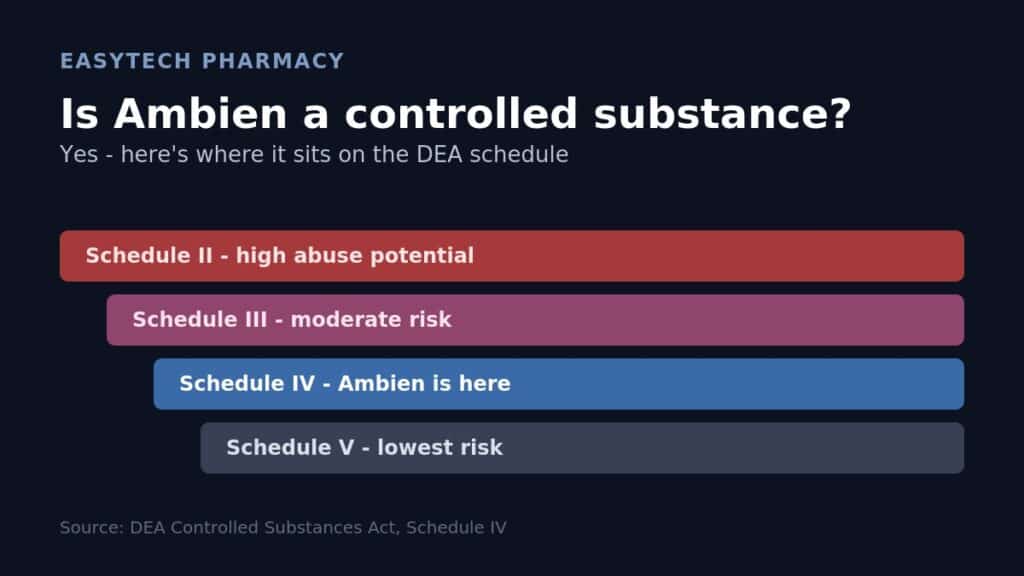
Short answer: yes. Ambien is a Schedule IV controlled substance. But that one-line answer skips the part that actually matters to you — what “controlled” changes about how you get it, how often you can refill it, and what a pharmacy checks before handing it over. Let’s go through that in plain terms.
What “Schedule IV” actually means
The Drug Enforcement Administration sorts medications into five schedules based on medical use and misuse risk. Schedule I sits at the top, reserved for drugs with no accepted medical use. Schedule V sits at the bottom, covering the lowest-risk medications. Ambien lands in the middle, at Schedule IV.
That placement isn’t random. Ambien treats a real medical problem effectively: short-term insomnia. At the same time, it can lead to tolerance, dependence, and, in some cases, misuse. Schedule IV reflects both facts at once. Real benefit. Real risk. Somewhere between mild and serious.
What changes day-to-day because of this
A Schedule IV classification isn’t just a label in a database. It shapes the practical experience of getting Ambien:
- Refills run on a limit. A prescription typically allows up to five refills within six months, then it expires and needs renewal.
- Pharmacies verify before dispensing. Expect an ID check and a quick confirmation that the prescription is current and accurate.
- Records get tracked. Pharmacies keep dispensing records for controlled substances for a set period. This helps catch errors, duplicate fills, or patterns worth a second look.
- Long-term use gets reassessed. Ambien is meant for short-term treatment, so check-ins happen periodically rather than an automatic, endless renewal.
None of this exists to slow you down for no reason. Sedative-hypnotics carry a documented pattern of tolerance and dependence. These checks catch problems early, before they grow.
Why Ambien ended up controlled in the first place
Ambien acts on the same general brain system as benzodiazepines, even though its chemical structure differs. That shared mechanism explains the shared risks. Tolerance can build with regular use. Stopping suddenly can trigger rebound insomnia. Misuse is possible, though less common than with higher-schedule drugs.
Our guide on Ambien dependence covers how tolerance isn’t only physical. The Schedule IV rules exist partly to catch that pattern early, before it turns into something harder to unwind.
Controlled doesn’t mean dangerous to use correctly
It’s worth separating two ideas that often blur together. “Controlled substance” doesn’t mean “dangerous medication to avoid.” Plenty of genuinely useful, low-risk-when-used-correctly medications sit in Schedule IV, including several common anti-anxiety and sleep medications. The classification simply means the drug needs a level of oversight that non-controlled medications don’t.
Used as intended, for the short window it’s meant for, Ambien remains one of the more effective options for breaking a bad stretch of insomnia. The risks show up mainly with longer-than-intended use, mixing it with alcohol or other sedatives, or skipping the check-ins built into the refill process.
What this means if you’re searching “Ambien near me”
If you’re looking for a pharmacy that carries Ambien, the controlled-substance status explains exactly why the process looks a certain way:
- A current, valid prescription needs to be on file or transferred to the pharmacy
- The pharmacy confirms identity and prescription details before dispensing
- Refills follow the schedule set on the prescription, not an open-ended repeat order
- A pharmacist may reach out if something looks unusual, like an early refill request
This isn’t friction for its own sake. It’s the same system that keeps the medication working safely over time, and it moves faster than most people expect once a prescription is on file. Many pharmacies, including local ones, can fill and prepare an Ambien prescription for pickup or delivery the same day.
Signs worth watching for once you’re taking Ambien
Because of the dependence risk built into its Schedule IV status, a few patterns deserve attention over time:
- Needing a higher dose to get the same effect
- Feeling unable to sleep at all without it, even briefly
- Requesting refills earlier than the prescription allows
- Combining it with alcohol or other sedating medications
Any of this sound familiar? Our guide on Ambien Addiction Treatment Options walks through what that looks like and what actually helps. And for concerns about a dose that’s gone beyond what’s intended, our guide on Ambien Overdose: Signs and Effects covers exactly what to watch for and when to call for help.
The bottom line
Ambien is a Schedule IV controlled substance because it works, and because that same effectiveness carries a real risk of tolerance and dependence when it’s used longer or differently than intended. That classification shapes refill limits, pharmacy checks, and periodic reassessment. Not to create hurdles, but to keep the medication safe and effective for the people who need it. Understanding this process ahead of time makes the whole experience faster and clearer.
For more on how this fits into the bigger picture, see the DEA’s official drug scheduling overview.
Frequently asked questions
Is Ambien a controlled substance everywhere in the US?
Yes. Federal Schedule IV status applies nationwide. A small number of states add their own extra tracking requirements on top of the federal rules.
How many refills can I get on an Ambien prescription?
Typically up to five refills within six months from the date the prescription was written. After that, a new prescription is needed.
Does being a controlled substance mean Ambien is more dangerous than other sleep aids?
Not automatically. It means Ambien carries a documented risk of tolerance and dependence that non-controlled sleep aids generally don’t, which is why it comes with more oversight.
Can a pharmacy refuse to fill an early Ambien refill?
Yes, and it happens often. Pharmacists watch for early refill requests specifically because of the dependence risk tied to Schedule IV medications.
For local pharmacy access, our Ambien near me guide covers options across the world.
👉 Visit EasyTech Pharmacy — find the right sleep medication for your situation today.