How Long Does Ambien Take to Work? The Real Timeline Nobody Explains Clearly
You take the pill. You get into bed. And then you wait.
For anyone taking Ambien for the first time — or switching to a new dosage — those minutes between swallowing the tablet and actually feeling anything can feel surprisingly long. You start wondering whether it is working. Whether you took it correctly. Whether tonight is going to be another sleepless night even with medication.
So here is the straightforward answer to how long does Ambien take to work — and more importantly, everything that affects that timeline so you know exactly what to expect from the moment you take it.
If you are also still working out which Ambien option is right for your specific sleep pattern, our guide on what sleeping pill works the fastest for insomnia compares onset times across every major sleep medication.
The Short Answer — 15 to 30 Minutes for Most People
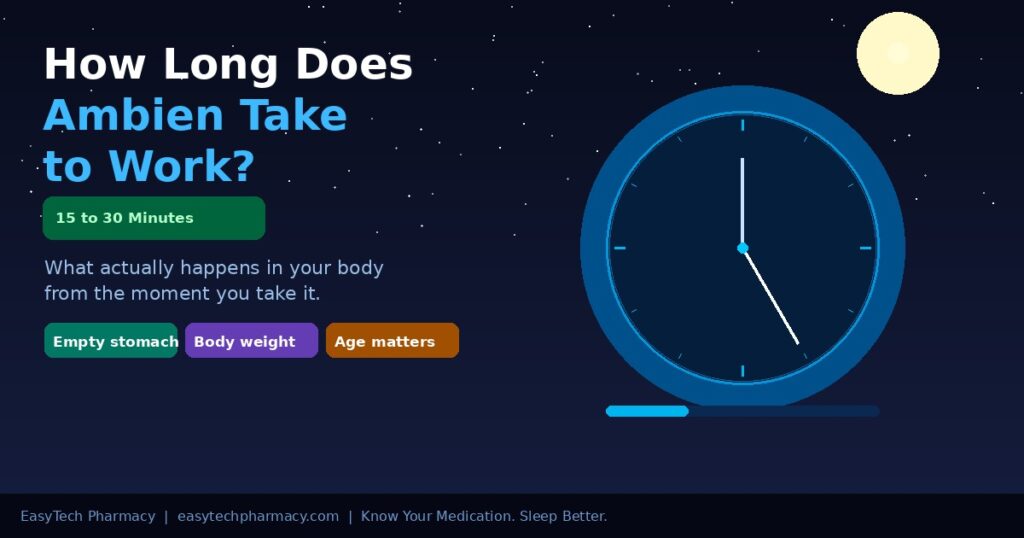
For the majority of adults taking standard immediate-release zolpidem, Ambien begins producing noticeable drowsiness somewhere between 15 and 30 minutes after swallowing the tablet. Most people describe the feeling as a gradual heaviness — mental chatter quieting, eyes getting heavier, the typical resistance to sleep fading. Within that window most people drift off without the usual battle.
However — and this is the part that matters — that 15 to 30 minute window assumes ideal conditions. Several very common factors can push that window significantly in either direction. Understanding them is the difference between getting the medication to work efficiently and lying there wondering why it does not seem to be doing anything.
What Is Actually Happening in Your Body During Those First 30 Minutes
Once you swallow the tablet, zolpidem begins absorbing through the gastrointestinal tract and entering the bloodstream. According to MedlinePlus, zolpidem reaches its peak concentration in the blood within approximately 1.6 hours — but the sedating effect begins well before peak concentration is reached.
As zolpidem levels rise in the bloodstream it crosses into the brain and binds to GABA-A receptors — the same receptors your brain uses to naturally slow itself down at the end of the day. Ambien amplifies that signal dramatically, accelerating the transition from alert wakefulness into the deeper, slower brain activity associated with sleep onset.
The result — your thoughts slow. Your body relaxes. The hyperarousal that keeps insomnia sufferers awake despite genuine exhaustion gets overridden. Sleep follows.
The key thing to understand is that this process is not a sudden knockout. It is a gradual, progressive shift in brain activity. People who take Ambien and then try to stay awake — watching TV, answering messages, waiting for it to “fully kick in” before going to bed — are working directly against this process and often find it takes much longer or produces strange effects like memory gaps.
The Factors That Make Ambien Work Faster or Slower
The 15 to 30 minute window is an average — not a guarantee. Here is what actually determines which end of that range you land on, and whether the timeline shifts outside it entirely.
Food — The Single Biggest Variable
This is the factor most people do not know about until they have already experienced the difference themselves. Taking Ambien after a substantial meal can delay its onset by 45 minutes to a full hour compared to taking it on an empty stomach.
The reason is pharmacological. Food in the stomach slows gastric emptying — the rate at which contents move from the stomach into the small intestine where absorption primarily occurs. Zolpidem has to wait. The FDA specifically notes in zolpidem’s prescribing information that a high-fat meal significantly reduces both the rate and extent of zolpidem absorption.
The practical takeaway: take Ambien at least 2 hours after your last meal for the fastest and most consistent onset. If you ate a large dinner at 7pm, taking Ambien at 10pm gives your digestive system time to clear. If you took it at 8pm — right after eating — you may be staring at the ceiling wondering why nothing is happening for the first hour.
Whether You Are Lying Down or Still Active
Ambien is designed to be taken immediately before getting into bed — not 30 minutes in advance while you finish tidying up or scrolling through your phone. Taking it and then staying upright and active significantly slows the perceived onset because your nervous system is still receiving alertness signals from your environment and activity.
The fastest results consistently come from taking the tablet, putting the phone down, going directly to a dark and quiet room, and lying down. The medication’s effect and the environmental sleep signals work together rather than against each other.
Your Age
Older adults metabolize zolpidem more slowly than younger adults. This means the medication takes longer to build up to effective levels in the bloodstream — which can extend the time to onset. It also means the medication stays active longer, increasing next-morning impairment risk. This is why starting doses for adults over 65 are typically lower — the slower metabolism means less medication achieves the same effect, but over a longer duration.
Body Weight and Metabolism
Individual metabolic rate affects how quickly any medication reaches active levels in the bloodstream. People with faster overall metabolisms may notice onset slightly sooner. People with slower metabolisms or those taking other medications that affect liver enzyme activity may experience a longer ramp-up period.
Tolerance — If You Have Been Taking It a While
For people who have been using zolpidem regularly for several weeks or more, tolerance development can affect not just how effective it is but how quickly that effect is perceived. If you have noticed Ambien seeming to take longer to work than it did when you first started, our detailed guide on why does Ambien stop working after a few weeks explains exactly what is happening and what to do about it.
Alcohol
Alcohol changes the timing and intensity of Ambien’s effects in unpredictable ways. Even a small amount can make the onset faster and more intense — which sounds like a benefit but actually significantly increases the risk of oversedation, memory gaps, and parasomnias. This is not a strategy to make Ambien work faster. It is a genuine safety risk that makes the medication’s effects dangerously unpredictable.
Immediate-Release vs Extended-Release — Does the Form Change the Onset?
Yes — meaningfully.
Standard immediate-release zolpidem (regular Ambien) is designed for fast absorption and is optimized for sleep onset. Its onset characteristics — 15 to 30 minutes — reflect this design priority.
Ambien CR (extended-release) uses a two-layer tablet. The first layer releases quickly and produces the same 15 to 30 minute onset as the immediate-release version. The second layer releases slowly over the following hours to maintain therapeutic blood levels through the night. So the initial onset time is similar — but the medication’s presence extends much further into the night, addressing sleep maintenance as well as onset.
Generic versions of both forms work identically to the brand-name originals in terms of onset time. The active ingredient, dosage, and absorption characteristics are the same — only the packaging differs. For a full breakdown of why generic zolpidem is clinically identical, our comparison guide on is generic zolpidem as good as Ambien covers everything.
What the Timeline Looks Like Minute by Minute
| Time After Taking | What Is Happening | What You Feel |
|---|---|---|
| 0 to 10 minutes | Tablet dissolving, absorption beginning | Usually nothing noticeable yet |
| 10 to 20 minutes | Zolpidem entering bloodstream, early GABA binding | Mild heaviness, slightly slower thoughts |
| 20 to 30 minutes | Blood levels rising toward therapeutic range | Clear drowsiness, eyes heavier, mental quieting |
| 30 to 60 minutes | Approaching peak concentration | Most people asleep by this point |
| 60 to 90 minutes | Peak blood concentration reached | Deep sleep (if in appropriate conditions) |
| 5 to 6 hours later | Levels declining toward clearance | Natural waking or lighter sleep stage |
This timeline assumes immediate-release zolpidem taken on an empty or light stomach in a dark, quiet environment without alcohol. Shift any of those conditions and the timeline shifts with it.
Why Ambien Might Not Seem to Be Working for You
If you feel like Ambien is not working or taking longer than expected, one of these is almost certainly the reason.
You Ate Right Before Taking It
As covered above — the most common cause of delayed onset. Give it more time, or change your timing relative to meals on future nights.
You Are Fighting the Drowsiness
Staying up after taking Ambien — scrolling, watching TV, having a conversation — actively counteracts the medication’s effect. The drowsiness is there, but you are overriding it with stimulation. Go to bed immediately after taking it.
Your Brain Is in High Anxiety Mode
Significant anxiety or hyperarousal — the type that comes with acute stress, panic, or major life events — can blunt the perceived onset of Ambien. The medication is working but the competing brain signals are strong enough to partially override the drowsiness. This is one situation where a healthcare provider might suggest a temporary dose adjustment or an alternative approach.
Tolerance Has Developed
If Ambien used to work faster and now seems to take longer, tolerance is a real possibility. This is especially likely after three to four weeks of regular nightly use. The receptor sensitivity that made 15 minutes possible in the first few days requires higher concentrations to achieve the same effect as sensitivity declines.
You Are Expecting a Knockout Effect
This surprises people. Ambien does not produce a dramatic sudden sedation the way anesthesia does. It is a gradual fade — mental activity slowing, body relaxing, eyes growing heavy. People who take it and then actively monitor themselves for it to “kick in” often miss the transition entirely because it happened quietly while they were waiting for something more dramatic.
How Long Ambien Stays Active After It Starts Working
Understanding onset is only part of the picture. Here is how long the medication remains active once it does start working.
- Immediate-release zolpidem: Half-life of approximately 2.5 to 3 hours in healthy adults. Therapeutic sleep effects typically cover 5 to 6 hours.
- Ambien CR (extended-release): Designed to cover 7 to 8 hours through its two-phase release mechanism.
- Older adults: Clearance is significantly slower — the medication may remain active for 8 to 10 hours or more, increasing next-day impairment risk.
This is why the 7 to 8 hour sleep window rule exists — and why it is not just a suggestion. Taking Ambien with fewer hours available does not simply result in waking up a little groggy. It can produce meaningful next-morning impairment that affects driving, reaction time, and cognitive function in ways that persist even when you feel subjectively alert. The Sleep Foundation specifically flags next-morning driving impairment as one of the most clinically significant safety concerns associated with zolpidem.
Getting the Most Out of Every Dose — Practical Tips
Based on everything above, here is the straightforward checklist for getting Ambien to work as quickly and effectively as possible every time you take it.
- Wait at least 2 hours after eating before taking Ambien — or take it before dinner if your schedule allows
- Go directly to bed immediately after taking it — no TV, no phone, no lingering activities
- Make the room dark and quiet — the medication and environment work together
- Keep the room cool — around 65 to 68 degrees Fahrenheit is consistently associated with faster sleep onset
- No alcohol on the same day — even hours before taking Ambien, alcohol changes the pharmacokinetics in unpredictable and risky ways
- Take it at the same time every night — consistency trains your brain to associate the pill with the upcoming sleep transition
- Do not take it if you have fewer than 7 hours available — the medication will still be active when you need to wake up
Frequently Asked Questions
How long does Ambien take to work if I take it on an empty stomach?
On an empty stomach, most people begin feeling the sedating effects of immediate-release zolpidem within 15 to 20 minutes. This is the fastest realistic onset under typical conditions. Going directly to bed in a dark, quiet room at this point allows most people to be asleep within 30 minutes of taking the tablet.
How long does Ambien CR take to work compared to regular Ambien?
The initial onset of Ambien CR is similar to regular Ambien — typically 15 to 30 minutes. The difference is not in how quickly it starts working but in how long it remains active. Ambien CR’s second layer continues releasing medication through the night to help maintain sleep, whereas regular Ambien’s effects taper off more quickly.
Why did Ambien work faster when I first started taking it?
Tolerance development is the most likely explanation. With regular nightly use, GABA receptor sensitivity decreases over time — meaning the same dose achieves peak blood concentration but produces a less pronounced and slower-perceived effect. This is also why overall effectiveness reduces over weeks of use. Our guide on why does Ambien stop working covers this in full with practical solutions.
Is it normal to not feel Ambien working at all?
Some people fall asleep so naturally once the medication begins working that they never consciously register the transition. The drowsiness comes on gradually, they are lying in a dark quiet room, and sleep happens before they notice anything dramatic. If you are taking Ambien and genuinely not sleeping — not just missing the conscious transition but actually lying awake for hours — speak with your pharmacist or healthcare provider about dose, timing, and whether an alternative might be more appropriate.
Can I speed up how fast Ambien works?
The most reliable ways to speed up onset are taking it on an empty or light stomach and going directly to bed in a dark, quiet environment immediately after taking it. These two changes alone can meaningfully reduce time to sleep onset. Beyond that, removing competing stimulation — screens, bright lights, active conversation — prevents the brain from fighting the medication’s effect.
Bottom Line — The Clock Starts the Moment You Get Into Bed
The answer to how long does Ambien take to work is 15 to 30 minutes under ideal conditions — and the conditions are more within your control than most people realize. Food timing, environment, position, and what you do in those first 20 minutes after taking the tablet all meaningfully affect how quickly the medication does its job.
The people who get the fastest, most consistent results from Ambien are not the ones taking the highest dose. They are the ones who understand the pharmacology well enough to set up the right conditions every time. Empty stomach, dark room, phone face down, eyes closed. That is the formula.
If you are still working out where to access your sleep medication conveniently and affordably, our Ambien near me guide covers local and online options across the US. And for anyone looking at the cost side of things, our breakdown of how much does Ambien cost without insurance shows exactly what you should be paying — and how to pay significantly less.
At EasyTech Pharmacy, we carry FDA-approved generic zolpidem in all standard dosages with transparent pricing, fast shipping, and real pharmacist support available when you need it.