Ambien and Next-Day Driving Impairment: What the Data and the Law Both Say
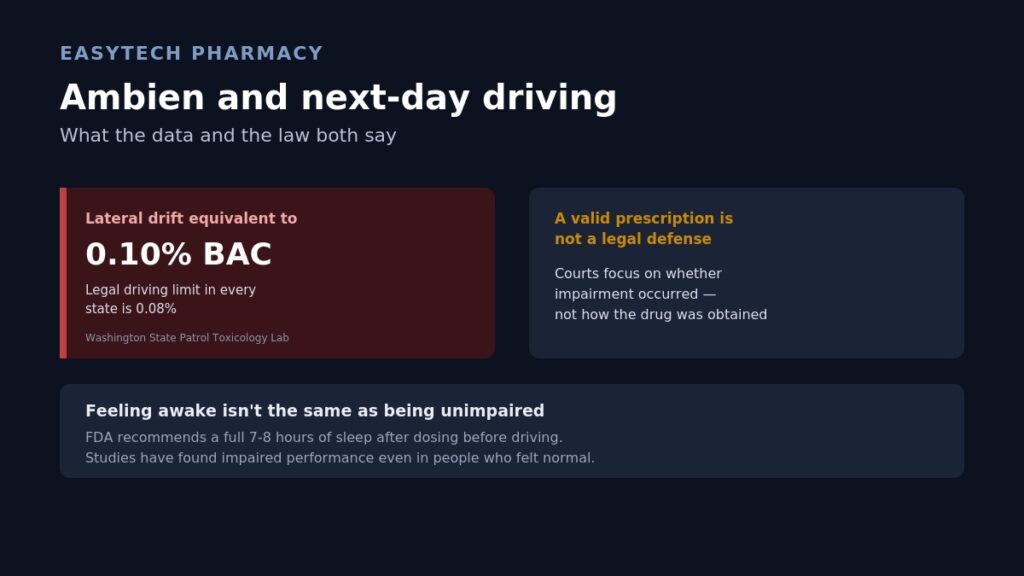
Here’s a detail that surprises a lot of people: taking Ambien exactly as prescribed doesn’t protect you from a DUI charge the next morning. That’s not a technicality. It’s how the law actually treats impairment. Real, measurable data backs this up, showing what zolpidem does to driving performance well after you’ve woken up.
What “Next-Day Impairment” Actually Measures
This isn’t a vague feeling of grogginess. Researchers have studied it directly using standardized driving tests, and the results are specific. One well-cited study found that zolpidem produced an increase in lateral drift, essentially the car drifting within its lane. That increase was equivalent to a blood alcohol concentration of 0.10%. For context, the legal driving limit in every U.S. state is 0.08%. That comparison alone puts the risk in concrete terms most people don’t expect from a sleep medication.
The mechanism comes down to timing and half-life. Zolpidem’s half-life sits around two hours, but that’s an average. Clearance varies by individual, dose, and other factors. Take a dose without a full seven to eight hours of sleep afterward, or take more than the recommended amount, and measurable levels can still circulate well into the next morning, even when you feel awake and alert.
Why “I Felt Fine” Isn’t the Same as “I Was Fine”
This is one of the trickiest parts of next-day impairment: subjective alertness and actual driving performance don’t always match. Studies on zolpidem and similar sleep medications have found impaired driving performance in people who reported feeling normal and awake. The drug affects reaction time, coordination, and attention in ways you might not consciously notice. That’s exactly why the FDA’s 2013 warning focused on measurable blood levels rather than how a person says they feel.
Can You Actually Get a DUI on a Legal Prescription?
Yes, and this catches people off guard more than almost anything else about this medication. Every U.S. state allows prosecution for driving under the influence of drugs, not just alcohol. Having a valid prescription is not a legal defense if the medication impaired your ability to drive safely. Courts have consistently ruled that the standard is impairment itself, not whether you obtained the substance legally.
This applies even to sleep-driving cases where the person has no memory of getting behind the wheel. Courts have generally treated this similarly to voluntary intoxication. The person chose to take a medication with known impairment risks, so most rulings on this question haven’t accepted lack of memory during the episode as a valid defense.
Line Up Support Before You Adjust Your Dose or Timing
If you and your provider decide to lower your dose, switch medications, or change your timing because of driving concerns, line up that support before you make the change, not after. Adjusting course doesn’t mean abandoning help for sleep entirely.
If the underlying insomnia is still an issue at a lower dose, non-habit-forming options are worth discussing. Our guide on sleeping pills that are not habit forming and our comparison of trazodone vs Ambien both cover alternatives with a different risk profile. Our guide on vitamins for sleeplessness covers non-pharmaceutical support worth building into your routine, especially useful if you’re trying to reduce reliance on a dose that’s affecting your mornings.
If you’re managing another condition alongside this adjustment, blood pressure medications are a common overlap, review your full medication list with your pharmacist. Our guide on does Ambien lower blood pressure covers one relevant interaction worth knowing about.
If next-day grogginess persists even after adjusting your dose or timing, that’s worth a proper evaluation rather than just pushing through it behind the wheel. Our guide on when sleeplessness needs a doctor covers the signs that mean it’s time for that conversation.
According to MedlinePlus, doctors recommend gradually reducing the dose of zolpidem rather than stopping suddenly, particularly after regular use, to minimize withdrawal effects, worth keeping in mind if driving concerns are part of what’s prompting a change.
What a DUI Charge Involving Ambien Actually Looks Like
- Field sobriety and drug recognition evaluation. Officers who suspect drug impairment, rather than alcohol, often bring in a trained Drug Recognition Expert to evaluate coordination, pupil response, and other physical signs.
- Blood or urine testing. A positive test for zolpidem doesn’t automatically prove impairment at the time of driving, since the drug can remain detectable well after its effects fade. Prosecutors still use it as evidence alongside other observations.
- Charges and penalties vary by state. Some states classify this as a misdemeanor DUID, generally a lesser charge than a full DUI. A small number, including Florida since 2018, have specifically classified zolpidem as a controlled substance under DUI statutes, which can affect how a case gets charged.
How to Actually Reduce Your Risk
- Build in a full 7 to 8 hours between taking the dose and needing to drive. This is the FDA’s specific recommendation to minimize next-morning impairment.
- Take the lowest effective dose. Our guide on the Ambien Dosage covers the 2013 dosing warning in more depth. It exists specifically because higher doses correlate with more next-day impairment.
- Never combine it with alcohol or other sedatives the night before driving. This combination compounds impairment well beyond what either substance alone would cause.
- Pay attention to how you actually perform, not just how you feel. If mornings after a dose consistently involve grogginess, slower reactions, or difficulty concentrating, bring that to your prescriber rather than pushing through.
- Have a backup plan for mornings when a full night’s sleep wasn’t possible. A shortened sleep window is one of the clearest risk factors for lingering impairment.
The Bottom Line
Next-day driving impairment from Ambien is measurable, well-documented, and legally significant. A valid prescription protects you from nothing once you’re behind the wheel. Feeling alert isn’t a reliable guide to whether you actually are unimpaired. Understanding the real timing and dosing guidance, and building in a genuine buffer before driving, is the clearest way to stay both safe and legally protected.
For the original clinical research on zolpidem’s driving impairment profile, see Zolpidem and Driving Impairment, published by the Washington State Patrol Toxicology Lab.
Frequently asked questions
Can I get a DUI for driving on Ambien even with a valid prescription?
Yes. A legal prescription doesn’t prevent a DUI charge if the medication impaired your ability to drive. Courts focus on whether impairment occurred, not whether you obtained the drug legally.
How long after taking Ambien is it safe to drive?
The FDA recommends a full 7 to 8 hours of sleep after taking the dose before driving or doing other activities that require full alertness.
Can I be charged with a DUI if I don’t remember driving at all?
Yes. Courts have generally treated sleep-driving cases similarly to voluntary intoxication, since the person chose to take a medication with known impairment risks.
Does feeling awake mean I’m safe to drive after taking Ambien?
Not necessarily. Research has found impaired driving performance in people who reported feeling normal and alert. That’s why current dosing guidance relies on blood-level data, not subjective feeling.
Related reading
- The Ambien black box warning: a full timeline
- Ambien complex sleep behaviors: sleepwalking, sleep-driving, and the black box warning
- Ambien and fall risk in elderly patients: what the data shows
- Is Ambien a controlled substance? Schedule IV explained
Questions about your dose and driving safety? Talk to your pharmacist or prescriber directly. EasyTech Pharmacy can help you review your prescription and timing.
For local pharmacy access near you, our Ambien near me guide covers pharmacies across the world.
Visit EasyTech Pharmacy — sleep medication with real pharmacist guidance.