Ambien High — What It Actually Is, Why People Seek It, and Why It Is Dangerous
People search for “Ambien high” for different reasons are curious about what the experience is Some have already had an unexpected experience and want to understand what happened. Some are looking for information because someone they know is misusing the medication. And some are researching because they are struggling with their own use patterns.
This guide covers the topic directly and honestly. What an Ambien high actually is at the neurological level. Why people seek it. What the experience actually involves versus what people expect. And why — in every clinical and practical sense — it is a dangerous path that does not go where people hope it will.
If you are currently concerned about your own Ambien use pattern, the most important section of this guide is the last one. If you are researching the topic for information, the full picture is here.
What Is an Ambien High — The Neurological Reality
Ambien (zolpidem) produces its effects by amplifying GABA-A receptor activity across the brain. GABA is the central nervous system’s primary inhibitory signal — the mechanism that slows neural activity. At therapeutic doses taken before sleep, this produces sedation, cognitive slowing, and the conditions that allow sleep onset.
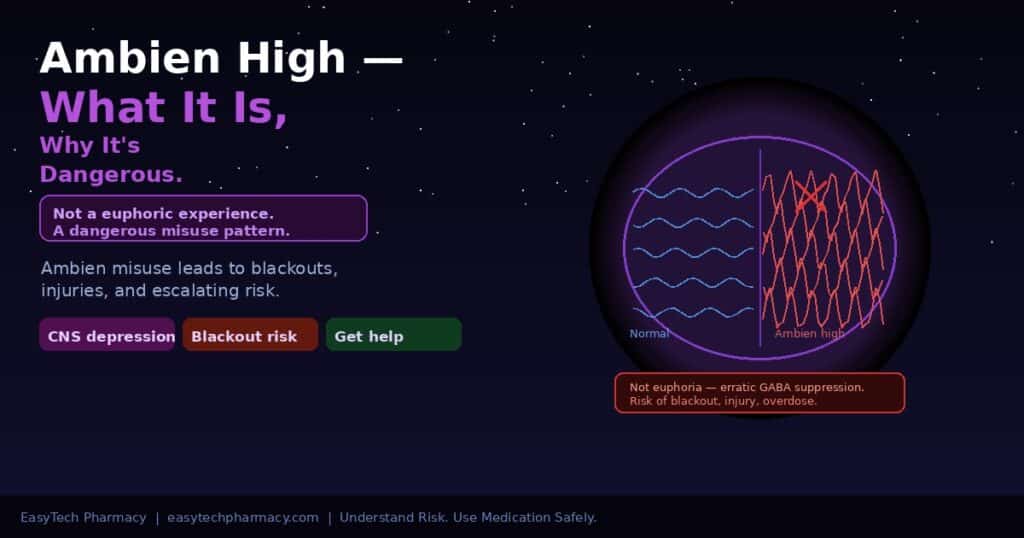
When Ambien is taken at higher doses, combined with alcohol, taken while fighting the drowsiness rather than going to bed, or taken in ways other than as intended — the GABA amplification becomes more extreme and less predictable. The experience people call an “Ambien high” is the result of this excessive, irregular GABA suppression affecting brain regions unevenly.
It is not euphoria in the way opioids or stimulants produce it. Opioids produce euphoria through activation of the reward pathway — a dopamine surge that produces genuine feelings of pleasure and wellbeing. Stimulants do the same through a different mechanism. Ambien does neither of these things. It has no significant effect on the dopamine reward system at any dose.
What it produces instead is dissociation, disinhibition, and perceptual distortion — effects that come from the uneven suppression of different brain regions at once. The prefrontal cortex — responsible for judgment, impulse control, and reality-checking — goes offline early and strongly. Meanwhile, sensory and motor systems remain partially active in ways that produce strange perceptual experiences without the cognitive framework to contextualize them.
According to the DEA’s zolpidem abuse profile, the most commonly reported effects when Ambien is misused include dissociation, memory loss, visual distortions, and disinhibited behavior — not the euphoria typically associated with controlled substance misuse. People often describe the experience as dreamlike, disorienting, and confusing rather than pleasurable.
Why People Seek an Ambien High — The Real Reasons
Understanding why people misuse Ambien is not about excusing the behavior — it is about understanding the underlying dynamics that make the pattern hard to interrupt.
Resistance to the Drowsiness
The most common path to an unintended Ambien high is not deliberate misuse — it is taking Ambien and then staying awake. When someone takes Ambien and remains upright and active, the medication begins producing its GABA suppression while environmental and behavioral alertness signals are still present. The resulting state — partial sedation while still active — produces the disoriented, disinhibited experience people describe as an Ambien high.
This is also why this pattern is dangerous in ways that pure sleep use is not. A person in this state has significantly impaired judgment and motor control but is not in bed. They may make decisions — to drive, to eat, to contact people — that they would never make with normal cognition. Our guide on Ambien hallucinations covers how this state relates to the parasomnia experiences that can occur during misuse.
Deliberate Dose Escalation
Some people deliberately take higher doses than authorized — sometimes in combination with alcohol — seeking a more pronounced altered state. This pattern typically begins when tolerance has developed and the standard dose no longer produces the same effect. Rather than addressing the tolerance problem, the person escalates the dose to try to recapture the initial effect.
This escalation does not produce the desired result. Tolerance develops to the sedative effects but not equally to the side effects and risks. Increasing the dose primarily increases the risk of blackout, injury, and overdose — not the subjective pleasure of the experience.
Self-Medication of Anxiety or Distress
A significant portion of Ambien misuse involves people using the medication to escape emotional distress rather than to sleep. The dissociative quality of high-dose zolpidem can temporarily blur painful feelings, intrusive thoughts, or acute anxiety. This is not a therapeutic effect — it is the pharmacological equivalent of trying to run from a problem. The underlying distress is unchanged when the medication clears, and the pattern of escalating use develops quickly.
Curiosity or Social Influence
Some misuse begins with curiosity about a medication that is already present in the household — particularly among younger adults or adolescents who come across a family member’s Ambien. The perceptual and behavioral effects at supratherapeutic doses are sometimes described in social media or peer contexts as interesting or entertaining, creating curiosity that does not come with accurate information about the risks involved.
What the Ambien High Experience Actually Involves
The experience reported by people who have used Ambien above therapeutic doses, while resisting sleep, or combined with alcohol includes the following:
- Dissociation: A sense of detachment from the environment or from one’s own actions. Many people describe feeling like they are watching themselves from outside rather than being present in their own experience.
- Anterograde amnesia: Memory formation is severely impaired. Extended periods — sometimes hours — have no memory trace the following morning. People may engage in conversations, send messages, eat entire meals, or leave their homes with no recollection afterward.
- Visual and perceptual distortions: Objects may appear to move, patterns may seem animated, and people may see things that are not present — not in the vivid way associated with psychedelics, but in the confusing, disorienting way associated with excessive GABA suppression. This is different from a pleasant hallucination experience and is frequently described as frightening rather than enjoyable.
- Disinhibition: Reduced impulse control produces behavior the person would not exhibit sober — sending messages they regret, making impulsive decisions, saying things they would not ordinarily say. This is not experienced as pleasurable freedom — it is the absence of judgment without the presence of any positive alternative.
- Poor motor coordination: Falls, dropping objects, difficulty walking. Combined with the dissociative state, this creates significant injury risk from activities as simple as getting up to use the bathroom.
- Respiratory depression at very high doses: At supratherapeutic doses, particularly in combination with alcohol or other CNS depressants, zolpidem can suppress the brain’s respiratory drive. This is the overdose mechanism — the same pathway that makes opioid overdoses fatal operates in a less pronounced way with zolpidem at high doses.
The honest characterization of this experience is not a high in any recreational sense. It is cognitive impairment, memory loss, physical risk, and dissociation — without the positive aspects people seeking an altered state are typically looking for.
The Specific Dangers of Ambien Misuse
Each aspect of the experience described above carries specific, documented risks.
Injury From Impaired Motor Control
Falls are the most common acute physical injury associated with Ambien misuse. Someone in a dissociated state with impaired coordination who gets up, moves around, or attempts any physical activity faces a significantly elevated fall risk. Head injuries, fractures, and burns from kitchen incidents during amnesiac episodes are all documented in emergency department data.
Decisions Made During Blackout
The amnesia associated with Ambien misuse means that conversations, agreements, financial transactions, and other decisions made during an episode have no memory trace. People have made significant decisions — sent compromising messages, agreed to things, made purchases — with no awareness of having done so. The consequences of these decisions exist in reality despite the absence of any memory of making them.
Driving Under the Influence
Sleep-driving — getting into a car and driving while in an amnesiac state from Ambien — is one of the most dangerous documented outcomes of Ambien misuse. It has resulted in accidents, DUI charges, and fatalities. The person has no awareness of driving and no memory of it afterward. The absence of intent does not change the outcome.
Escalating Tolerance and Dependence
Misuse patterns — higher doses, more frequent use, combination with alcohol — accelerate tolerance development dramatically. As tolerance builds, higher doses are needed to produce any effect at all. The dependence that develops is stronger and more difficult to discontinue than that from therapeutic use. Stopping after a significant misuse period produces pronounced rebound effects — insomnia worse than before starting, anxiety, agitation — that make discontinuation very difficult without support.
Overdose Risk
At very high doses or in combination with alcohol, benzodiazepines, or opioids, zolpidem overdose is possible and can be fatal. The respiratory depression mechanism — present at supratherapeutic doses — combined with the memory impairment that makes it impossible to know how much has been taken creates a genuine overdose risk. Zolpidem overdose is represented in poison control and emergency department data in the US every year.
The Alcohol Combination — Why It Escalates Every Risk
The Ambien misuse pattern most commonly associated with serious harm involves simultaneous alcohol use. Alcohol independently enhances GABA activity — adding its CNS depressant effect on top of zolpidem’s creates a synergistic suppression significantly more extreme than either substance alone.
The combination dramatically increases every risk in the above list. Respiratory depression risk increases. Blackout duration extends. Motor impairment becomes more severe. The dissociative state becomes deeper and more frightening. And critically — the person’s ability to recognize that they are in danger and need help is itself impaired.
Our dedicated guide on Ambien and alcohol covers the full mechanism and documented consequences of this specific combination.
If Someone You Know Is Misusing Ambien
Recognizing Ambien misuse in someone you care about can be difficult because the amnesia involved means the person may genuinely not know — or acknowledge — what is happening. Signs worth paying attention to include:
- Finding evidence of nighttime activity the person has no memory of
- Noticing the person’s Ambien supply running out faster than expected given authorized doses
- Observing disoriented, slurred, or strange behavior in the evening hours
- Finding concerning messages or communications the person does not remember sending
- Noticing the person becoming defensive or agitated when asked about their medication use
Having a direct conversation is more effective than hoping the pattern self-corrects. The SAMHSA National Helpline at 1-800-662-4357 provides free, confidential information and treatment referrals for substance use concerns — available 24 hours a day, 7 days a week.
If You Are Concerned About Your Own Ambien Use
This section is specifically for people who recognize themselves in what has been described above. Several signs suggest a use pattern has moved beyond therapeutic.
- Taking more Ambien than the authorized amount
- Taking Ambien at times other than bedtime
- Using Ambien to cope with emotional distress rather than insomnia
- Feeling unable to sleep at all without Ambien even after weeks of use
- Finding that you need an increasing amount to feel any effect
- Waking with no memory of the previous evening despite having been apparently awake
These are recognized patterns of sedative-hypnotic misuse. They are not character failures. They are pharmacological processes — tolerance and dependence — that respond to structured support.
The most effective first step is talking to a pharmacist or healthcare provider honestly about what is happening. They can assess the situation, help with a structured tapering plan if needed, and connect you with appropriate support. Stopping Ambien abruptly after significant extended use can produce withdrawal effects — a medically supervised taper is significantly safer and more comfortable than stopping cold turkey.
SAMHSA’s National Helpline (1-800-662-4357) is available 24/7, free, and confidential. If you are not ready for that step, our guide on sleeping pills that are not habit forming covers alternatives that address insomnia without the dependence risk of zolpidem.
Getting Back to Therapeutic Use — What That Looks Like
For people who want to reset their Ambien use to the therapeutic purpose it was designed for — short-term sleep onset support at appropriate doses — several approaches help.
A structured dose taper under pharmacist guidance reduces withdrawal effects and rebound insomnia. Cognitive behavioral therapy for insomnia (CBT-I) addresses the underlying sleep patterns that made Ambien necessary and provides sustainable alternatives. Switching to a non-controlled sleep medication like trazodone eliminates the Schedule IV dependency concern entirely while maintaining sleep support during the transition period.
The goal is not just to stop misusing Ambien — it is to establish a relationship with sleep that does not require escalating medication. That is achievable. It requires more than willpower — it requires the right strategy and usually some support — but it is a well-established clinical path with good outcomes.
Frequently Asked Questions
What does an Ambien high feel like?
The experience most commonly described includes dissociation (feeling detached from reality or from oneself), visual distortions, significantly impaired memory formation (blackout), disinhibited behavior, and poor motor coordination. It is not characterized by euphoria — it is disorienting and frequently frightening rather than pleasurable. Many people who experience it describe it as confusing and do not have full memory of what occurred.
Is it possible to get high on Ambien?
Zolpidem can produce significant altered states when taken above therapeutic doses or combined with alcohol — but these are not euphoric in the way recreational drug users typically seek. The experience involves CNS depression, dissociation, and memory impairment rather than any positive activation. The DEA notes this distinction in its abuse documentation — misuse of Ambien produces impairment, not the reward pathway activation associated with substances typically sought for recreational use.
Is Ambien addictive?
Physical dependence can develop with extended use or misuse. This is why Ambien is a Schedule IV controlled substance — it has recognized dependence potential. Therapeutic short-term use carries lower dependence risk than extended daily use or misuse patterns. Stopping after significant extended use can produce withdrawal effects including rebound insomnia and anxiety — a medically supervised taper is recommended rather than abrupt discontinuation.
What should I do if I think I took too much Ambien?
Call Poison Control immediately at 1-800-222-1222. If breathing is slow or labored, if the person cannot be roused, or if you suspect a large overdose — call 911 immediately. Do not wait to see if the person “sleeps it off.” Combined with alcohol, Ambien overdose can progress rapidly and requires emergency medical attention.
Can Ambien misuse be treated?
Yes — sedative-hypnotic dependence is a well-understood and treatable condition. A structured dose taper under medical supervision, combined with behavioral sleep therapy and in some cases transition to a non-controlled alternative, produces good outcomes for most people. SAMHSA’s National Helpline (1-800-662-4357) provides free 24/7 referrals to treatment resources.
Bottom Line — This Is Not What People Hope It Will Be
The honest summary of Ambien high is this. The experience people are looking for — pleasurable altered state, euphoria, escape — is not what Ambien produces when misused. What it produces is memory loss, dissociation, impaired judgment, physical injury risk, and escalating dependence. The people who seek an Ambien high most commonly describe the experience as frightening and disorienting — not pleasurable — and many have no memory of it at all.
Ambien is a genuinely useful medication when used appropriately — the right dose, at the right time, for the right duration. It helps millions of people get through the kind of short-term insomnia that can otherwise derail work, health, and mental wellbeing. Using it outside those parameters does not produce a better experience. It produces a more dangerous one.
At EasyTech Pharmacy, our pharmacist team is available to discuss any concerns about your current medication use — including if you feel your Ambien use has moved outside the therapeutic range. We carry FDA-approved generic zolpidem and alternatives for people who need a non-controlled option.
Looking for information about safer sleep options? Our guide on Ambien Price in 2026 covers every alternative. And for local pharmacy access near you, our How to Find the Best Place to buy ambien online overnight? guide covers options across the US.
Visit EasyTech Pharmacy — the right sleep medication used the right way.