Ambien vs. Xanax: Two Different Drugs Often Confused
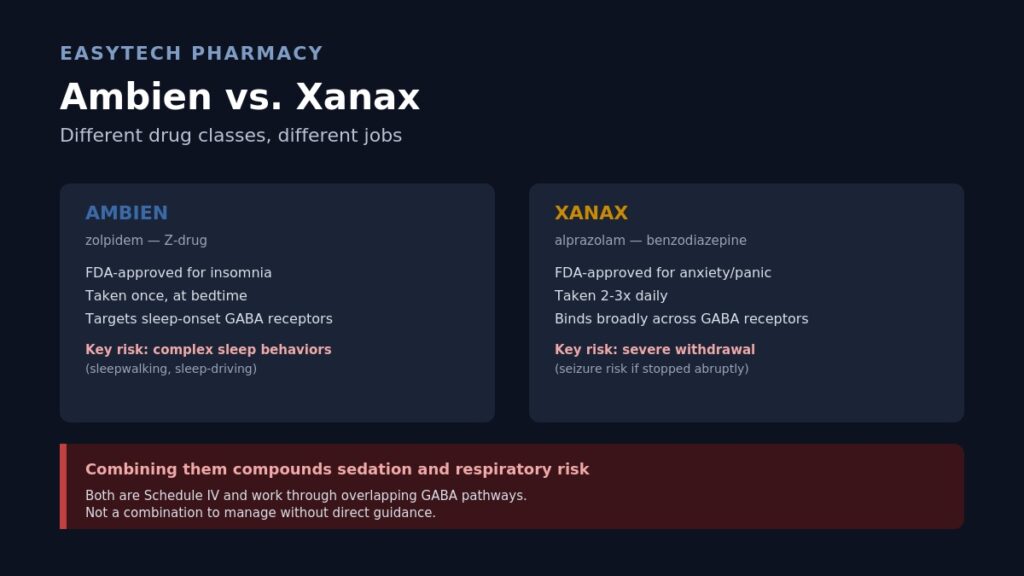
These two get lumped together constantly, and it’s easy to see why—they are small pills that make you feel calmer, require a prescription, and show up in conversations about dependence and sleep. But Ambien and Xanax aren’t cousins doing the same job differently. Pharmaceutical companies designed them for entirely different problems, and understanding that difference actually matters for your safety, not just your vocabulary.
The Core Difference: What Each One Is Actually For
Ambien (zolpidem) belongs to the non-benzodiazepine class of sedative-hypnotics, which doctors often call a “Z-drug.” The FDA specifically approved it to treat short-term insomnia; patients take it once at bedtime to promote sleep onset.
Xanax (alprazolam) is a benzodiazepine. The FDA approved it for generalized anxiety disorder and panic disorder, and patients typically take it multiple times throughout the day rather than once at bedtime. Any use for sleep counts as off-label—meaning regulatory bodies did not approve or design the drug for that purpose, even though patients take it for sleep in practice.
Same Neurotransmitter, Different Targeting
Both drugs work through GABA, the brain chemical responsible for calming neural activity, but they get there differently. Xanax binds broadly across benzodiazepine receptors throughout multiple brain regions, which is part of why it affects anxiety, muscle tension, and general calm all at once. Ambien selectively targets GABA-A receptors associated mainly with sleep onset, a narrower, more targeted action. This selectivity is a meaningful part of why Ambien tends to produce fewer of the broader sedative and anti-anxiety effects Xanax carries.
Duration and Dosing: Genuinely Different Patterns
Ambien is short-acting and taken once nightly, built around a single job: helping you fall asleep. Xanax has a longer duration of action and is typically dosed two to three times a day, built for sustained anxiety management throughout waking hours. This isn’t a minor scheduling detail. It reflects two completely different treatment philosophies.
Risk Profile: Similar Category, Different Specific Dangers
Both are Schedule IV controlled substances with real dependence and misuse potential. Both appear on the Beers Criteria, the list of medications considered potentially inappropriate for older adults due to fall, fracture, and cognitive risk. But the specific dangers each carries look different:
- Ambien is specifically associated with complex sleep behaviors, sleepwalking, sleep-driving, and similar episodes, covered in depth in our guide on Ambien’s black box warning.
- Xanax carries a higher-profile withdrawal risk. Stopping it suddenly after regular use can produce especially severe withdrawal symptoms, including seizure risk in some cases, generally considered more intense than typical zolpidem withdrawal.
- Xanax combined with opioids carries a well-documented risk of severe respiratory depression, a combination the FDA has specifically flagged as dangerous.
- One study found zolpidem associated with a higher incidence of fractures than alprazolam specifically, a reminder that “less severe overall” doesn’t mean risk-free in every category.
What Happens When People Take Both
This combination comes up more than you’d expect, sometimes prescribed together for someone managing both anxiety and insomnia, sometimes combined without medical guidance. Either way, both drugs depress the central nervous system through overlapping GABA pathways, and combining them compounds sedation, impairs coordination and memory further, and raises the risk of dangerous respiratory depression beyond what either drug alone would produce. This isn’t a combination to manage casually or without direct guidance.
Cost and Availability
Both medications are available as generics, zolpidem and alprazolam, at significantly lower cost than any brand-name version. Our guide on Ambien vs. zolpidem covers the brand-versus-generic pricing gap in more detail, and the same general pattern, generic dramatically cheaper, applies to Xanax and alprazolam as well.
Which One Might Actually Fit Your Situation
- Primary issue is falling asleep, no significant daytime anxiety? Ambien is built specifically for this and carries FDA approval for it.
- Primary issue is anxiety or panic, with sleep trouble as a secondary symptom? Xanax targets the anxiety directly, which may resolve sleep issues driven by anxiety rather than treating sleep and anxiety as separate problems.
- Concerned about severe withdrawal risk? This is generally considered more pronounced with Xanax than with Ambien, worth factoring into a long-term treatment conversation.
- Concerned about complex sleep behaviors specifically? This risk is far more associated with Ambien than Xanax.
The Bottom Line
Ambien and Xanax get confused because they’re both small, calming, controlled-substance pills, but they’re built for genuinely different problems: sleep onset versus anxiety and panic management. They work through the same neurotransmitter system with different targeting, carry different specific risks, and combining them without guidance meaningfully raises danger rather than doubling benefit. Knowing which problem you’re actually trying to solve is the real starting point for figuring out which one, if either, fits.
For a detailed clinical comparison, see SingleCare’s comparison of Ambien and Xanax.
Frequently asked questions
Is Xanax stronger than Ambien?
They’re not directly comparable in strength since they treat different conditions through different mechanisms. Xanax has broader sedative effects across multiple brain regions, while Ambien is more selectively targeted toward sleep onset.
Can I take Ambien and Xanax together?
This combination significantly compounds sedation and respiratory depression risk. It shouldn’t be done without direct medical guidance, even if both medications are separately prescribed.
Which has worse withdrawal, Ambien or Xanax?
Xanax withdrawal is generally considered more severe, with a documented risk of seizures in some cases after abrupt discontinuation of regular use, compared to typical zolpidem withdrawal.
Can patients use Xanax for sleep instead of Ambien?
Doctors sometimes prescribe Xanax off-label for sleep, but the FDA hasn’t specifically approved it for insomnia the way it has Ambien. Its longer duration and different risk profile make it a genuinely distinct choice, not a simple substitute.
Related reading
- Ambien complex sleep behaviors: sleepwalking, sleep-driving, and the black box warning
- Ambien vs. zolpidem: brand vs. generic explained
- Ambien alternatives: a full overview of your options
- Substitutes for Ambien: A Full Overview of Your Options
Managing both anxiety and sleep trouble and not sure which direction to go? Talk to your pharmacist or prescriber. EasyTech Pharmacy can help you think through your options.
For local pharmacy access near you, our Ambien near me guide covers pharmacies across the world.
Visit EasyTech Pharmacy — sleep medication with real pharmacist guidance.