Ambien Alternatives for Pregnant Women: What the 2026 Research Actually Recommends
If you’ve read our broader guide on Ambien and pregnancy safety, you already know the malformation data has genuinely improved. But that post answers “is Ambien risky,” not “what do I actually take instead.” This one focuses specifically on the alternatives themselves, ranked by what the 2025 and 2026 research actually supports.
Why This Deserves Its Own Ranking
A 2025 case report and literature review in the Journal of Clinical Sleep Medicine specifically examined this exact question, alternatives to Z-drugs during pregnancy, and found the evidence quality varies considerably between options. Some alternatives have decades of exposure data behind them. Others remain genuinely under-studied. Treating them as interchangeable would miss that real distinction.
Doxylamine: The Established First-Line Choice
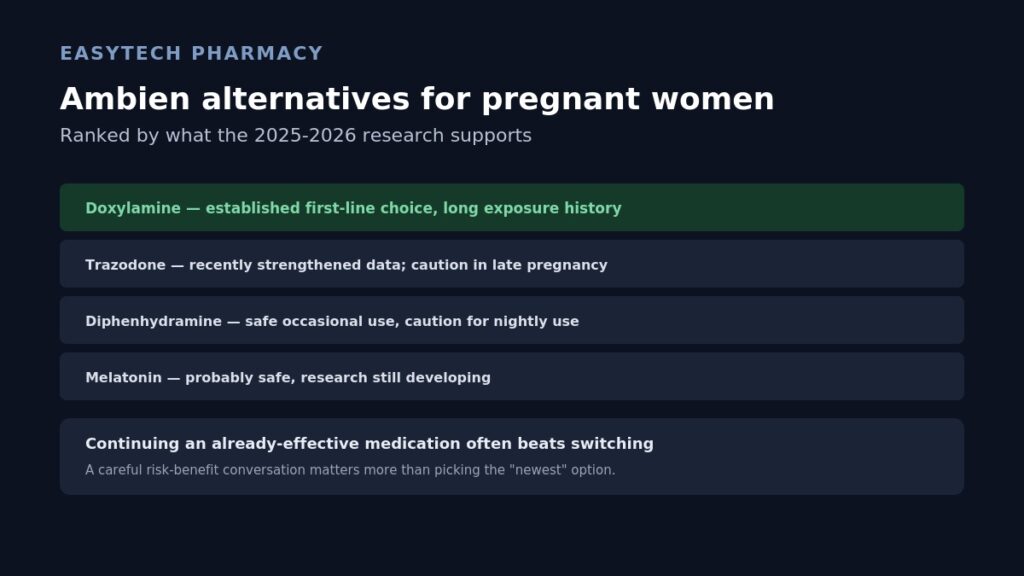
This is where the current research lands most clearly. Doxylamine remains first-line choice for insomnia in pregnancy that hasn’t responded to non-pharmacological strategies. Its safety track record comes largely through its role as an ingredient in Diclegis, an FDA-approved combination treatment for pregnancy nausea, giving it a genuinely long history of exposure data in pregnant populations specifically, not just borrowed from general population studies.
Trazodone: More Reassuring Than Expected, With a Real Late-Pregnancy Caveat
Trazodone’s pregnancy safety data has grown more reassuring recently. Studies covering over 300 first-trimester exposures found no increased risk of birth defects above the general population baseline, and multiple studies found no increase in miscarriage risk. A randomized controlled trial found trazodone at 50 mg performed similarly to diphenhydramine at 25 mg after six weeks, with both improving sleep duration and efficiency, and both also improving depressive symptoms. The main caution centers specifically on effects on newborns when trazodone is used late in pregnancy, an important nuance rather than a blanket concern across all trimesters.
Diphenhydramine: Genuinely Safe, With a Real Caveat
Diphenhydramine is generally considered safe for occasional use during pregnancy, and most studies haven’t found a link between its use and birth defects. The caveat is right there in that phrase, occasional use. It’s worth being direct about something several sources flag clearly: some medical institutions specifically list pregnancy as a reason to avoid using diphenhydramine or doxylamine as routine, nightly sleep aids, reflecting the fact that unsupervised, regular use hasn’t been established as safe the way occasional use has.
Melatonin: Probably Safe, With Research Still Catching Up
Research indicates taking melatonin during pregnancy is probably safe, though the evidence base remains thinner than doxylamine’s or trazodone’s. Our broader guide on Ambien vs. melatonin covers the mechanism and dosing details that apply here too, including the common mistake of taking a much higher dose than research actually supports.
Benzodiazepines: An Option Specifically for Anxiety-Linked Insomnia
For pregnant women whose insomnia is tangled up with anxiety specifically, certain benzodiazepines like lorazepam and clonazepam may be useful, with adequate data supporting their reproductive safety in this specific context. This connects to the broader anxiety-insomnia pattern covered in our guide on the best Ambien alternative for anxiety-related insomnia, though the pregnancy-specific risk-benefit calculation here deserves its own careful conversation.
Why Continuing What Already Works Sometimes Beats Switching
This is a genuinely important, easy-to-overlook point from the 2026 research: continuing a previously effective hypnotic, after a careful risk-benefit discussion, is generally considered preferable to starting an entirely new medication during pregnancy. Switching medications isn’t automatically the safer move just because the new option sounds gentler. Sometimes the better path is sticking with what’s already working, evaluated carefully rather than swapped reflexively.
Non-Drug Options Worth Trying First
Behavioral strategies remain the first-line treatment for insomnia in pregnancy specifically, before any medication conversation. This aligns directly with the broader case for CBT-I covered in our comparison of CBT-I vs. Ambien, and it carries zero medication-exposure considerations at all, a genuinely appealing feature during pregnancy specifically.
Side-by-Side: What the Evidence Actually Supports
- Strongest, longest-standing evidence: Doxylamine, largely through its Diclegis-related exposure data.
- Recently strengthened evidence: Trazodone, backed by a direct head-to-head trial against diphenhydramine.
- Safe for occasional use, weaker for nightly use: Diphenhydramine.
- Probably safe, still under-researched: Melatonin.
- Situational, anxiety-specific: Certain benzodiazepines, evaluated case by case.
- Zero exposure risk: CBT-I and behavioral strategies, recommended as the actual first-line approach.
The Bottom Line
The alternatives to Ambien during pregnancy aren’t interchangeable, and 2026’s research makes the distinctions clearer than ever. Doxylamine remains the most established first-line pharmacological choice. Trazodone’s safety picture has genuinely improved, with a real, trimester-specific caveat worth knowing. Diphenhydramine works for occasional use but carries more caution around nightly use than its OTC status might suggest. Behavioral strategies remain the actual first-line recommendation before any of this, and continuing an already-effective medication sometimes beats switching reflexively to something that sounds gentler.
For the full 2026 case review, see “How do you Zzz during pregnancy?”, published in the Journal of Clinical Sleep Medicine.
Frequently asked questions
What’s the safest sleep medication to take during pregnancy?
Current research points to doxylamine as the established first-line pharmacological choice, largely due to its long track record through its use in pregnancy-nausea treatments.
Is trazodone safe to take for insomnia while pregnant?
Recent research is more reassuring than previously thought, with large studies finding no increased birth defect or miscarriage risk. The main caution centers on use specifically in late pregnancy.
Can I take Benadryl every night for sleep during pregnancy?
Occasional use is generally considered safe, but some medical institutions specifically caution against routine, nightly use during pregnancy, since that pattern hasn’t been established as safe the way occasional use has.
Should I switch medications if my current sleep aid was working before pregnancy?
Not necessarily. Continuing a previously effective medication, after a careful risk-benefit conversation, is often considered preferable to starting something new during pregnancy.
Pregnant and trying to figure out the safest path for your sleep trouble? Talk to your pharmacist or OB provider. EasyTech Pharmacy can help you think it through.
For local pharmacy access near you, our Ambien near me guide covers pharmacies across the world.
Visit EasyTech Pharmacy — sleep medication with real pharmacist guidance.