Effective Insomnia Therapies: CBT-I, Behavioral Treatments, and Medical Approaches
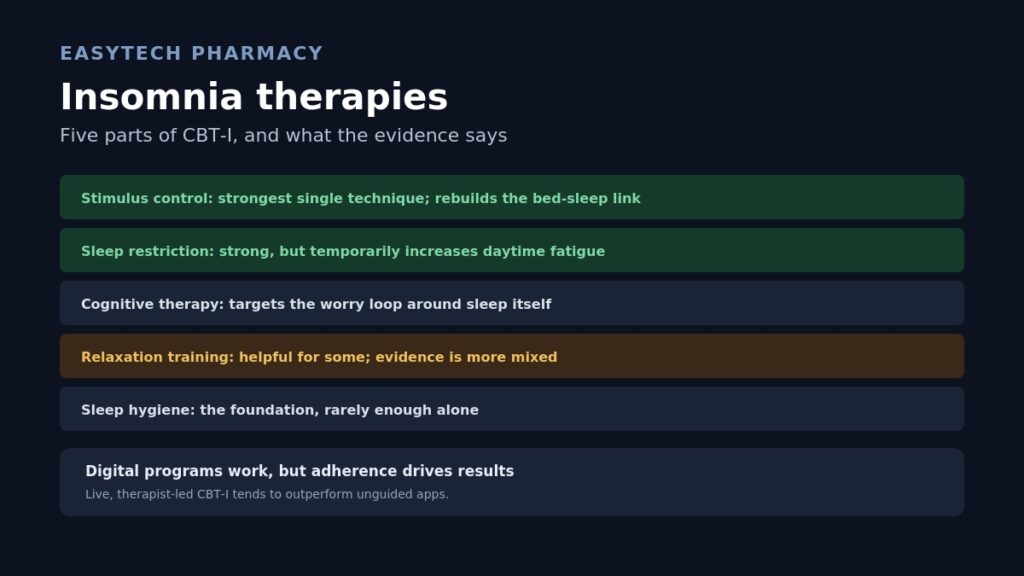
“Insomnia therapy” usually means one thing in a clinical setting: cognitive behavioral therapy for insomnia, or CBT-I. But CBT-I isn’t a single technique. It’s a bundle of several, and each piece has its own job and its own level of evidence. Knowing what’s inside the bundle helps you judge any program, whether it’s delivered by a therapist, an app, or a book.
What CBT-I Actually Contains
CBT-I changes the thoughts and behaviors that keep insomnia going. Most programs combine five core components:
- Stimulus control, which rebuilds the link between your bed and sleep
- Sleep restriction, which limits time in bed to build sleep drive
- Cognitive therapy, which targets unhelpful beliefs and worries about sleep
- Relaxation training, which lowers arousal before bed
- Sleep hygiene education, which covers the habits and environment around sleep
Clinicians usually deliver these over six to eight weekly sessions. Our guide on CBT-I vs. Ambien covers how the full package performs against medication in head-to-head trial data.
Stimulus Control: The Strongest Single Technique
Researchers often call stimulus control the best single behavioral technique for insomnia. The idea is simple. If you lie awake in bed night after night, your brain learns to link the bed with frustration instead of sleep. Stimulus control reverses that link. You go to bed only when sleepy, leave the bed if you can’t sleep, and keep the bedroom for sleep. We cover the practical steps in our guide on how to help insomnia naturally.
Sleep Restriction: Effective, With a Temporary Cost
People with insomnia often spend far too much time lying awake in bed. Sleep restriction limits your time in bed to increase your drive to sleep. The tradeoff is real: it temporarily increases daytime fatigue. That is why therapists usually guide this step and adjust it over time. Alongside stimulus control, it shows strong promise as a stand-alone treatment.
Cognitive Therapy: Targeting the Worry Loop
Insomnia rarely stays a purely physical problem. Over time, worry about sleep becomes its own trigger. Cognitive therapy identifies catastrophic thoughts, such as “I’ll be useless tomorrow if I don’t sleep tonight,” and tests them against reality. This piece matters most for the racing-thoughts pattern covered in our guide on the best sleep aid for trouble falling asleep, since it targets the same arousal that medication only sedates.
Relaxation Training: Helpful, but Mixed Evidence
Relaxation techniques aim to reduce pre-sleep anxiety and physical tension. The evidence here is less consistent than for stimulus control or sleep restriction. The 2021 American Academy of Sleep Medicine guidelines conditionally recommend relaxation therapy, a more cautious endorsement than the behavioral techniques above. It can still help many people, especially when anxiety plays a big role.
Sleep Hygiene: Necessary, but Rarely Enough Alone
Sleep hygiene covers the basics: consistent timing, a cool dark bedroom, limiting caffeine, and winding down. These habits support every other therapy. On their own, though, they rarely resolve chronic insomnia. Think of hygiene as the foundation, not the whole building.
Digital CBT-I: Real Results, Real Limits
Digital CBT-I delivers the same components through an app or website. A systematic review of fully automated programs, with no therapist involved, found moderate to large effects on insomnia severity compared with control groups. That makes digital CBT-I a legitimate option when therapists are scarce or costly.
Two limits are worth knowing. First, adherence drives results. Completing the program isn’t enough; you need to follow the techniques. Second, the complexity of a full multicomponent program can hurt adherence in unguided formats. Research also suggests live, therapist-led CBT-I produces stronger effects than asynchronous digital programs, so a guided option is worth choosing when you can.
Acceptance and Commitment Therapy: A Newer Add-On
Acceptance and commitment therapy, or ACT, takes a different angle. Instead of fighting sleeplessness, it teaches mindfulness and acceptance of racing thoughts. Studies show ACT can help adults with insomnia, and researchers are now testing CBT-I combined with ACT for people who have both insomnia and anxiety. If anxiety fuels your sleep trouble, our guide on the best Ambien alternative for anxiety-related insomnia covers this overlap in more depth.
Therapy vs. Medication: How They Fit Together
These therapies don’t compete with every medication option. Some people use medication as a short bridge while therapy takes hold. The key difference lies in what each approach treats. Medication manages symptoms while it’s active. Therapy changes the underlying pattern, which is why its benefits tend to last.
How to Choose a Starting Point
- Lie awake frustrated in bed? Start with stimulus control.
- Spend far more time in bed than you actually sleep? Sleep restriction targets exactly this, ideally with guidance.
- Mind racing about sleep itself? Cognitive therapy or ACT addresses the worry loop.
- Can’t access a therapist? A well-designed digital program is a reasonable alternative, though live support tends to work better.
- Not sure where to begin? Our complete insomnia treatment guide maps every option by pattern and situation.
The Bottom Line
Insomnia therapy isn’t one technique. It’s a toolkit of five core parts, and the evidence differs for each one. Stimulus control and sleep restriction have the strongest support. Cognitive therapy tackles the worry that keeps insomnia alive. Relaxation training helps some people but shows mixed results. Digital programs offer real benefit with real adherence challenges, and ACT adds a promising option when anxiety is involved. Matching the technique to your pattern works better than trying everything at once.
For a clear overview of how CBT-I works and who provides it, see the Sleep Foundation’s guide to CBT-I.
Frequently asked questions
What are the main insomnia therapies?
CBT-I is the main one. It combines stimulus control, sleep restriction, cognitive therapy, relaxation training, and sleep hygiene education. Acceptance and commitment therapy is a newer add-on.
Which part of CBT-I works best?
Stimulus control and sleep restriction show the strongest evidence as stand-alone techniques. Relaxation therapy shows more mixed results.
Does digital CBT-I work as well as seeing a therapist?
Fully automated programs show moderate to large effects compared with controls. Research suggests live, therapist-led delivery tends to produce stronger effects, and adherence strongly shapes results in either format.
Is sleep restriction safe?
It temporarily increases daytime fatigue, so it’s usually done with guidance and adjusted over time rather than started alone at an extreme level.
Curious which therapy fits your sleep pattern? Talk to your pharmacist. EasyTech Pharmacy can help you think through your next step.
For local pharmacy access near you, our Ambien near me guide covers pharmacies across the world.
Visit EasyTech Pharmacy — sleep medication with real pharmacist guidance.