Zolpidem Withdrawal Timeline: What Each Stage Actually Feels Like
If you’re reading this at 2 a.m. because your body feels like it’s buzzing and sleep won’t come, here’s what you actually need to know: this has a shape. It’s not random, and it’s not permanent. Zolpidem withdrawal follows a fairly predictable timeline, and knowing what stage you’re in can make the whole thing feel a lot less like free fall.
Why withdrawal happens at all
Zolpidem works by boosting a calming brain chemical called GABA. Take it regularly for more than a couple of weeks, and your brain starts adjusting its own signaling to compensate. That adjustment is normal biology, not a character flaw. But it means that once the medication stops, the brain needs time to recalibrate back to producing its own calm and sleep signals. That gap is what withdrawal actually is.
The zolpidem withdrawal timeline, stage by stage
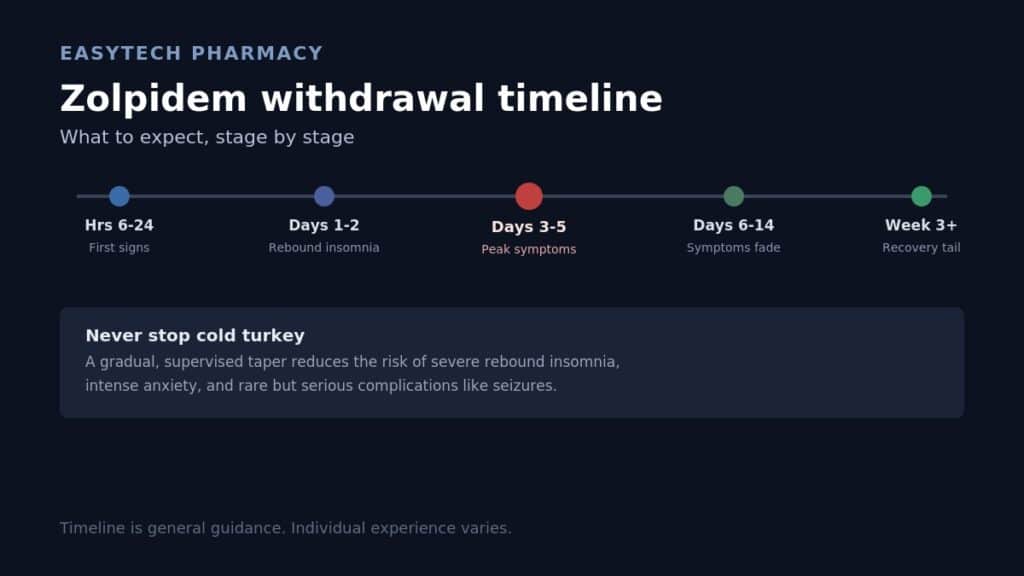
Timelines vary person to person, but the general shape looks like this.
Hours 6 to 24: the first signs
Because zolpidem clears the body quickly, symptoms often start within six to eight hours of the last dose. Early signs tend to be subtle: trouble settling down, a low hum of restlessness, maybe some irritability. Easy to mistake for just a bad night, at first.
Days 1 to 2: rebound insomnia kicks in
This is usually when rebound insomnia shows up in full force, sleep that feels worse than the original problem the medication was treating. Anxiety, mild confusion, and mood swings tend to show up alongside it. It’s a rough stretch, and it’s also completely expected.
Days 3 to 5: the peak
Most people hit their hardest days here. Physical symptoms often intensify, stomach discomfort, shakiness, sweating, a flu-like heaviness. Anxiety can spike into something closer to panic for some people. This is the stage where things feel the most overwhelming, and also the stage that passes the fastest once it starts easing.
Days 6 to 14: the physical symptoms start fading
By the end of the first week or so, most of the physical discomfort begins to lift. Sleep is often still disrupted, but usually less dramatically. Energy starts coming back in small increments.
Weeks 3 onward: the psychological tail
For some people, this is where it ends. For others, especially after longer-term use, lingering anxiety, low mood, or sensitive sleep can stick around for weeks or even a couple of months. This doesn’t mean something went wrong. It means the brain is still finishing its recalibration, and it’s worth naming so it doesn’t catch you off guard.
Why tapering beats stopping cold turkey
Here’s the part that’s genuinely important to get right: stopping zolpidem abruptly, especially after regular or long-term use, carries real risk. The nervous system can become overexcited when the medication disappears too fast, and in some cases that leads to severe rebound insomnia, intense anxiety, or in rare situations, seizures.
A gradual taper, where the dose steps down over time instead of stopping all at once, gives the brain room to adjust without that shock. This is exactly the kind of decision that needs a healthcare provider involved. Not as a formality, but because the right taper speed depends on how long you’ve been taking it, your dose, and your overall health, and that’s genuinely hard to judge accurately on your own.
If withdrawal is on your mind because you’ve noticed some of the dependence patterns we cover in our guide on Ambien dependence, that piece is worth reading alongside this one. And if anything during withdrawal ever crosses into severe territory, our guide on Ambien overdose signs and effects covers when a situation needs emergency attention rather than home management.
What actually helps during the process
- Go slow, not fast. A longer taper is almost always more comfortable and safer than a shorter one.
- Keep a consistent sleep and wake time, even on the nights sleep barely comes. It helps the body re-anchor its rhythm faster.
- Cut caffeine and alcohol during the taper. Both interfere with an already unsettled nervous system.
- Track your symptoms. A simple daily note of how you’re sleeping and feeling gives your provider real data to adjust the taper pace.
- Line up support before you start, whether that’s a pharmacist check-in, a therapist, or just a person who knows what you’re going through.
When to reach out for extra support
Reach out sooner rather than later if you notice confusion that doesn’t clear, hallucinations, chest tightness, or anything that feels like it’s escalating rather than settling. These aren’t expected parts of a routine taper, and they deserve attention right away rather than a wait-and-see approach.
The bottom line
Zolpidem withdrawal has a real, fairly predictable shape: a rough start within the first day, a peak around days three to five, physical symptoms easing over the following week or two, and sometimes a longer psychological tail after that. Knowing this shape ahead of time doesn’t make it easy, but it does make it navigable. Paired with a proper taper and the right support, most people come through this and land somewhere with steadier, more natural sleep on the other side.
For a clinical overview of withdrawal management for sedative-hypnotics, the National Library of Medicine’s overview of benzodiazepine and sedative-hypnotic withdrawal covers the underlying mechanism in more clinical depth.
Frequently asked questions
How long does zolpidem withdrawal usually last?
Most physical symptoms resolve within one to two weeks. Psychological symptoms like anxiety or sensitive sleep can linger for several weeks to a couple of months in some cases, especially after longer-term use.
Is it dangerous to stop Ambien suddenly?
It can be. Abrupt discontinuation raises the risk of severe rebound insomnia, intense anxiety, and in rare cases, seizures. A gradual, supervised taper is significantly safer.
What’s the worst part of the timeline?
Days three through five tend to be the hardest for most people, when physical symptoms and rebound insomnia typically peak.
Does everyone experience the same withdrawal timeline?
No. Dose, how long you were taking it, and individual health factors all shape the timeline. A healthcare provider can give you a more personalized expectation.
For local pharmacy access, our Ambien near me guide covers options across the world.
👉 Visit EasyTech Pharmacy — find the right sleep medication for your situation today.