Ambien vs. Melatonin: Dosage and Mechanism Compared
Here’s a question that comes up constantly and has a genuinely useful non-answer: how much melatonin equals a dose of Ambien? The honest response is that no such conversion exists, and understanding why clears up more about these two options than any dosage chart could.
Two Completely Different Systems, Not Two Strengths of the Same Thing
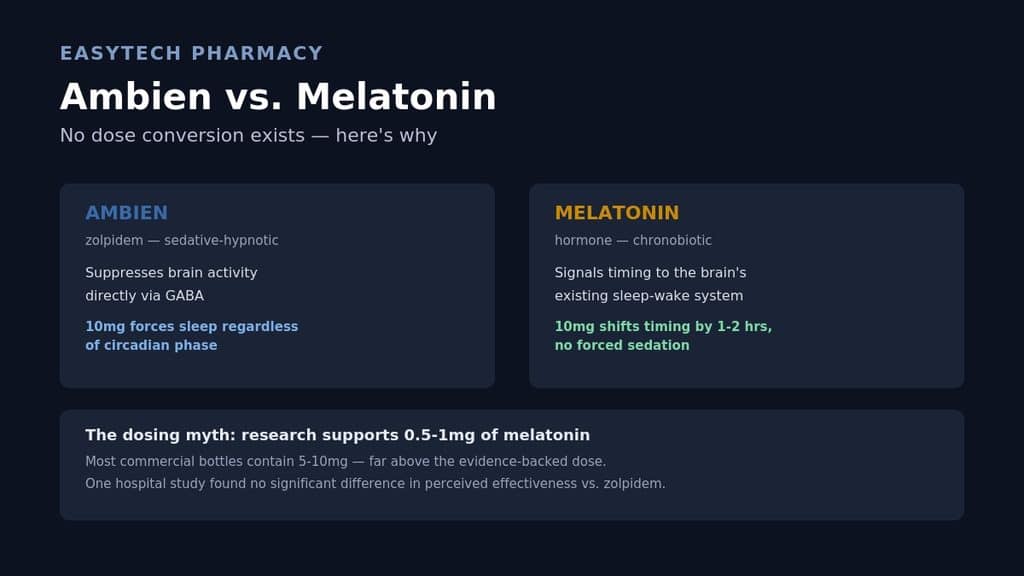
Ambien and melatonin don’t sit on the same scale at different points. They act on entirely separate systems in the brain. Ambien binds to GABA-A receptors and amplifies GABA, the brain’s primary inhibitory neurotransmitter. That amplification suppresses brain activity directly, chemically inducing sleep regardless of what your internal clock is doing. Melatonin does something different: it signals timing, not sedation. It’s a hormone your pineal gland naturally produces at night, and supplemental melatonin works by telling your brain it’s nighttime, shifting the window when sleep becomes more likely rather than forcing it to happen.
A useful way to picture it: a 10 mg Ambien tablet will put most people to sleep regardless of their circadian phase. A 10 mg melatonin tablet, already a notably high dose, would shift sleep timing by an hour or two without producing that same forced sedation. No dose of melatonin recreates what zolpidem does, because they’re not doing the same job in the first place.
The Melatonin Dosage Myth Worth Correcting
Here’s something genuinely surprising that gets lost in most conversations about melatonin: the effective dose range in research is 0.5 to 1 mg, significantly lower than what most commercial products actually contain. Walk down any supplement aisle and you’ll find 5 mg and 10 mg tablets marketed as standard doses. Higher doses don’t necessarily work better for sleep timing, and taking more than the research-supported amount doesn’t reliably improve outcomes. This is a case where “more must be stronger” genuinely doesn’t hold up.
What Ambien’s Dosing Looks Like by Comparison
Ambien’s dosing is tightly defined and sex-adjusted: 5 mg for women, 10 mg for men, for immediate-release tablets, a distinction covered in more depth in our guide on the Ambien black box warning timeline, which walks through the 2013 dosing correction behind this split. This precision reflects the fact that zolpidem’s dose directly determines how much sedation you get. Melatonin dosing doesn’t work this way, since its job is signaling timing, not producing a graded sedative effect.
Effectiveness: Genuinely More Comparable Than You’d Expect
Despite the mechanism gap, a hospital-based study found no significant difference in patient-perceived sleep effectiveness between melatonin and zolpidem, suggesting comparable subjective benefit for some people. This doesn’t erase the mechanism difference. It suggests that for certain kinds of sleep trouble, particularly those tied to timing rather than pure sedation need, melatonin can genuinely compete with Ambien on the outcome that matters most: whether you actually feel like you slept well.
Where Each One Actually Excels
- Melatonin fits circadian rhythm problems well, jet lag, shift work sleep disorder, delayed sleep phase, situations where the issue is timing, not an inability to sleep at all.
- Ambien fits sleep-onset insomnia directly, situations where the brain simply won’t quiet down regardless of what time it is.
- Melatonin carries essentially no dependence risk and no controlled-substance status, a genuine advantage covered in our broader guide on Ambien alternatives.
- Ambien carries real, well-documented dependence and complex sleep behavior risks, covered in our guide on Ambien’s black box warning, risks melatonin simply doesn’t share.
Side Effects: Both Real, Very Different in Severity
Both share some overlapping mild effects: drowsiness, dizziness, headache, and dry mouth. Beyond that, the lists diverge sharply. Ambien-specific effects include a distinct “drugged” feeling, loss of coordination, confusion, and, notably, sleepwalking or sleep-driving risk. Melatonin-specific effects tend to be milder: vomiting in some cases, changes in appetite, or a lingering bad taste. Neither list is trivial, but Ambien’s carries meaningfully more serious potential outcomes.
A Genuine Clinical Use Case: Switching Direction
One area of real clinical interest involves switching people off Z-drugs like zolpidem and onto controlled-release melatonin, particularly in older adults or people managing depression alongside insomnia. Research on this transition has found it can succeed safely in many cases, without the rebound or withdrawal symptoms associated with stopping a Z-drug abruptly, a topic related to what we’ve covered in our guide on the zolpidem withdrawal timeline. This isn’t a switch to make independently, but it reflects a genuine, studied pathway some people pursue.
The Bottom Line
There’s no dosage chart that converts Ambien to melatonin, because they’re not measuring the same thing. Ambien chemically suppresses brain activity to force sleep. Melatonin signals timing to your existing sleep-wake system without overriding it. That mechanism gap explains why melatonin fits circadian problems well while Ambien fits stubborn sleep-onset insomnia, and why melatonin’s real effective dose is far lower than what most bottles actually contain. Neither is simply the stronger or weaker option. They’re solving different problems entirely.
For more on how each works, see GoodRx’s comparison of Ambien and melatonin.
Frequently asked questions
How much melatonin is equal to 10 mg of Ambien?
There’s no equivalent dose. The two work through entirely different mechanisms, chemical sedation versus circadian signaling, so no milligram conversion between them exists.
Why do melatonin supplements come in doses much higher than research supports?
Research indicates an effective range of 0.5 to 1 mg, but most commercial products contain 5 to 10 mg, reflecting market conventions rather than dosing evidence.
Is melatonin as effective as Ambien for sleep?
One hospital-based study found no significant difference in patient-perceived effectiveness between the two, though they work through different mechanisms and may suit different types of sleep problems.
Can I switch from Ambien to melatonin safely?
Research on switching from Z-drugs to controlled-release melatonin has shown success in some populations, but this transition should be planned with guidance rather than attempted independently.
Related reading
- Ambien vs. valerian root: what the evidence actually shows
- Ambien alternatives: a full overview of your options
- The Ambien black box warning: a full timeline
- Zolpidem withdrawal timeline: what each stage feels like
- Ambien complex sleep behaviors: sleepwalking, sleep-driving, and the black box warning
Trying to figure out whether your sleep issue is about timing or sedation? Talk to your pharmacist. EasyTech Pharmacy can help you think it through.
For local pharmacy access near you, our Ambien near me guide covers pharmacies across the world.
Visit EasyTech Pharmacy — sleep medication with real pharmacist guidance.