Ambien vs. Quviviq: Key Differences in Sleep Aids
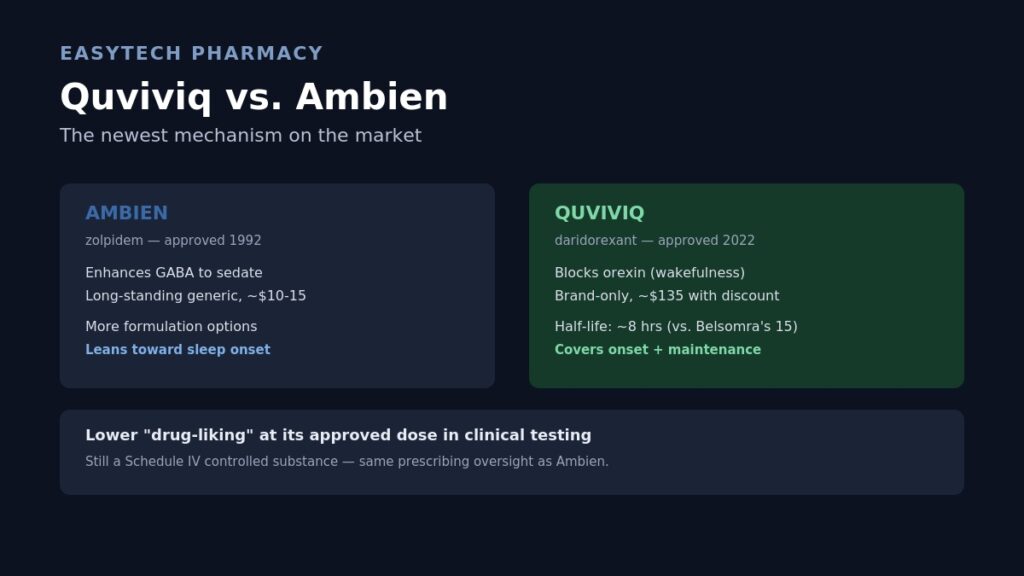
Quviviq is genuinely the newest mechanism covered anywhere in this comparison series, approved in January 2022, three decades after Ambien first reached the market. That gap in age shows up in real, measurable ways: different research standards, different real-world data volume, and a genuinely different approach to blocking wakefulness rather than inducing sedation.
Same General Idea as Belsomra, Different Specific Drug
Quviviq, generic name daridorexant, belongs to the same drug class as Belsomra, covered in our comparison of Belsomra vs. Ambien: dual orexin receptor antagonists, or DORAs, which work by blocking orexin, the brain chemical that promotes wakefulness, rather than amplifying a calming signal the way Ambien does. Quviviq and Belsomra work through the same general mechanism, but they’re not the same drug, and the differences between them are worth knowing if you’re weighing this class specifically.
The Half-Life Difference Between the Two Orexin Blockers
Quviviq has a half-life of around eight hours, compared to Belsomra’s roughly 15 hours. This means Quviviq clears the body more quickly, potentially reducing next-day sleepiness risk compared to its older cousin in the same drug class. It also tends to start working slightly faster than both Belsomra and Dayvigo, the other DORA on the market.
How Quviviq Compares to Ambien Directly
Ambien works by slowing brain activity through GABA, the calming neurotransmitter, while Quviviq targets orexin instead, aiming to promote better sleep quality by removing the wakefulness signal rather than adding sedation. Both are FDA-approved for insomnia, and both can help people fall asleep, though Quviviq is specifically approved to help with both falling asleep and staying asleep, similar in scope to Ambien CR rather than immediate-release Ambien alone.
A Genuinely Interesting Abuse-Potential Finding
This is worth knowing in real detail, since it’s more specific and better-sourced than most claims about “lower abuse potential.” A clinical study among recreational sedative drug users tested Quviviq at 50 mg, the FDA-approved dose, alongside 100 mg and 150 mg doses, comparing “drug-liking” effects against suvorexant and zolpidem. At the approved 50 mg dose, drug-liking was significantly lower compared to both suvorexant at 150 mg and zolpidem at 30 mg. At the higher 100 mg dose, drug-liking effects became similar across all three drugs. In plain terms: at its actual prescribed dose, Quviviq showed meaningfully less abuse-liability signal than Ambien in this specific study, though that gap narrowed at higher, non-approved doses.
Still a Controlled Substance, Despite This Signal
Quviviq remains a Schedule IV controlled substance, the same classification as Ambien, covered in our guide on Ambien’s Schedule IV status. The lower drug-liking signal doesn’t exempt it from the same prescribing oversight, refill structure, and dependence monitoring that governs every controlled substance in this comparison series. A more favorable research signal is not the same as a different regulatory category.
Formulation: Ambien Offers More Flexibility
Ambien comes in more dosage forms than Quviviq, including immediate-release, extended-release, and sublingual tablets, offering options tailored to different sleep patterns. Quviviq is only available as a standard oral tablet, in 25 mg or 50 mg strengths, a narrower set of choices than Ambien’s broader formulation lineup.
Cost: A Real, Current Gap
Quviviq is brand-name only, with no generic version currently available, a cost gap similar to what we’ve covered for Belsomra in our guide on the generic zolpidem alternatives compared. A cash-price discount can bring Quviviq to around $135 through some programs, still well above generic zolpidem’s typical $10 to $15 monthly cost, a gap covered in more depth in our guide on Ambien vs. zolpidem.
Side Effects: Broadly Similar, With Real Overlap
Both medications can cause headache, dizziness, and drowsiness, and both carry the risk of serious complex sleep behaviors like sleepwalking or sleep-driving, though Ambien carries a stronger, more established FDA boxed warning for this risk specifically, covered in our guide on Ambien’s black box warning. Quviviq’s newer market presence means its long-term real-world safety data is still accumulating relative to Ambien’s three decades of postmarketing surveillance.
Side-by-Side: What Actually Separates Them
- Mechanism: Ambien enhances GABA. Quviviq blocks orexin.
- Approval date: Ambien in 1992. Quviviq in 2022, thirty years apart.
- Coverage: Quviviq addresses both onset and maintenance by design. Standard Ambien leans toward onset.
- Abuse-liability signal: Clinical trial data suggests Quviviq may show lower drug-liking at its approved dose than zolpidem.
- Generic availability: Ambien has a long-standing, inexpensive generic. Quviviq does not.
- Formulation options: Ambien offers more choices, including extended-release and sublingual forms.
Who Tends to Fit Each Option
People specifically interested in the newer orexin mechanism, or who want a single medication covering both sleep onset and maintenance, may find Quviviq worth discussing. People prioritizing cost, formulation flexibility, or a longer track record of real-world data tend to remain better matched to Ambien.
The Bottom Line
Quviviq represents genuinely new ground in sleep medicine, three decades of pharmacological progress since Ambien first reached the market. It blocks wakefulness rather than inducing sedation, shows a genuinely interesting lower drug-liking signal in clinical testing at its approved dose, and covers a broader window of the night by design. It also remains a Schedule IV controlled substance, carries no generic option yet, and offers fewer formulation choices than Ambien’s established lineup. The right choice depends on whether the newer mechanism and dual coverage outweigh Ambien’s cost advantage and longer track record for your specific situation.
For a detailed clinical comparison, see GoodRx’s comparison of Quviviq and Ambien.
Frequently asked questions
Is Quviviq stronger than Ambien?
They’re not directly comparable in strength, since they work through different mechanisms. Quviviq blocks wakefulness signals, while Ambien enhances a calming brain chemical directly.
Does Quviviq have a lower risk of dependence than Ambien?
Clinical trial data suggests lower drug-liking at Quviviq’s approved 50 mg dose compared to zolpidem, though this gap narrowed at higher, non-approved doses, and Quviviq remains a Schedule IV controlled substance.
Is there a generic version of Quviviq?
Not currently. Quviviq is only available as a brand-name medication, while Ambien has had an inexpensive generic since 2007.
How is Quviviq different from Belsomra, since both block orexin?
Quviviq has a shorter half-life, around 8 hours compared to Belsomra’s 15, and tends to start working slightly faster, potentially reducing next-day sleepiness risk relative to Belsomra.
Curious whether the newer orexin mechanism fits your situation? Talk to your pharmacist. EasyTech Pharmacy can help you think it through.
For local pharmacy access near you, our Ambien near me guide covers pharmacies across the world.
Visit EasyTech Pharmacy — sleep medication with real pharmacist guidance.