How to Fall Asleep Instantly: Fresh Tricks and a Playbook for Every Kind of Night
You’ve tried counting sheep. You’ve tried the breathing trick everyone shares online. Yet here you are again, staring at the ceiling. If you’re searching for how to fall asleep instantly, you’re not alone. Millions of Americans do the same thing every night.
This guide offers something different. First, you’ll learn what “instantly” really means. Then you’ll get seven fresh tricks and a playbook for the nights that feel hardest.
Can You Really Fall Asleep Instantly?
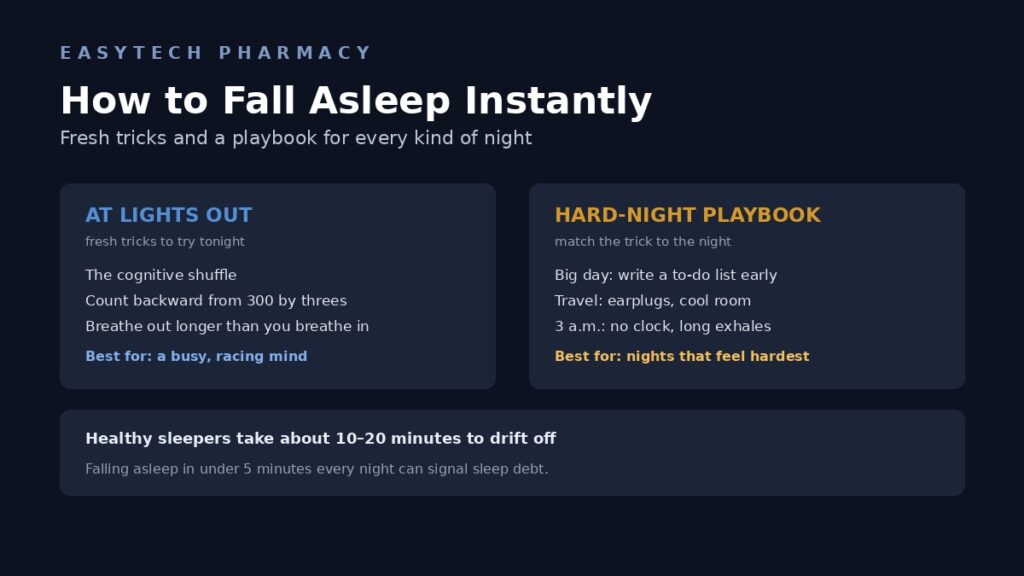
Here’s a surprising fact. A healthy sleeper usually takes about 10 to 20 minutes to drift off. That short wind-down is normal and healthy.
In fact, falling asleep in under five minutes, night after night, can be a warning sign. It often means your body carries a sleep debt. The National Heart, Lung, and Blood Institute explains how ongoing sleep loss affects your health.
So aim for “fast and easy,” not truly instant. The tricks below help you get there.
Already Tried the Classics?
You may already know the military method, 4-7-8 breathing, and muscle relaxation. If not, start with our guide on how to sleep quickly, which walks through 12 proven methods. This post picks up where that one leaves off.
7 New Ways to Fall Asleep Fast
1. The Cognitive Shuffle
This mental game keeps your brain busy with harmless, random images. Pick a simple word, like “bread.” Then, for each letter, picture as many unrelated things as you can. For “b,” you might see a bike, a banana, and a bucket. Move to “r” when you run out.
Why does it work? Random, calm images mimic the drifting thoughts your brain makes as it falls asleep. They also crowd out worry.
2. Write Tomorrow’s To-Do List
Spend five minutes writing everything you need to do tomorrow. In one study, people who wrote a to-do list before bed fell asleep faster. The comparison group wrote about tasks they’d already finished. Once it’s on paper, your brain can stop rehearsing it.
3. Count Backward by Threes
Of all the ways to fall asleep fast, this one needs no tools at all. Start at 300 and count down by threes: 300, 297, 294. The task takes just enough focus to block racing thoughts. Yet it’s dull enough to make you drowsy.
4. Warm Your Feet
Warm feet help your body release heat, which cools your core and signals sleep. Wear soft socks, or use a warm water bottle near your feet for a few minutes.
5. Try a Guided Rest Recording
Body scans and guided rest scripts walk you through slow, calm attention to each part of your body. The National Center for Complementary and Integrative Health notes that relaxation techniques may help with sleep. Many free apps offer short versions.
6. Breathe Out Longer Than You Breathe In
Skip the counting. Simply make each breath out a little longer than each breath in. Long exhales calm your heart rate and quiet your nervous system.
7. Take a Detailed Mental Walk
Picture a place you love, like a beach or your childhood home. Walk through it slowly in your mind. Notice the colors, sounds, smells, and textures. The more detail you add, the less room worry has.
Your Playbook: How to Fall Asleep Instantly on Hard Nights
Some nights bring their own challenges. Here’s what to try in each situation.
The Night Before a Big Day
- Write your to-do list early in the evening, not at bedtime
- Lay out your clothes and pack your bag
- Remind yourself that one short night won’t ruin tomorrow
- Try the cognitive shuffle once the lights go off
In a Hotel or a New Place
- Bring a familiar item, like your pillowcase
- Use earplugs or a white noise app
- Block light from the door gap with a towel
- Keep the room cool, since hotel rooms often run warm
Wide Awake at 3 a.m.
- Don’t check the clock, because it ramps up stress
- Try long exhales or a detailed mental walk
- If you’re still awake after about 20 minutes, get up and read in dim light
- Skip your phone, since bright screens wake you further
Waking often in the middle of the night? Some people ask about short-acting sleep aids.
When Your Partner Snores
It’s hard to fall asleep quickly next to a snorer. A little planning helps.
- Use foam earplugs or a steady fan
- Try to fall asleep first, before the snoring starts
- Encourage your partner to book a check-up, since loud snoring can signal sleep apnea
When Anxiety Keeps You Up
- Set a 15-minute “worry time” earlier in the evening
- Use the counting-back trick to break the worry loop
- Limit news and social media after dinner
Mistakes That Stop You From Falling Asleep Quickly
- Trying too hard: forcing sleep usually backfires
- Checking the time: it adds pressure and stress
- Using your phone in bed: bright light and endless scrolling keep you alert
- Napping late in the day: a 4 p.m. nap can delay bedtime sleepiness
- Going to bed too early: lying awake for hours weakens the bed-sleep link
Better daytime habits also help you sleep more deeply once you drift off. Our guide to natural remedies for deep sleep covers them.
What About Sleep Aids That Help You Fall Asleep Fast?
Some people use sleep aids on top of these tricks. Speed varies a lot from one product to the next. Our guide on Vitamin That Promotes Sleep.
When Quick Tricks Aren’t Enough
If you struggle to fall asleep three or more nights a week for months, tricks alone may not fix it. Chronic insomnia often responds best to CBT-I, a short, proven doctor. Our guide on Sleep Issue Doctor: When Insomnia Needs Medical Help explains how it works.
FAQs About How to Fall Asleep Instantly
What is the fastest way to fall asleep instantly?
For many people, the cognitive shuffle or long, slow exhales work fastest. Try each for a few nights to find your favorite.
Is falling asleep in 2 minutes normal?
Not usually. Falling asleep that fast every night often signals that you need more sleep overall.
Why can’t I fall asleep fast even when I’m tired?
Stress, late screens, and an uneven schedule can keep your brain alert, even when your body feels worn out.
Do sleep sounds help you fall asleep quickly?
Yes, for many people. Steady sounds like rain, a fan, or white noise mask sudden noises that jolt you awake.
How long should these tricks take to work?
Some work the first night. Others get easier with practice over a week or two.
Bottom Line — Build Your Own Fall-Asleep Toolkit
There’s no single answer to how to fall asleep instantly. Instead, keep a small toolkit ready. Use the to-do list early, the cognitive shuffle at lights out, and long exhales at 3 a.m. Pick the trick that fits the night, and give it time to work.
If a sleep aid becomes part of your plan, our Ambien near me guide shows how to find it at a local pharmacy and compare prices.