Prescription Sleep Medications: The Full List, Sorted by Type
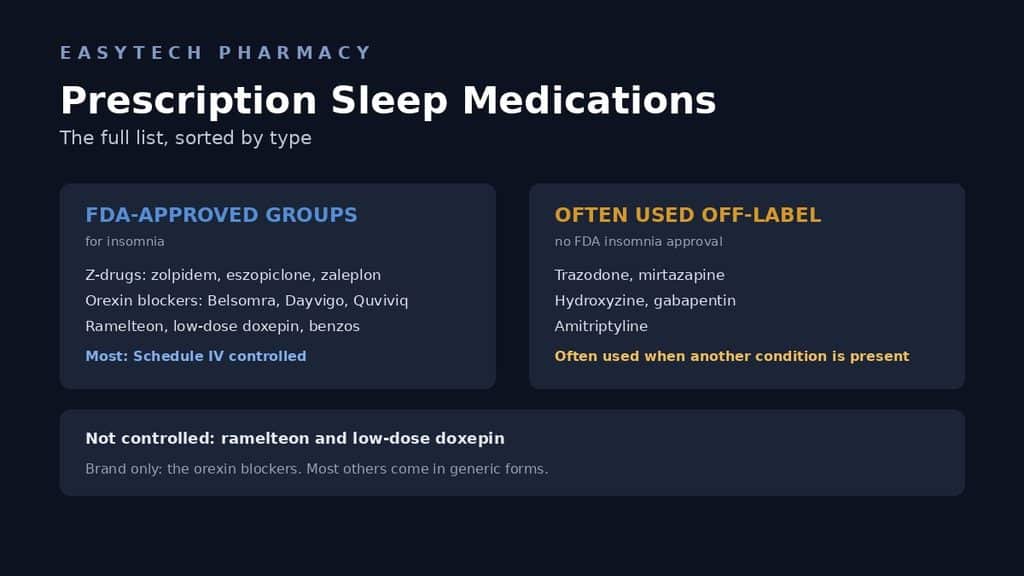
Trying to make sense of prescription sleep medications can feel like reading a foreign language. Brand names, generic names, and drug groups all blur together. So we built one simple list. It sorts every FDA-approved insomnia medicine by type, with the key facts side by side.
Use this guide as a quick reference before your next pharmacy visit. For deeper detail on any medicine, follow the links in each section.
How to Read This List of Sleep Medications
For each medicine, you’ll see four quick facts:
- Brand and generic names
- Main target: falling asleep, staying asleep, or both
- Controlled status: whether the DEA lists it as a controlled substance
- Generic available: which usually means a lower price
Several sleep medicines fall under Schedule IV. That means the DEA sees some risk of misuse, so stricter refill rules apply. The DEA’s drug scheduling page explains each schedule.
Z-Drugs: Common Insomnia Medications
Z-drugs are the best-known prescription sleep medications in America. They work on the brain’s main calming system. Most act fast and wear off fairly quickly.
Zolpidem (Ambien, Ambien CR, Edluar)
- Target: regular forms help you fall asleep; the extended-release form also helps you stay asleep
- Controlled: Schedule IV
- Generic: yes
Learn more in our guide to generic Ambien.
Eszopiclone (Lunesta)
- Target: falling and staying asleep
- Controlled: Schedule IV
- Generic: yes
Zaleplon (Sonata)
- Target: falling asleep, since it wears off very quickly
- Good to know: its short action means less morning grogginess for many people, as long as they allow enough time in bed
- Controlled: Schedule IV
- Generic: yes
Compare all three in Ambien vs Lunesta vs Sonata. The FDA added a boxed warning to this group about sleepwalking and other complex sleep behaviors.
Orexin Blockers: Newer Insomnia Medications
These medicines quiet the brain’s “stay awake” signal instead of sedating the whole brain. They help with both falling and staying asleep.
- Suvorexant (Belsomra): Schedule IV; brand only
- Lemborexant (Dayvigo): Schedule IV; brand only
- Daridorexant (Quviviq): Schedule IV; brand only
Next-day drowsiness can still happen, especially with higher doses. They also aren’t a good fit for people with narcolepsy. Because they’re brand-only, they usually cost more. See how they compare in Belsomra vs Ambien.
Melatonin-Type Sleep Medicines
Ramelteon (Rozerem)
- Target: falling asleep
- Controlled: no
- Generic: yes
Ramelteon works on the brain’s melatonin system. It carries little risk of misuse, which makes it a popular lower-risk choice. It works best for trouble falling asleep and doesn’t help much with night waking. People who take fluvoxamine shouldn’t use it.
Low-Dose Doxepin: An Antidepressant With an Insomnia Approval
Doxepin, Low Dose (Silenor)
- Target: staying asleep
- Controlled: no
- Generic: yes
At very small doses, doxepin mainly blocks histamine, a “stay awake” signal. It’s the only antidepressant with an official insomnia approval. Many people take it about 30 minutes before bed. A heavy meal close to bedtime can delay its effect.
Benzodiazepines Approved for Insomnia
These older insomnia medications work well, but they carry more risk of dependence, falls, and next-day drowsiness. Most experts now favor newer options. Some, like flurazepam and quazepam, last a long time in the body, so morning grogginess is common.
- Temazepam (Restoril): Schedule IV; generic yes
- Triazolam (Halcion): Schedule IV; generic yes
- Estazolam: Schedule IV; generic yes
- Flurazepam: Schedule IV; generic yes
- Quazepam (Doral): Schedule IV
Off-Label Options Often Used for Sleep
These medicines don’t carry an FDA insomnia approval. Still, many people use them for sleep, often when another condition is also present.
- Trazodone: an antidepressant used at low doses for sleep
- Mirtazapine: a calming antidepressant that may raise appetite
- Hydroxyzine: an antihistamine that also eases anxiety
- Gabapentin: sometimes used when pain and poor sleep go together
- Amitriptyline: an older antidepressant that causes drowsiness
- Quetiapine: experts advise against using it just for sleep
Learn how the calming antidepressants work in Sedating Antidepressants Explained.
Quick Comparison: Sleep Medications List at a Glance
- Help you fall asleep: zaleplon, zolpidem, ramelteon
- Help you stay asleep: low-dose doxepin, extended-release zolpidem
- Help with both: eszopiclone, orexin blockers
- Not controlled: ramelteon, low-dose doxepin
- Brand only: orexin blockers
Common Side Effects Across Insomnia Medications
Each group has its own profile. Still, a few side effects show up across many sleep medicines:
- Next-day drowsiness: more likely with longer-acting options
- Dizziness: raises the risk of falls, especially at night
- Headache: common in the first few days
- Complex sleep behaviors: mainly linked to Z-drugs
- Rebound insomnia: possible after stopping some medicines suddenly
Never drink alcohol with a sleep medicine. It stacks the drowsiness and can slow your breathing.
What This List of Sleep Medications Doesn’t Cover
This guide focuses on insomnia. Other sleep disorders use very different medicines:
- Narcolepsy: medicines that promote daytime alertness
- Restless legs syndrome: iron and nerve-calming medicines
- Body clock disorders: timed light, melatonin, or tasimelteon for Non-24
- Sleep apnea: usually CPAP or oral devices, not pills
What Controlled Status Means for You
Schedule IV sleep medicines follow stricter rules at the pharmacy:
- Pharmacies can’t refill them early
- Refills have limits on number and time
- Pharmacies may limit transfers to another store
- You may need to show ID at pickup
Our guide on whether Ambien is a controlled substance explains these rules in more detail.
Choosing Among FDA-Approved Sleep Medicines
Your pharmacist and care team will weigh several factors:
- Whether you struggle to fall asleep, stay asleep, or both
- Your age and fall risk
- Other health conditions, like sleep apnea or liver disease
- Every other medicine and supplement you take
- Cost and insurance coverage
Older adults need extra care. Our guide to the safest sleep medication for elderly patients ranks the options. For a broader overview of every type of sleep aid, read our sleeping pills complete guide.
FAQs: Prescription Sleep Medications
What is the most common sleep medicine in the US?
Zolpidem, sold as Ambien and its generics, is one of the most common. Trazodone is also widely used off-label.
Which sleep medicines aren’t controlled substances?
Ramelteon and low-dose doxepin aren’t controlled. Most other insomnia medicines fall under Schedule IV.
What are the newest insomnia medications?
The orexin blockers are the newest group. Daridorexant (Quviviq) gained approval in 2022.
Do any sleep medicines have generics?
Yes. Zolpidem, eszopiclone, zaleplon, ramelteon, low-dose doxepin, and most benzodiazepines all come in generic forms.
Which sleep medicine is safest?
It depends on the person. Ramelteon and low-dose doxepin carry fewer risks for many people, especially older adults.
Bottom Line — Know Your Options Before You Choose
Prescription sleep medications fall into a few clear groups: Z-drugs, orexin blockers, ramelteon, low-dose doxepin, and benzodiazepines. Each one targets sleep a little differently and carries its own trade-offs. Bring this list to your pharmacist, and ask which option fits your sleep problem best.
Ready to fill a sleep medicine? Our Ambien near me guide shows how to find a local pharmacy and compare prices.