Ambien Tolerance: Why It Happens and What To Do About It
There’s a specific kind of frustrating night: you take the same dose you always have, do everything the same way, and still end up staring at the ceiling. If that’s been happening more often, you’re probably not imagining it. Ambien tolerance is a real, well-documented pattern, and understanding why it happens makes the next step a lot less confusing.
What Tolerance Actually Means
Tolerance is simple to define and less simple to feel: it’s when a dose that used to work stops producing the same effect. With Ambien, the hallmark sign is straightforward. Someone who used to fall asleep easily on a standard dose starts noticing it takes longer, works less completely, or doesn’t work at all some nights.
This isn’t a matter of willpower or “getting used to it” in a casual sense. It reflects real changes happening at the level of brain chemistry.
Why It Happens
Ambien works by boosting GABA, a brain chemical that slows down nervous system activity and helps the brain wind toward sleep. With repeated use, the brain adapts to that extra boost in a few different ways.
- Metabolic changes. The body can start processing zolpidem more efficiently over time, meaning less of it stays active in the system to do its job.
- Brain adaptation. The brain’s receptors respond less strongly to the same amount of GABA activity, so the sedating effect shrinks even if the dose stays the same.
- Behavioral patterns. Sleep is partly learned. Repeated pairing of the pill with the act of falling asleep can shift how the brain responds to the medication over time, independent of the biology alone.
Put together, these shifts explain why someone taking 5 mg to fall asleep might find, months later, that the same 5 mg barely touches their restlessness.
How Fast Does This Happen?
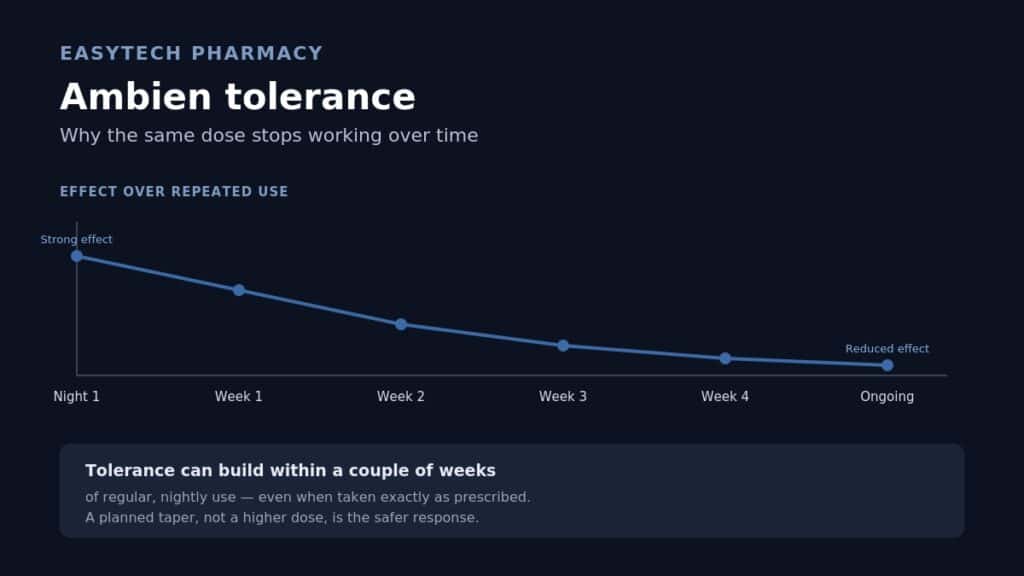
Faster than most people expect. Ambien is meant for short-term use, and tolerance can start building within just a couple of weeks of regular, nightly use. That’s part of why it’s typically prescribed for a limited stretch rather than as an open-ended nightly habit.
Signs Tolerance Is Building
- The usual dose takes longer to work, or doesn’t fully work anymore
- Needing to take more than the original amount to get the same effect
- Going through a prescription faster than expected
- Feeling like sleep quality has quietly declined even though the routine hasn’t changed
Noticing one of these once or twice isn’t necessarily meaningful. A consistent pattern over a couple of weeks is worth paying attention to.
Why Tolerance and Dependence Often Travel Together
Tolerance on its own is a biological response. Dependence is what happens when the body has adjusted enough that stopping or cutting back causes withdrawal symptoms. The two frequently show up together, since the same adaptations driving tolerance are often what create the dependence underneath it. If tolerance has been building for a while, it’s worth reading our guide on signs of Ambien addiction, which covers how this pattern can shift into something that needs more direct attention.
What Not To Do
The instinct when a dose stops working is often to simply take more. This isn’t a safe way to handle rising tolerance. Increasing the dose without guidance raises the risk of next-day grogginess, memory issues, and, if combined with alcohol or other sedatives, more serious complications. It also tends to accelerate the same tolerance cycle rather than solve it.
What Actually Helps
A few approaches tend to make a real difference when tolerance has crept in:
- A planned break or taper, rather than an abrupt stop, gives the brain room to reset its sensitivity without triggering severe rebound insomnia. Our guide on the zolpidem withdrawal timeline covers what that process typically looks like.
- Reassessing the underlying sleep issue. Sometimes what looks like rising tolerance is really an unaddressed stressor or habit working against the medication.
- Building sleep hygiene alongside the medication, consistent bedtimes, reduced screens before bed, and a calmer wind-down routine, so the medication isn’t doing all the work alone.
- Bringing the pattern up honestly rather than quietly adjusting the dose independently. A prescriber can look at the full picture, including how long you’ve been taking it and whether a different approach makes more sense.
The Bottom Line
Ambien tolerance is a real, biologically grounded pattern, not a sign that something’s wrong with you or that the medication has failed. It happens because the brain adapts to repeated use, sometimes within just a couple of weeks. Catching it early, and responding with a plan rather than simply increasing the dose, is what keeps a temporary sleep aid from turning into a much harder problem to unwind.
For a deeper look at the biology behind how tolerance develops, the National Library of Medicine’s overview of sedative-hypnotic tolerance and dependence covers the underlying mechanisms in more clinical detail.
Frequently asked questions
How long does it take to build a tolerance to Ambien?
Tolerance can start developing within a couple of weeks of regular, nightly use, which is faster than most people expect from a short-term sleep medication.
Is it safe to just take a higher dose if Ambien stops working?
Increasing the dose on your own isn’t a safe response to tolerance. It raises the risk of side effects and tends to accelerate the same cycle rather than resolve it.
Does tolerance mean I’m addicted?
Not necessarily. Tolerance is a biological adaptation that can happen even with medication used exactly as directed. It’s worth monitoring, but it’s a different pattern than addiction on its own.
Can tolerance be reversed?
Often, yes, typically through a planned break or taper that gives the brain’s receptors time to reset their sensitivity, rather than continuing to increase the dose.
For local pharmacy access, our Ambien near me guide covers options across the world.
👉 Visit EasyTech Pharmacy — find the right sleep medication for your situation today.