How Do Sleeping Pills Work? A Pill’s Journey From Bedtime to Morning
Estimated reading time: 6 minutes
How do sleeping pills work once you swallow them? Most people picture a simple switch: take a pill, fall asleep. In reality, the pill takes a journey through your stomach, blood, brain, and liver. Each step affects how fast it works, how long it lasts, and how you feel the next morning.
This guide follows that journey, step by step. You’ll also learn why sleeping pills sometimes don’t work and how pill-induced sleep compares with natural sleep.
The Short Answer: What Sleeping Pills Do
Sleeping pills tip your brain’s balance from “awake” toward “asleep.” Some boost calming signals. Others block wake-up signals or nudge your body clock. Our sleep medications overview explains each brain system in detail.
To work, though, the medicine first has to reach your brain at the right time and in the right amount. That’s where the journey comes in.
How Sleeping Pills Work: The Journey in 5 Steps
Step 1: Swallow and Absorb
The pill dissolves in your stomach and passes into your bloodstream, mostly through the small intestine. Some forms, like tablets that melt under the tongue, absorb faster.
Step 2: Food Can Slow It Down
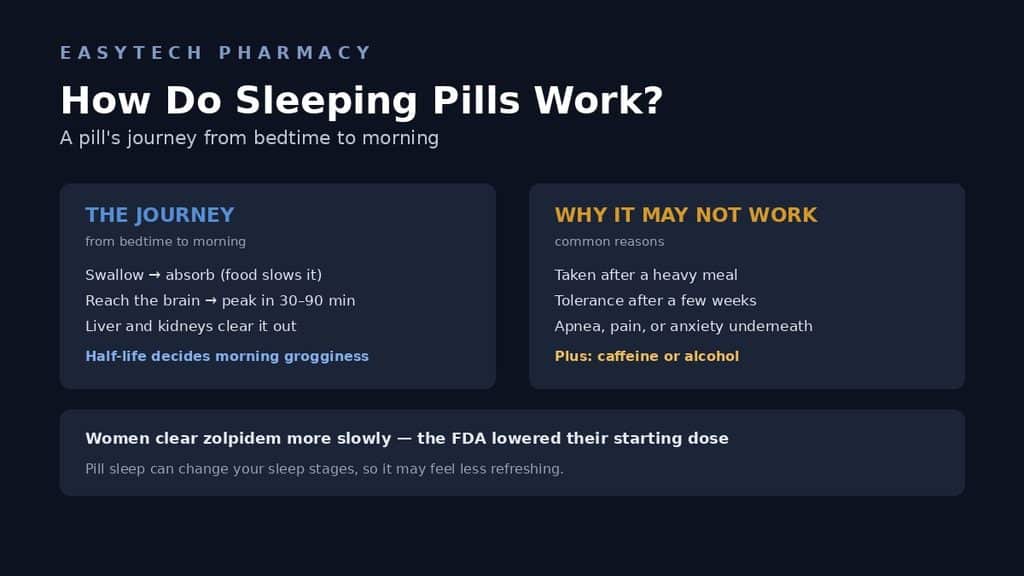
A big or fatty meal slows absorption. For example, taking zolpidem right after dinner can delay its effect by quite a bit. That’s why many sleep aids work best on an empty stomach.
Step 3: Sleeping Pills in the Body Reach the Brain
Once in the blood, the medicine crosses into the brain. There, it acts on its target, such as GABA, orexin, or melatonin receptors.
Step 4: Hit the Peak
Each medicine reaches its highest level in the blood at a certain time. Many fast-acting sleep aids peak within about 30 to 90 minutes. Our guide on how long Ambien takes to work covers this timing.
Step 5: Clear Out by Morning
Your liver breaks the medicine down, and your kidneys flush out the leftovers. How quickly that happens decides how you feel when you wake up.
Half-Life: Why Some Sleeping Pill Effects Linger
Half-life is the time your body takes to clear half of a medicine. It’s the single biggest clue to morning grogginess.
- Short half-life: wears off quickly; less morning fog, but may not last all night
- Medium half-life: covers the full night; some people feel it in the morning
- Long half-life: can linger into the next day, especially in older adults
Zolpidem, for example, has a fairly short half-life. Some older benzodiazepines, by contrast, can stay in the body for days. Our guide on short-acting vs long-acting sleep medications compares them. To see how long one medicine keeps you asleep, read Sleep Anxiety Medication Options.
Who Clears Sleeping Pills in the Body More Slowly?
Not everyone processes these medicines at the same speed. Clearance often slows in:
- Older adults: the liver and kidneys work more slowly with age
- Women: women clear zolpidem more slowly, which led the FDA to lower the starting dose for women
- People with liver or kidney disease: medicine can build up
- People on certain other medicines: some drugs slow the liver enzymes that break sleep aids down
Learn more in our post on kidney and liver function. MedlinePlus also lists the main zolpidem precautions.
Do Sleeping Pill Effects Match Natural Sleep?
Natural sleep moves through stages in cycles of about 90 minutes, from light sleep to deep sleep to dreaming. The National Heart, Lung, and Blood Institute explains these stages.
Sleeping pills can change that pattern. Some reduce deep sleep. Others change dreaming sleep. A few may even boost deep sleep slightly. So you may sleep longer on a pill without feeling fully refreshed. In fact, studies often find that sleeping pills add less extra sleep than people expect. Many people feel the biggest benefit from less worry about sleep. Our guide to natural remedies for deep sleep shows how to get more restorative rest.
Why Sleeping Pills Sometimes Don’t Work
Understanding how sleeping pills work also explains why they sometimes fail. In most cases, the cause is simple and fixable. Here are the usual suspects.
Taken With a Heavy Meal
Food can delay the effect, so you lie awake waiting. A light snack is usually fine, but skip big, fatty meals close to bedtime.
Taken at the Wrong Time
Too early, and the peak hits before bed. Too late, and you wake up groggy.
Tolerance
Over weeks, your brain may adapt, so the same dose works less well. OTC antihistamines lose their effect especially fast. Our guides on Ambien tolerance.
The Real Problem Is Something Else
Sleep apnea, pain, reflux, anxiety, or a full bladder can all override a sleep aid. In these cases, treating the underlying problem usually helps far more than a stronger pill. A quick review with your pharmacist can point you in the right direction.
Caffeine or Alcohol
Afternoon caffeine fights the pill. Alcohol makes sleep lighter later in the night and stacks dangerously with many sleep aids.
What Sleeping Pills Do Beyond Sleep
Here’s another key part of what sleeping pills do. Most sleep aids act on brain systems that do more than control sleep. As a result, they can affect balance, memory, coordination, and breathing too. That explains common side effects like morning fog, unsteady walking, and memory gaps.
Tips for Safer Sleeping Pill Effects
- Take it right before bed, on an empty or light stomach
- Allow a full night in bed after each dose
- Skip alcohol completely
- Avoid caffeine after noon
- Never take an extra dose in the middle of the night unless your care team says it’s safe
- Pair it with CBT-I and a steady sleep schedule
For brand names and types in one place, see our full list of sleep medications.
FAQs: How Do Sleeping Pills Work?
any fast-acting sleep aids start working within 15 to 30 minutes. Food can slow this down.
The medicine may still be in your system, especially if it has a long half-life or you took it late.
They help you sleep, but they can change your sleep stages. Pill sleep may not feel as refreshing as natural sleep.
Your brain can build tolerance over time, so the same dose has less effect.
Most work faster on an empty or light stomach. Check the label or ask your pharmacist.
Bottom Line — Timing, Clearance, and Habits Matter
So, how do sleeping pills work? They travel from your stomach to your brain and nudge your sleep-wake balance. Then your liver and kidneys clear them out. Food, timing, age, and other medicines all shape that journey. Take them wisely, and pair them with good sleep habits for the best results.
Ready to fill a sleep medicine? Our Ambien near me guide shows how to find a local pharmacy and compare prices.
Table of contents
- The Short Answer: What Sleeping Pills Do
- How Sleeping Pills Work: The Journey in 5 Steps
- Half-Life: Why Some Sleeping Pill Effects Linger
- Who Clears Sleeping Pills in the Body More Slowly?
- Do Sleeping Pill Effects Match Natural Sleep?
- Why Sleeping Pills Sometimes Don’t Work
- What Sleeping Pills Do Beyond Sleep
- Tips for Safer Sleeping Pill Effects
- FAQs: How Do Sleeping Pills Work?
- Bottom Line — Timing, Clearance, and Habits Matter