Ambien vs Ambien CR — The Real Difference and How to Pick the Right One
If you have ever looked at your Ambien authorization and noticed it says “CR” — or if you have been taking regular Ambien and wondered whether the CR version would work better — this guide is exactly what you need.
Ambien and Ambien CR sound almost identical. They share the same active ingredient, the same brand name, and the same general purpose. However, they solve different parts of the insomnia problem. Choosing the wrong one means either paying more than necessary or not getting the coverage your particular sleep pattern actually needs.
Here is the complete picture on Ambien and Ambien CR — what makes them different, which sleep problems each one is designed for, what the cost difference looks like, and exactly how to decide which is right for you.
For the full process of accessing either version, our guide on how to buy Ambien online covers everything from authorization to delivery.
What They Share — The Common Ground
Before diving into the differences, it helps to establish what Ambien and Ambien CR actually have in common.
Both contain zolpidem tartrate as the active ingredient. Both work by amplifying GABA-A receptor activity in the brain — slowing neural activity to produce the sedation that allows sleep onset. Both are Schedule IV controlled substances. Both are available as FDA-approved generics that cost significantly less than the brand-name versions. Both carry the same core safety considerations — the 7 to 8 hour sleep window, no alcohol combination, next-morning driving caution.
The difference between them is not what they contain. It is how they release that ingredient into your bloodstream — and therefore how long they keep you asleep.
The Core Difference — One Layer vs Two Layers
This is the physical difference that produces every other distinction between the two medications.
Regular Ambien (Immediate-Release)
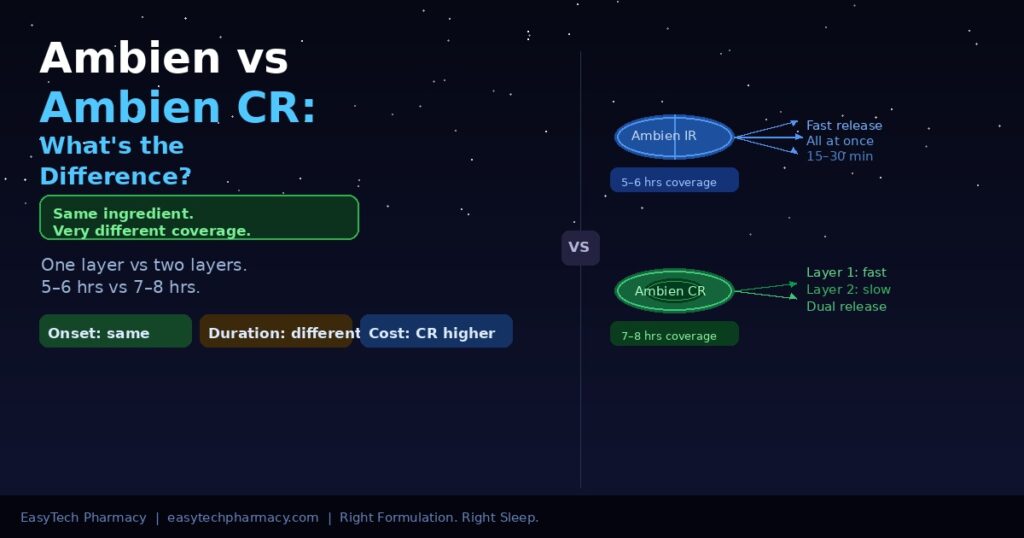
Standard Ambien is a single-layer tablet. It dissolves completely and releases all of its zolpidem into your system at once. Peak blood concentration is reached within approximately 1.5 to 2 hours. Therapeutic sleep-supporting levels are active for roughly 5 to 6 hours before tapering off.
This single-burst delivery makes immediate-release Ambien particularly effective for sleep onset — getting you to sleep quickly. However, as those therapeutic levels taper after 5 to 6 hours, some people wake in the early morning hours as the medication’s coverage window ends.
Ambien CR (Controlled-Release)
Ambien CR uses a two-layer tablet — a pharmaceutical technology called bilayer formulation. The first layer behaves identically to the immediate-release tablet — it dissolves quickly and produces the same fast onset. This gets you to sleep at essentially the same speed as regular Ambien.
The second layer is different. It is designed to dissolve slowly, releasing additional zolpidem into the bloodstream over the following hours. This maintains therapeutic blood levels through the second half of the night — the window when regular Ambien’s levels have already declined below effective thresholds.
The result: Ambien CR supports 7 to 8 hours of sleep compared to regular Ambien’s 5 to 6. Same onset. Longer coverage.
Our detailed guide on how long does Ambien make you sleep covers the full coverage timeline for both formulations with detailed breakdowns.
Side by Side — Every Key Difference
| Feature | Ambien (IR) | Ambien CR |
|---|---|---|
| Active ingredient | Zolpidem tartrate | Zolpidem tartrate |
| Tablet structure | Single layer | Two layers |
| Release type | Immediate — all at once | Dual — fast then slow |
| Onset time | 15 to 30 minutes | 15 to 30 minutes (same) |
| Sleep coverage | 5 to 6 hours | 7 to 8 hours |
| Best for | Trouble falling asleep | Trouble staying asleep |
| Available doses (IR) | 5mg, 10mg | 6.25mg, 12.5mg |
| Generic available? | Yes — widely | Yes — widely |
| Brand cost (30-day) | $180 – $400 | $280 – $520 |
| Generic + GoodRx | $8 – $15 | $14 – $28 |
| Can you crush it? | Generally yes | No — destroys the CR mechanism |
| Next-morning impairment risk | Moderate | Slightly higher — longer active window |
Which Sleep Problem Does Each One Actually Solve
The most practical question is not “which is better” — it is “which one fits my specific sleep pattern.” And that answer comes down to where your insomnia actually lives.
You Have Trouble Falling Asleep — Regular Ambien
If your problem is getting to sleep in the first place — lying awake for an hour or more before eventually drifting off — regular immediate-release Ambien is the more appropriate choice. It provides fast, reliable sleep onset within 15 to 30 minutes. Once you are asleep, you sleep through the night without waking issues.
Using Ambien CR for pure sleep onset insomnia means paying more for extended coverage you do not need, and carrying additional next-morning impairment risk from the longer active window.
You Fall Asleep Fine but Wake Up Too Early — Ambien CR
If you fall asleep reasonably well but consistently wake at 2am, 3am, or 4am and cannot get back to sleep — this is sleep maintenance insomnia. Regular Ambien’s coverage window ends right in this zone. Ambien CR’s second layer keeps blood levels active through this critical window.
This is the specific patient profile Ambien CR was developed for. Its extended coverage directly addresses the early morning waking that regular Ambien leaves uncovered.
Our dedicated guide on the best sleeping pills for people who wake up at night covers Ambien CR alongside every other sleep maintenance option — including eszopiclone, which has an even longer half-life for more persistent early morning waking.
You Have Both Problems — Ambien CR
Some people struggle with both falling asleep and staying asleep. For this combined pattern, Ambien CR addresses both components — the first layer handles onset, the second layer handles maintenance. This is typically a stronger indication for CR than either problem alone.
The Dose Difference — Why the Numbers Changed
You might notice that regular Ambien comes in 5mg and 10mg, while Ambien CR comes in 6.25mg and 12.5mg. This is not arbitrary.
When Ambien CR was developed, the FDA required separate clinical studies to establish appropriate dosing for the controlled-release formulation. The extended-release mechanism changes how zolpidem builds up in the bloodstream over time. The 6.25mg and 12.5mg doses were determined to produce therapeutic blood levels equivalent to the 5mg and 10mg immediate-release doses respectively — but through the slower sustained delivery profile.
This means you cannot simply compare milligram numbers between the two formulations. A 12.5mg Ambien CR dose produces similar initial peak effects to a 10mg regular Ambien dose — but sustains those levels longer rather than producing a higher peak concentration.
Can You Crush or Cut Ambien CR
This matters more than people expect. The answer is no — and the reason is directly relevant to how it works.
Crushing, chewing, or cutting Ambien CR destroys the bilayer mechanism. The second layer — designed to release slowly over hours — releases all at once instead. You effectively convert it into a high-dose immediate-release tablet. This eliminates the sleep maintenance benefit, increases peak blood concentration above intended levels, and raises the risk of oversedation and next-morning impairment.
Regular Ambien can generally be cut if a lower dose is needed. Ambien CR must be swallowed whole, intact. If you need to adjust your dose downward, discuss switching to immediate-release at a lower dose rather than cutting the CR tablet.
Cost — What the Difference Actually Looks Like
Ambien CR consistently costs more than regular Ambien — brand and generic alike. Here is the realistic pricing comparison.
| Option | Ambien IR (30-day) | Ambien CR (30-day) |
|---|---|---|
| Brand name — no insurance | $180 – $400 | $280 – $520 |
| Generic — retail no coupon | $15 – $35 | $22 – $55 |
| Generic + GoodRx coupon | $8 – $15 | $14 – $28 |
| Medicare Part D (typical) | $0 – $10 | $5 – $20 |
The cost premium for Ambien CR at the generic level — roughly $6 to $15 more per month with GoodRx — is modest enough that if your sleep pattern genuinely requires extended coverage, the additional cost is reasonable. However, paying the CR premium when regular Ambien would solve your actual problem is simply unnecessary spending.
Always use GoodRx to compare current pricing at pharmacies near you before filling either formulation. Pricing varies by zip code and pharmacy even within the same chain. For the full pricing breakdown across every pharmacy option, our guide on the generic zolpidem vs Ambien comparison covers costs in detail.
Generic Versions — Are They Just as Good
Yes — completely. Both generic zolpidem immediate-release and generic zolpidem extended-release are FDA-required to be bioequivalent to their brand-name counterparts. The active ingredient, dosage, absorption characteristics, and clinical effect are identical.
Generic zolpidem extended-release — the generic equivalent of Ambien CR — is widely available at most major US pharmacies. It uses the same bilayer mechanism. It produces the same dual-release profile. The only difference from brand Ambien CR is the label and the price.
There is no clinical reason to pay brand-name prices for either formulation. Generic IR at $8 to $15 per month and generic CR at $14 to $28 per month deliver identical therapeutic outcomes to their brand equivalents costing 10 to 20 times more.
Side Effects — Does CR Have Different Risks
Both formulations share the same core side effect profile — next-morning drowsiness, dizziness, memory effects, and parasomnia risk. However, a few differences are worth noting.
Next-morning impairment is slightly more pronounced with Ambien CR for some people — because the second layer continues releasing zolpidem into the early morning hours. Blood levels at the 7 to 8 hour mark are higher with CR than they would be with IR, which has largely cleared by that point.
This is specifically why the FDA recommends a lower starting dose for women in both formulations — and why the 6.25mg CR dose exists as the lower starting option for women and older adults rather than beginning with 12.5mg.
For those with a history of sleepwalking or other parasomnias, the extended active window of Ambien CR provides a longer potential window for parasomnia episodes to occur during lighter sleep stages in the early morning. This is not a reason to avoid Ambien CR if you need it — but it is worth discussing with your pharmacist if parasomnias have been a concern with sleep medication in the past.
Our guide on why does Ambien stop working after a few weeks also covers tolerance development — which occurs with both formulations and is worth understanding before starting either long-term.
Switching Between Formulations — What to Know
Switching from regular Ambien to Ambien CR — or vice versa — is straightforward. They contain the same active ingredient. However, a few practical points make the transition smoother.
- Switching IR to CR: The dose changes from 5mg or 10mg to 6.25mg or 12.5mg respectively. This is a dose adjustment, not just a formulation change — confirm the equivalent dose with your pharmacist before the first CR fill.
- Switching CR to IR: If you were on CR specifically because of early morning waking and that problem remains, switching to IR will likely bring the waking back. Make sure the reason for switching is clear before making the change.
- Never crush the CR tablet after switching: People familiar with cutting regular Ambien sometimes try to do the same with CR. This is the one thing that genuinely should not happen with the CR formulation.
Frequently Asked Questions
What is the difference between Ambien and Ambien CR?
Regular Ambien uses a single-layer immediate-release tablet that releases all zolpidem at once, providing 5 to 6 hours of sleep coverage. Ambien CR uses a two-layer controlled-release tablet — the first layer provides fast onset, the second layer releases slowly to extend coverage to 7 to 8 hours. Same active ingredient, same onset speed, different duration.
Is Ambien CR better than regular Ambien?
Neither is universally better — they solve different problems. Regular Ambien is better for pure sleep onset insomnia. Ambien CR is better for sleep maintenance insomnia — waking in the early morning hours. Choosing the right one depends entirely on your specific sleep pattern.
Can I take Ambien CR if I only have trouble falling asleep?
You can, but it is more medication than you need for pure onset insomnia — with slightly higher next-morning impairment risk and higher cost. Regular immediate-release zolpidem solves sleep onset insomnia more efficiently and at lower cost and risk.
How much more does Ambien CR cost than regular Ambien?
At the generic level with a GoodRx coupon, Ambien CR typically costs $6 to $15 more per month than regular generic zolpidem. At brand-name prices without insurance, the gap is larger — roughly $100 to $150 more per month.
Can I crush or cut Ambien CR to get a lower dose?
No — crushing or cutting Ambien CR destroys the bilayer mechanism and converts it into a high-dose immediate-release tablet. This eliminates the sleep maintenance benefit and raises oversedation risk. If you need a lower dose, switch to immediate-release zolpidem at the appropriate lower strength instead.
Is generic zolpidem extended-release the same as Ambien CR?
Yes — completely. Generic zolpidem extended-release is FDA-required to be bioequivalent to brand Ambien CR. The same bilayer mechanism, same dosages, same clinical effect. The only difference is cost — typically 70% to 90% cheaper than brand Ambien CR.
Bottom Line — Match the Formulation to Your Sleep Pattern
The difference between Ambien and Ambien CR is straightforward once you understand the delivery mechanism. Regular Ambien: fast release, 5 to 6 hour coverage, best for falling asleep. Ambien CR: dual release, 7 to 8 hour coverage, best for staying asleep.
Onset speed is the same for both. Cost is modestly higher for CR. Next-morning impairment risk is slightly higher for CR. The right choice depends entirely on which part of the night is your problem.
If you fall asleep fine and wake through the night — CR. If you struggle to fall asleep but sleep well once you do — regular Ambien. If both are problems — CR covers both. Simple as that.
At EasyTech Pharmacy, we carry both generic zolpidem immediate-release and extended-release in all standard dosages. Transparent pricing, fast delivery, and pharmacist support available to help you identify which formulation fits your sleep pattern.
Looking for local options near you? Our Ambien near me guide covers pharmacy access across the US for both formulations.
Visit EasyTech Pharmacy — the right Ambien formulation, the right price, delivered to your door.