The Ambien Black Box Warning: A Timeline of How We Got Here
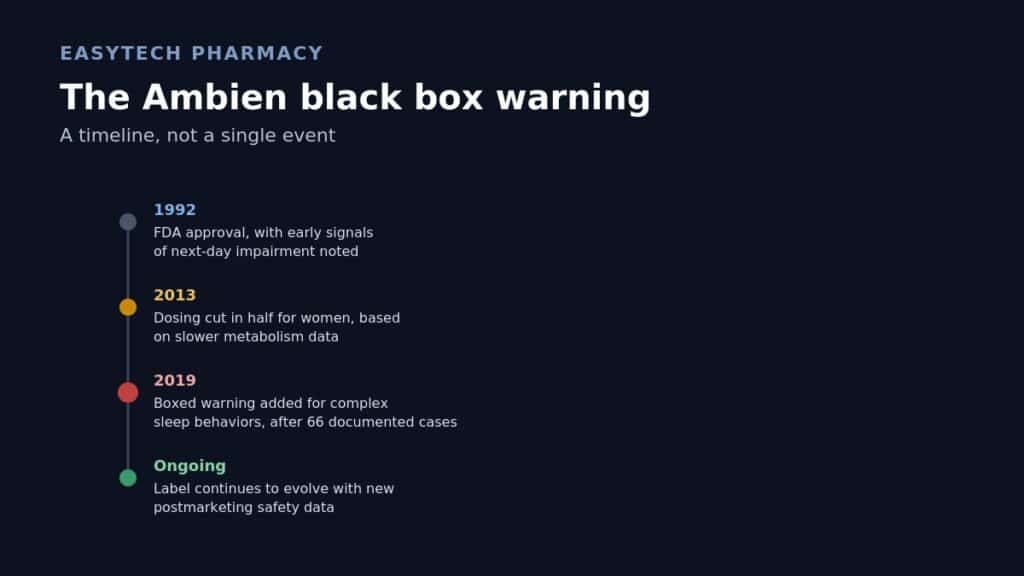
People often assume one dramatic event triggers a black box warning overnight. Ambien’s story differs. Evidence accumulated slowly across two decades, resulting in two separate regulatory actions that people often blur together in casual conversation. Understanding the actual timeline clarifies what the warning covers and why it exists.
What a Black Box Warning Actually Is
A black box warning, formally called a boxed warning, serves as the FDA’s strongest safety label. Its nickname comes from the literal black border surrounding the warning text on a drug’s label. The FDA reserves this label for risks that could cause death or significant harm. The warning sits prominently above the fold on prescribing information so doctors and patients see it immediately.
Not every serious side effect earns one. A boxed warning specifically requires evidence strong enough that regulators judge ordinary warning language insufficient to convey the risk. Ambien has accumulated enough evidence to prompt two related, but distinct, safety actions over the years.
1992: Approval, and an Early Signal
The FDA approved zolpidem, sold as Ambien, in 1992. During early trials, researchers noted signs of next-day impairment. A small subset of higher-dose cases also showed anterograde amnesia, which causes difficulty forming new memories after taking the drug. These early signals didn’t trigger a boxed warning at launch, but they planted the seeds for deeper scrutiny over the following decades.
2013: The Dosing Warning Most People Forget
People often omit this part of Ambien’s warning history from the conversation entirely. In January 2013, the FDA required manufacturers to halve the recommended zolpidem dose for women. The immediate-release Ambien dose dropped from 10 mg to 5 mg. The extended-release Ambien CR dose fell from 12.5 mg to 6.25 mg.
The reason was pharmacokinetic, not behavioral. Clinical studies found that women metabolize zolpidem more slowly than men. At the standard 10 mg dose, roughly 15% of women still had blood levels high enough the next morning to impair driving and other alertness-dependent tasks. Only about 3% of men showed similar impairment. With the extended-release version, the numbers appeared even more striking: 33% of women and 25% of men showed impairing levels the next morning.
The FDA followed up in May 2013 with an additional warning specifically for Ambien CR. The agency advised patients against driving or performing other alertness-dependent activities the day after taking it, regardless of dose. While not yet a boxed warning, hard pharmacokinetic data drove this significant, mandatory label change.
2019: The Boxed Warning for Complex Sleep Behaviors
Six years later, a different body of evidence prompted the boxed warning most people associate with Ambien today. Over 26 years of postmarketing surveillance, the FDA identified 66 documented cases of serious injury or death. Complex sleep behaviors like sleepwalking and sleep-driving caused these incidents while patients remained partially unconscious. In April 2019, the agency added its strongest label to Ambien and related zolpidem products. They also added a contraindication advising patients to stop the medication immediately after a confirmed episode.
Our guide on Ambien complex sleep behaviors covers this specific action in full detail. It explains what counts as a complex sleep behavior and what you should do if one occurs.
Why Two Separate Warnings Matter
These aren’t the same risk wearing two different names. The 2013 dosing warning addresses a measurable, chemical fact: zolpidem lingers longer in some bodies than others. This creates a next-morning impairment risk tied directly to dose and sex-based metabolism. The 2019 boxed warning addresses behavioral, unpredictable episodes. These complex, purposeful activities happen without conscious awareness and can occur even at standard doses with no prior history.
Together, they explain why Ambien carries more layered safety guidance than many other short-term treatments, even though doctors prescribe it widely.
What This History Means for How Patients Use Ambien Today
- Dosing is sex-specific for a documented pharmacological reason, not a generic caution.
- Next-day driving guidance exists independently of the sleepwalking risk because of the 2013 data.
- A single complex sleep behavior episode carries real weight under the 2019 contraindication. Our guide explains sleeplessness when to see a doctor.
- The label has changed multiple times. It will likely change again as ongoing postmarketing surveillance reveals new data.
The Bottom Line
The Ambien black box warning isn’t a single event. It serves as the latest chapter in a timeline stretching back to the drug’s 1992 approval. Pharmacokinetic data drove a major 2013 dosing correction, which eventually led into the 2019 boxed warning addressing complex sleep behaviors. Each step reflects real evidence accumulating over time rather than one dramatic incident. Understanding that fuller history makes the current label make a lot more sense.
For the original 2013 dosing communication in full, the FDA’s Drug Safety Communication on next-morning impairment covers the pharmacokinetic data behind the dosing change.
Frequently asked questions
Is the Ambien black box warning about sleepwalking or about dosing?
The 2019 boxed warning specifically addresses complex sleep behaviors like sleepwalking and sleep-driving. The 2013 dosing change represents a separate, earlier action addressing next-morning impairment risk.
Why do women get a lower recommended dose of Ambien?
Clinical studies found that women metabolize zolpidem more slowly than men. This slow metabolism leaves higher blood levels the next morning, creating a greater risk of next-day impairment at the standard dose.
When did Ambien get its boxed warning?
The FDA added the boxed warning for complex sleep behaviors in April 2019. The agency took this action after documenting 66 cases of serious injury or death over 26 years of use.
Has Ambien’s warning label changed more than once?
Yes. Beyond the 2013 dosing change and 2019 boxed warning, the FDA updated the label at other points as new safety data emerged. Regulators will likely update it again as they gather more information.
For local pharmacy access, our Ambien near me guide covers options across the world.
👉 Visit EasyTech Pharmacy — find the right sleep medication for your situation today.