Ambien and Pregnancy: What the Current Research Actually Shows
Roughly 78% of pregnant women deal with meaningful sleep trouble at some point. That number alone explains why “is Ambien safe during pregnancy” is such a common question. The honest answer has actually shifted in the past couple of years. Newer, larger studies have replaced some of the older, thinner data this question used to rest on. Here’s where the research actually stands.
A Quick Correction Worth Making First
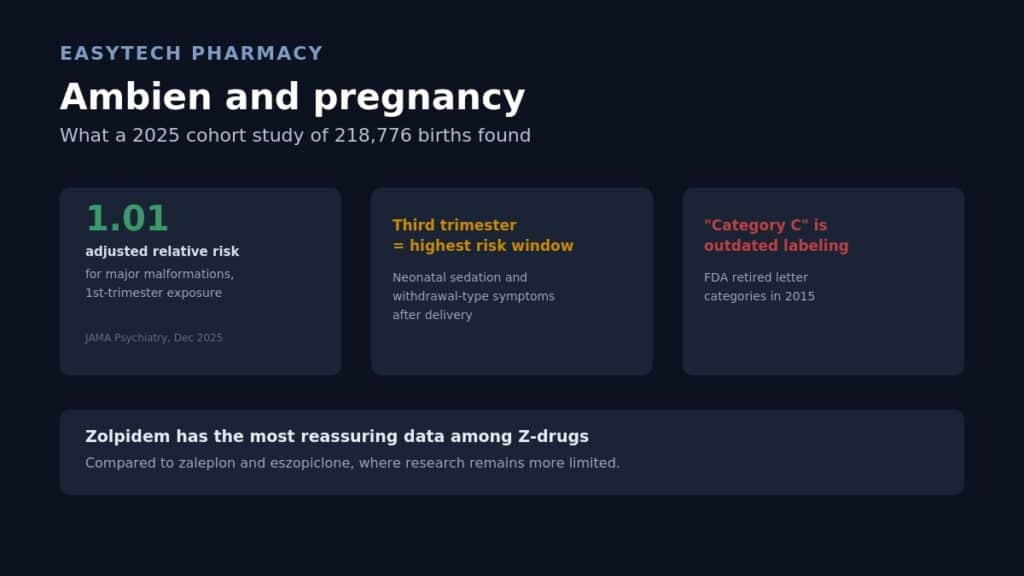
You’ll still see Ambien described online as a “Category C” pregnancy drug. That label is outdated. The FDA retired the old letter category system, A through X, back in 2015. A more detailed narrative labeling system replaced it under the Pregnancy and Lactation Labeling Rule. Modern prescribing information describes actual risk data in plain language rather than a single letter grade. It’s worth knowing this, since a lot of older content online still repeats the retired category system as if it’s current.
What Recent Research Actually Found
A large U.S. population-based cohort study looked at Z-drug use during the first trimester. Researchers published it in JAMA Psychiatry in late 2025. The study examined the medication class that includes zolpidem, and its association with major congenital malformations. Zolpidem accounted for the large majority of the exposures studied. The adjusted pooled relative risk for any major malformation came out to 1.01. That number essentially indicates no meaningful increase in malformation risk tied to first-trimester Z-drug exposure specifically.
That’s a genuinely reassuring finding. It reflects a broader pattern researchers have noted: among the Z-drugs, zolpidem currently has the most reassuring reproductive safety data available. Zaleplon and eszopiclone, by comparison, still have more limited research behind them.
Where the Real Caution Still Applies
The malformation data being reassuring doesn’t mean the conversation stops there. A few areas still warrant real attention:
- Preterm birth and low birth weight. Some studies have reported small increased risks in these areas, even without a corresponding rise in structural malformations.
- Third-trimester timing. Use later in pregnancy, closer to delivery, carries the highest documented risk of neonatal complications. This includes potential respiratory depression and withdrawal symptoms in the newborn.
- Placental crossing. Zolpidem crosses the placenta and reaches fetal circulation within hours of maternal use. This is part of why timing and dosing decisions matter throughout pregnancy, not only in the first trimester.
- Breastfeeding considerations. Zolpidem does pass into breast milk in small amounts. Case data has generally shown low levels with no adverse effects reported in the infant.
Why Trimester Timing Changes the Calculation
Pregnancy isn’t a single window when it comes to medication risk. First-trimester exposure is where organ formation happens. That’s why the malformation research focuses heavily on that period, and why the JAMA Psychiatry findings there are genuinely reassuring. Later in pregnancy, the concerns shift toward the newborn’s own adjustment after birth. A baby exposed to zolpidem close to delivery may need monitoring for sedation or withdrawal-type symptoms in the days afterward.
Line Up Support Before You Stop or Switch
If you and your provider decide to stop Ambien during pregnancy, or transition to a different approach, line up that support before you make the change, not after. Stopping doesn’t mean abandoning help for sleep entirely.
If the underlying insomnia is still an issue, non-habit-forming options are worth discussing. Our guide on sleeping pills that are not habit forming and our comparison of trazodone vs Ambien both cover alternatives with a different risk profile. Our guide on Ambien Dependence vs. Addiction covers non-pharmaceutical support worth building into your routine, especially useful during pregnancy when medication options are already more limited.
If you’re managing another condition alongside this transition, blood pressure changes are common during pregnancy, review your full medication list with your pharmacist. Our guide on does Ambien lower blood pressure covers one relevant interaction worth knowing about.
If sleep trouble persists well after stopping, that’s worth a proper evaluation rather than restarting Ambien by default. Our guide on when sleeplessness needs a doctor covers the signs that mean it’s time for that conversation.
According to MedlinePlus, doctors recommend gradually reducing the dose of zolpidem rather than stopping suddenly, particularly after regular use, to minimize withdrawal effects, guidance that applies during pregnancy just as it does otherwise.
What This Means in Practice
None of this data points to a single universal answer. It points to a more individualized calculation. Untreated insomnia during pregnancy carries its own documented risks, and that has to be weighed against the specific, now better-understood risk profile of zolpidem at different stages of pregnancy. This is a genuinely case-by-case decision. It benefits from a real conversation, not a blanket answer found online.
Anyone already taking Ambien before becoming pregnant, or considering it during pregnancy, benefits from bringing this data directly into that conversation. Outdated category labels and fear-based content haven’t kept pace with the newer research, so they’re worth setting aside.
Non-Medication Options Worth Discussing
Cognitive behavioral therapy for insomnia has strong evidence behind it generally. It carries no medication-related exposure concerns, which makes it a common first-line recommendation during pregnancy. Sleep hygiene adjustments, positioning changes for physical comfort, and addressing specific pregnancy-related sleep disruptors, like reflux or restless legs, are also often worth exploring before or alongside any medication discussion.
The Bottom Line
The research on Ambien and pregnancy has genuinely improved. A large 2025 cohort study found no meaningful increase in major malformation risk tied to first-trimester zolpidem exposure. That’s among the more reassuring data available for this medication class. Real considerations remain around trimester timing, preterm birth, and newborn monitoring closer to delivery. This is a conversation worth having directly, with current data in hand, rather than one settled by outdated labels or blanket answers.
For the full clinical update, see the MGH Center for Women’s Mental Health’s 2026 clinical review of Z-drugs and pregnancy.
Frequently asked questions
Is Ambien still classified as a Category C pregnancy drug?
The FDA retired that labeling system in 2015. Current prescribing information uses detailed narrative descriptions of risk instead of a single letter category.
Does taking Ambien in early pregnancy increase the risk of birth defects?
A large 2025 cohort study found an adjusted relative risk of 1.01 for major malformations with first-trimester Z-drug exposure. That indicates no meaningful increase in this specific risk.
Is it safer to take Ambien earlier or later in pregnancy?
Third-trimester use carries the highest documented risk of neonatal complications, including potential respiratory depression and withdrawal-type symptoms in the newborn after delivery.
Can I take Ambien while breastfeeding?
Zolpidem does pass into breast milk in small amounts. Case data has generally shown low levels with no adverse effects reported in infants, but this is worth discussing directly given individual circumstances.
Related reading
- Ambien and kidney or liver function: what actually matters
- Ambien and fall risk in elderly patients: what the data shows
- Ambien and depression risk: what the research shows
- Is Ambien a controlled substance? Schedule IV explained
If you’re pregnant, breastfeeding, or planning a pregnancy and have questions about your Ambien prescription, talk to your pharmacist or prescriber directly. EasyTech Pharmacy can help you review your prescription.
For local pharmacy access near you, our Ambien near me guide covers pharmacies across the world.
Visit EasyTech Pharmacy — sleep medication with real pharmacist guidance.