Is Lunesta Stronger Than Ambien? What “Stronger” Actually Means Here
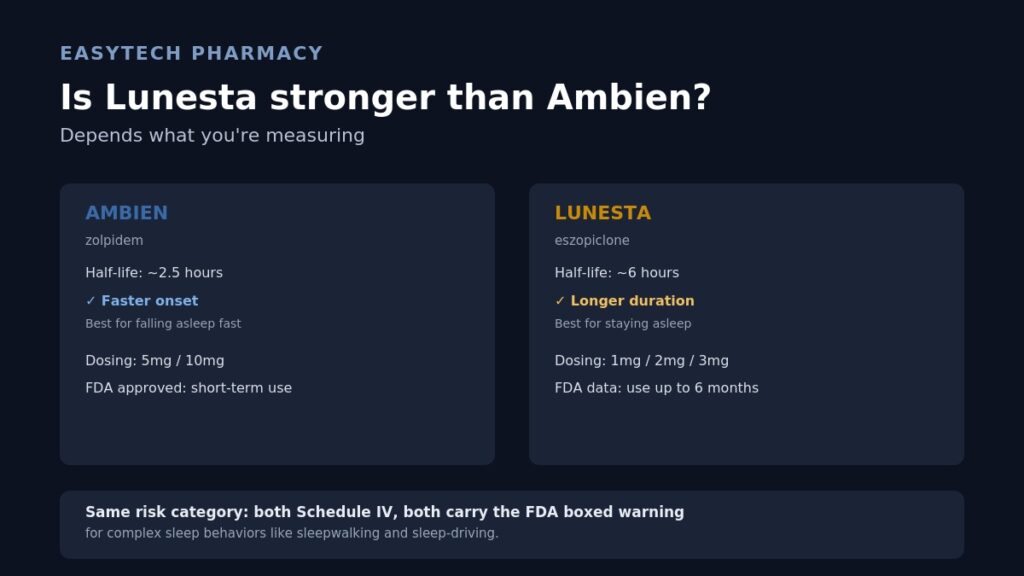
“Stronger” sounds like a simple question. With sleep medications, it almost never has a simple answer. Ask five different sources whether Lunesta is stronger than Ambien and you’ll get five slightly different explanations, because the word itself is doing a lot of work. Here’s what the actual data says, broken down by what “stronger” could mean in each case.
Why “Stronger” Isn’t One Thing
With sleep medications, strength can mean at least four different things: how fast it kicks in, how deep the sedation feels, how long the effect lasts, or how much risk it carries. Lunesta and Ambien don’t rank the same way across all four. A medication that’s “stronger” for staying asleep might be weaker for falling asleep fast, and vice versa. That’s the core reason this question resists a one-word answer.
Onset: Ambien Generally Wins
For pure speed, Ambien has the edge. Zolpidem reaches peak blood levels in around 1.5 hours, while eszopiclone, Lunesta’s active ingredient, peaks slightly faster at around 1 hour, though in practical use, Ambien is widely regarded as producing a quicker, more immediate sedating effect. Ambien is generally the pick when the main problem is simply falling asleep in the first place.
Duration: Lunesta Generally Wins
This is where Lunesta earns its “stronger” reputation. Eszopiclone’s half-life runs around 6 hours, more than double zolpidem’s roughly 2.5-hour half-life for immediate-release Ambien. In practical terms, that means Lunesta tends to stay active in the system longer, which can help people who wake up in the middle of the night rather than only struggling to fall asleep initially.
Ambien CR, the extended-release version, complicates a simple comparison. Its dual-layer design gives it a longer effective duration than standard Ambien, with a half-life closer to 2.8 to 4.5 hours, though it still generally falls short of Lunesta’s full duration.
Sedation Depth: Genuinely Unclear
Here’s where the research gets less definitive. No strong clinical evidence establishes that either drug produces deeper sedation than the other at standard doses. What differs is how each is experienced: Ambien’s fast onset can feel more abrupt and noticeable, while Lunesta’s slower, longer arc can feel gentler at the start but linger further into the morning.
Risk Profile: More Similar Than Different
This is where a lot of “which is stronger” framing misses something important medications are Schedule IV controlled substances carry the same FDA boxed warning for complex sleep behaviors, the sleepwalking and sleep-driving risks we’ve covered in our guide on Who Should Not Take Ambien. Both carry real next-day impairment risk, a topic we cover specifically for Ambien in our guide on next-day driving impairment, and Lunesta’s longer half-life arguably makes this concern more relevant for it, not less.
Dosing: Not a Direct Comparison
Lunesta typically comes in 1 mg, 2 mg, and 3 mg tablets, while Ambien immediate-release comes in 5 mg and 10 mg. These numbers aren’t directly comparable milligram-for-milligram, since the two drugs have different potencies at the receptor level. A rough clinical equivalence sometimes cited is 10 mg of zolpidem to roughly 2 to 3 mg of eszopiclone, but individual response varies enough that this is a starting reference point, not a precise conversion.
Approved Use Duration: A Real Practical Difference
Ambien is FDA-approved specifically for short-term insomnia treatment. Lunesta, by contrast, has clinical trial data supporting use out to six months and doesn’t carry the same short-term-only approval language. In practice, both are generally used for the shortest effective period, but this labeling difference reflects real differences in how each drug’s long-term data has been studied.
So Which One Is Actually “Stronger”?
- For falling asleep fast: Ambien generally has the edge
- For staying asleep through the night: Lunesta generally has the edge
- For overall sedation depth: Roughly comparable, no clear winner
- For risk and dependence potential: Essentially equivalent, both Schedule IV with similar warnings
- For next-day impairment risk: Lunesta’s longer half-life may extend this window further
Neither drug is simply “the stronger one.” Each is built around a different piece of the insomnia problem, and the right choice depends on which piece is actually giving you trouble.
The Bottom Line
Is Lunesta stronger than Ambien? It depends entirely on what you’re measuring. Ambien tends to act faster and suits sleep-onset problems well. Lunesta tends to last longer and suits sleep-maintenance problems better. Neither has a clear edge in overall sedation depth, and both carry essentially the same category of serious risks. The more useful question isn’t which is stronger. It’s which one actually matches the specific sleep problem you’re dealing with.
For a detailed clinical comparison of both medications, see Drugs.com’s comparison of Lunesta and Ambien.
Frequently asked questions
Is Lunesta more addictive than Ambien?
Both are Schedule IV controlled substances with similar dependence and abuse potential. Neither has strong evidence establishing it as clearly more addictive than the other.
Can I switch from Ambien to Lunesta directly?
Switching between the two is pharmacologically possible due to cross-tolerance, but the right approach depends on your specific situation and should be planned with your prescriber rather than done independently.
Which one causes more next-day grogginess?
Lunesta’s longer half-life means it can remain active further into the morning for some people, which may increase next-day impairment risk compared to standard-release Ambien.
Is 10 mg of Ambien equal to a specific Lunesta dose?
A commonly cited rough equivalence is 10 mg of zolpidem to about 2 to 3 mg of eszopiclone, but this is an approximation, not a precise conversion, since individual response varies.
Related reading
- Ambien complex sleep behaviors: sleepwalking, sleep-driving, and the black box warning
- Ambien and next-day driving impairment: risks and legal exposure
- Ambien tolerance: why it happens and what to do
- Is Ambien a controlled substance? Schedule IV explained
Not sure which sleep medication fits your situation best? Talk to your pharmacist or prescriber. EasyTech Pharmacy can help you review your options.
For local pharmacy access near you, our Ambien near me guide covers pharmacies across the world.
Visit EasyTech Pharmacy — sleep medication with real pharmacist guidance.