Best Non-Habit-Forming Sleep Aids Compared
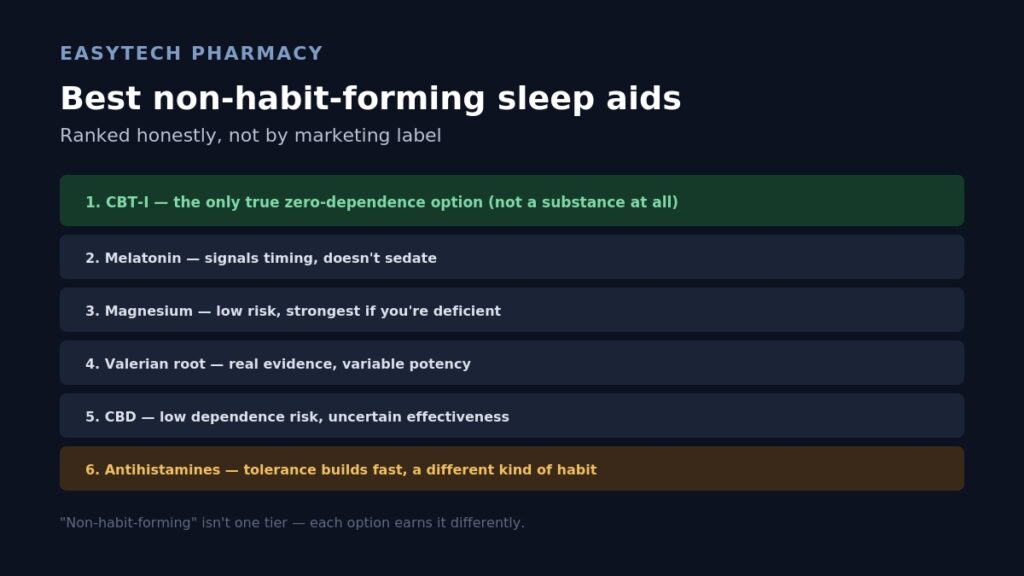
“Non-habit-forming” gets printed on a lot of packaging, but the term means something specific, not just “gentler than Ambien.” Some options genuinely carry no dependence risk. Others carry some, just less than a controlled substance. Ranking them honestly means separating marketing language from the actual mechanism behind each one.
What “Non-Habit-Forming” Actually Means
Dependence happens when the body adapts to a substance and reacts when it’s removed, through tolerance, withdrawal, or both. A genuinely non-habit-forming option doesn’t create that adaptation, regardless of how long or how often you use it. This is a meaningfully higher bar than simply “safer than a controlled substance,” and not every option marketed this way clears it equally well.
Ranked: From Truly Non-Habit-Forming to Lower-Risk-But-Not-Zero
1. Cognitive Behavioral Therapy for Insomnia (CBT-I): The Only True Zero
This is the one option on this list that isn’t a substance at all, which is exactly why it carries no dependence risk whatsoever. CBT-I addresses the thoughts and habits driving insomnia directly, and its effects are shown to persist after treatment ends, unlike anything you take. It’s recommended as first-line treatment for chronic insomnia by the American College of Physicians, ahead of medication. We cover this in more depth in our broader guide on Ambien alternatives.
2. Melatonin: Signaling, Not Sedating
Because melatonin works by signaling circadian timing rather than chemically forcing sedation, it doesn’t create the same tolerance and dependence pattern associated with sedative-hypnotics. It’s genuinely one of the lowest-risk options for regular use. Our full comparison in Ambien vs. melatonin covers the mechanism gap and a real dosing myth worth knowing before you buy a bottle.
3. Magnesium: Low Risk, With a Real Caveat
Magnesium carries essentially no dependence risk, since it’s correcting a nutritional gap rather than sedating the nervous system directly. The caveat isn’t about habit formation. It’s that the evidence for benefit is strongest specifically in people who are actually deficient, a distinction covered in full in our guide on Ambien vs. magnesium for sleep.
4. Valerian Root: Genuinely Low Risk, Less Standardized
Valerian doesn’t carry documented dependence risk the way sedative-hypnotics do, and its evidence for reducing time to fall asleep is real, if thinner than pharmaceutical trial data. The caveat here is regulatory, not habit-forming: as a supplement, potency varies by brand and batch, covered in our guide on Ambien vs. valerian root.
5. CBD: Low Habit-Forming Risk, Genuinely Uncertain Effectiveness
CBD doesn’t show the tolerance and withdrawal pattern associated with controlled substances, so it earns its non-habit-forming label fairly. Where it falls short isn’t dependence risk but evidence: the best-designed sleep-specific trial found no effect on objective sleep measures, a gap covered honestly in our guide on Ambien vs. CBD for sleep.
6. Diphenhydramine and Doxylamine: The Complicated Middle
These antihistamines don’t carry the same controlled-substance dependence profile as Ambien, but they’re not entirely without their own pattern: tolerance to the sedative effect develops, often within days, meaning regular use stops delivering the same benefit even without classic withdrawal symptoms. That’s a different kind of habit-forming concern, functional tolerance rather than physical dependence, but it still means these aren’t ideal for nightly, long-term use. Our comparisons in Ambien vs. Benadryl and Ambien vs. doxylamine cover this pattern in detail.
Where This Leaves Ambien
Ambien sits outside this ranking entirely, not because it’s ineffective, but because it’s built through a mechanism, direct GABA receptor activity, that carries genuine, well-documented dependence and tolerance potential, covered in our guide on Ambien tolerance. That’s not a flaw in the medication. It’s a tradeoff for the effectiveness that comes with its FDA approval for genuine chronic insomnia, an effectiveness bar none of the six options above have been held to in the same way.
How to Actually Choose Among Non-Habit-Forming Options
- Want the option with zero substance-related risk and the most durable long-term results? CBT-I, even though it takes more upfront effort than taking a pill.
- Dealing with jet lag, shift work, or a shifted sleep schedule specifically? Melatonin fits this problem better than any option on this list, including Ambien.
- Suspect a nutritional gap might be part of the picture? Magnesium, particularly the glycinate form, is worth investigating.
- Want something with real, if thinner, clinical support for falling asleep faster? Valerian root has genuine evidence behind it.
- Sleep trouble tangled up with anxiety specifically? CBD’s stronger evidence lies in anxiety reduction, with sleep sometimes improving as a secondary effect.
- Need occasional, short-term relief and nothing more? Diphenhydramine or doxylamine can work briefly, just not as a nightly long-term plan.
The Bottom Line
“Non-habit-forming” isn’t one single tier. CBT-I is the only true zero-risk option on this list, since it isn’t a substance at all. Melatonin, magnesium, and valerian root each carry genuinely low dependence risk through different mechanisms, each with its own real-world caveat around effectiveness or regulation. CBD earns its non-habit-forming label but comes with real uncertainty about whether it actually works for sleep specifically. Antihistamines occupy a messier middle ground, low on classic dependence but prone to fast-developing functional tolerance. None of these six match Ambien’s proven effectiveness for severe, persistent insomnia, but for many people, that tradeoff is exactly the point.
For a broader clinical overview of non-medication insomnia treatment, see the American College of Physicians’ clinical guideline on managing chronic insomnia.
Frequently asked questions
What’s the single most non-habit-forming sleep aid available?
Cognitive behavioral therapy for insomnia (CBT-I) carries zero substance-related dependence risk, since it isn’t a medication or supplement at all.
Is melatonin truly non-habit-forming?
Yes. Because it signals circadian timing rather than chemically sedating the brain, melatonin doesn’t produce the tolerance and dependence pattern associated with sedative-hypnotics.
Can antihistamines like Benadryl become habit-forming?
Not in the classic dependence sense, but tolerance to their sedative effect can develop within days of regular use, which functionally reduces their usefulness for nightly, long-term use.
Is CBD safe to use every night for sleep?
It doesn’t carry documented dependence risk, but the evidence supporting its effectiveness for sleep specifically remains mixed and comparatively thin.
Related reading
- Ambien alternatives: a full overview of your options
- Best OTC sleep aid vs. Ambien: a full comparison
- Ambien tolerance: why it happens and what to do
- Ambien vs. melatonin: how they actually work, compared
Trying to figure out which non-habit-forming option actually fits your situation? Talk to your pharmacist. EasyTech Pharmacy can help you think it through.
For local pharmacy access near you, our Ambien near me guide covers pharmacies across the world.
Visit EasyTech Pharmacy — sleep medication with real pharmacist guidance.