Can You Take Tylenol With Ambien? The Straight Answer — With the Details That Matter
It is the kind of question that comes up on a Tuesday night. You have a headache. You also need to take Ambien to sleep. You grab the Tylenol bottle, pause, and wonder whether it is actually fine to take both.
Most people either guess and take both anyway, or avoid the Tylenol entirely and lie there with a headache they could have treated. Neither approach is ideal — because the actual answer is more specific and more useful than a simple yes or no.
So here is the complete picture on can you take Tylenol with Ambien. What the interaction actually looks like. What the risks genuinely are. And exactly how to do this safely when you need pain relief and sleep on the same night.
For more on managing your Ambien use effectively, our guide on buy Ambien online covers the full picture of safe access and use.
The Direct Answer — Generally Yes, With Conditions
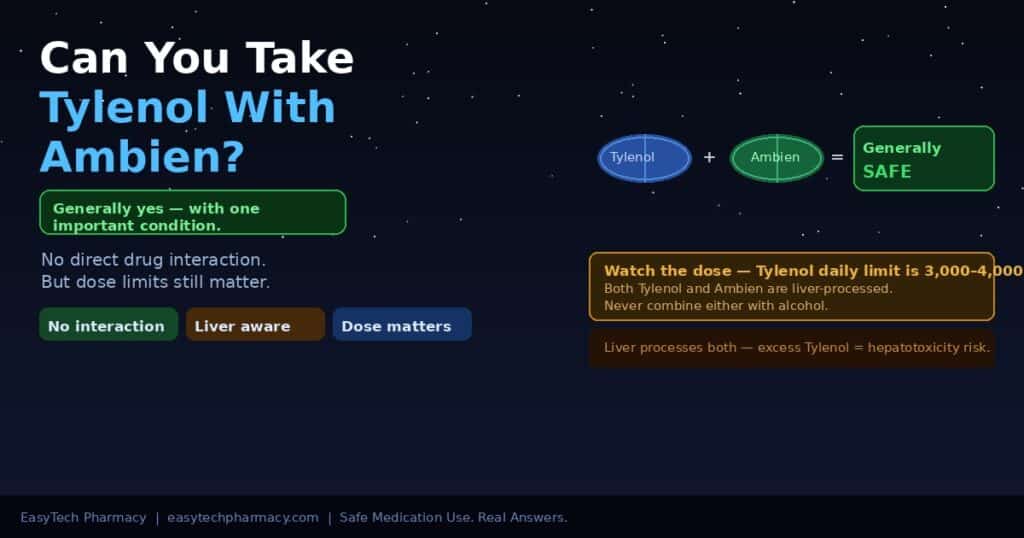
Tylenol (acetaminophen) and Ambien (zolpidem) do not have a direct pharmacological interaction. They work through completely different pathways. Ambien affects GABA receptors in the brain to produce sedation. Tylenol works through prostaglandin pathways to reduce pain and fever.
These two mechanisms do not interfere with each other. Taking standard doses of Tylenol alongside a standard dose of Ambien does not amplify sedation, change how quickly Ambien works, or produce any known direct drug-drug interaction.
According to Drugs.com’s interaction checker, there is no significant interaction between acetaminophen and zolpidem. The combination is widely used in clinical settings without specific concern.
However — and this is the part that actually matters — the conditions under which you take them together determine whether the combination stays safe. Two specific factors change the equation significantly.
The Liver Factor — Why Dose Limits Matter More Than People Realize
Both Tylenol and Ambien are processed by the liver. They use overlapping enzyme pathways — specifically the CYP450 system — to be metabolized and cleared from the body.
Under normal circumstances, the liver handles both without difficulty. Standard doses of each medication are well within the liver’s processing capacity. However, when Tylenol is taken in higher amounts or over extended periods, the liver’s processing pathway for acetaminophen can become saturated. A byproduct called NAPQI accumulates. NAPQI is directly hepatotoxic — it damages liver cells.
The daily acetaminophen limit for healthy adults is generally 3,000 mg to 4,000 mg. At doses above this level, liver damage risk rises significantly. This is the most common cause of acute liver failure in the United States — not because people are being reckless, but because acetaminophen is hidden in dozens of products simultaneously.
Think about a typical night. You take two regular-strength Tylenol for a headache (650 mg). Your cold medicine contains acetaminophen (another 325 mg per dose). Your daytime pain reliever also had acetaminophen. You are adding these up without realizing it — and the total can approach or exceed the safe daily limit without any single dose feeling excessive.
When you add Ambien to the picture — which also uses liver enzymes for metabolism — the liver’s processing load increases. This does not create a crisis at normal doses. However, it is a reason to be precise about how much acetaminophen you are actually consuming across all sources when you are also taking Ambien regularly.
The Alcohol Factor — The Combination That Changes Everything
There is one specific scenario where taking Tylenol and Ambien together becomes genuinely dangerous. That scenario involves alcohol.
Alcohol is a potent liver stressor. It depletes glutathione — the compound the liver uses to neutralize the toxic NAPQI byproduct of acetaminophen metabolism. When alcohol is present, even moderate doses of Tylenol can produce levels of NAPQI that damage liver cells.
Simultaneously, alcohol dramatically amplifies Ambien’s sedative effects — increasing CNS depression, parasomnia risk, respiratory concerns, and memory effects in ways that make the combination genuinely dangerous. Our detailed guide on Ambien and alcohol covers this specific interaction fully.
The practical rule is straightforward. On any night you take Ambien, avoid alcohol entirely. On any night you take Tylenol, limit alcohol severely or avoid it. When you are taking both Tylenol and Ambien on the same night, alcohol should not be in the equation at all.
Tylenol vs Ibuprofen vs Aspirin — Which Pain Reliever Works Best With Ambien
If you have a choice of pain relievers on a night when you are also taking Ambien, it is worth knowing how each one compares.
| Pain Reliever | Interaction With Ambien | Main Caution | Best For |
|---|---|---|---|
| Tylenol (acetaminophen) | No direct interaction | Daily dose limit — liver processing overlap | Headache, mild fever, general pain |
| Ibuprofen (Advil, Motrin) | No direct interaction | GI irritation — take with food. Not ideal before bed on empty stomach. | Inflammation, muscle pain, menstrual cramps |
| Naproxen (Aleve) | No direct interaction | Longer half-life — GI effects can persist overnight | Joint pain, longer-lasting pain |
| Aspirin | No direct interaction | GI bleeding risk — not ideal before sleep | Fever, pain — but not the first choice at bedtime |
Among these options, Tylenol is generally the most practical choice for bedtime pain relief when you are also taking Ambien. It does not irritate the stomach the way ibuprofen can when taken without food before sleep. It does not carry the prolonged GI effects of naproxen. And it has the most well-characterized safety profile alongside zolpidem specifically.
The key — as always — is staying within the daily dose limit and accounting for all sources of acetaminophen, not just the tablets you are consciously taking as “Tylenol.”
When Pain Is Disrupting Your Sleep — The Bigger Picture
There is a useful question worth asking when you find yourself regularly needing pain relief on the same nights you take Ambien. Is the pain contributing to the insomnia? Or are they two separate, coincidental problems?
Pain is one of the most common underlying causes of sleep disruption that medication alone cannot fully address. If you consistently need pain relief at bedtime, the pain itself may be part of what is keeping you from sleeping well — meaning Ambien is addressing the symptom while leaving the cause intact.
This matters practically because some pain conditions respond well to specific sleep-compatible approaches. For example:
- Headaches at bedtime — often tension-related, which responds well to magnesium glycinate (200–400mg), a consistent sleep schedule, and screen time reduction before bed
- Back or joint pain — often worsened by mattress quality and sleep position. Anti-inflammatory approaches during the day reduce nighttime pain without the bedtime drug-load concern
- General body tension — frequently anxiety-related. Addressing the anxiety through the approaches covered in our guide on trazodone vs Ambien often reduces both the tension and the sleep problem simultaneously
None of this means you should never take Tylenol with Ambien. Sometimes you just have a headache and need to sleep. But if this combination is a regular occurrence, investigating the pain source directly tends to produce better outcomes than managing two symptoms indefinitely.
Tylenol PM and Ambien — An Important Distinction
This section matters and most guides skip it entirely.
Tylenol PM is not the same as regular Tylenol. It contains acetaminophen plus diphenhydramine — an antihistamine with sedating properties. Diphenhydramine is the active ingredient in Benadryl and most over-the-counter sleep aids.
Taking Tylenol PM with Ambien means combining two sedating substances. Diphenhydramine is a CNS depressant. While it works through a different pathway than Ambien (histamine receptors rather than GABA), adding its sedative effect to zolpidem’s sedative effect meaningfully increases next-morning grogginess, impaired coordination, and the risk of oversedation.
The combination is not in the same danger category as Ambien and alcohol — but it is not the same as regular Tylenol and Ambien either. For nighttime pain relief when taking Ambien, regular Tylenol (acetaminophen only) is the appropriate choice — not Tylenol PM, Tylenol Simply Sleep, or any other formulation that includes diphenhydramine.
Check the label of any pain reliever carefully before taking it alongside Ambien. Look specifically for diphenhydramine or doxylamine in the ingredients list — both are sedating antihistamines commonly included in nighttime pain relief formulations.
How to Take Tylenol and Ambien Together Safely
If you need to take both on the same night, these steps keep the combination as safe as possible.
- Use regular Tylenol only — not Tylenol PM or any nighttime formulation containing diphenhydramine or doxylamine
- Stay within the daily acetaminophen limit — add up all sources across the full day, not just the bedtime dose. The safe limit is 3,000 mg for most adults — lower if you have any liver concerns
- No alcohol — on any night combining Tylenol and Ambien, alcohol should be completely off the table
- Take Tylenol first, then Ambien when ready for bed — giving Tylenol 20–30 minutes to begin working before adding Ambien gives the liver a sequential processing start rather than simultaneous peak load
- Check all other medications — cold remedies, flu formulas, and many combination products contain hidden acetaminophen. Count these in your daily total
- Go directly to bed after taking Ambien — standard Ambien guidance regardless of what else you are taking. Staying awake after taking it increases side effect risk
Signs You May Have Taken Too Much Acetaminophen
Because acetaminophen toxicity is gradual and the early symptoms are easy to miss, knowing what to watch for matters.
- Nausea or vomiting in the hours after taking high-dose acetaminophen
- Pain in the upper right abdomen — where the liver sits
- Unusual fatigue or feeling unwell the morning after
- Yellowing of skin or eyes — a later sign of liver stress
If you suspect you have taken more acetaminophen than intended — whether through Tylenol, combination cold medicines, or other products — do not wait to see if you feel worse. Contact Poison Control at 1-800-222-1222 or seek medical evaluation immediately. Acetaminophen overdose is most effectively treated in the early hours before liver damage progresses.
Frequently Asked Questions
Can you take Tylenol with Ambien?
Yes — regular Tylenol (acetaminophen) and Ambien (zolpidem) do not have a direct drug interaction. They work through different pathways and do not amplify each other’s effects. The main considerations are staying within safe daily acetaminophen limits, avoiding alcohol with both medications, and choosing regular Tylenol rather than Tylenol PM or nighttime formulations containing diphenhydramine.
Is it safe to take Tylenol PM with Ambien?
Not recommended. Tylenol PM contains diphenhydramine — a sedating antihistamine — in addition to acetaminophen. Combining diphenhydramine’s sedating effect with Ambien’s sedating effect increases next-morning impairment and oversedation risk. Use regular Tylenol (acetaminophen only) if you need pain relief alongside Ambien.
How much Tylenol can I take with Ambien?
The same daily limit applies whether or not you are taking Ambien — 3,000 mg to 4,000 mg for healthy adults, counting all sources throughout the day. A typical adult dose for pain is 500 mg to 1,000 mg every 4 to 6 hours. The key is tracking total daily acetaminophen from all products, not just the dose you consciously identify as “Tylenol.”
Can I take ibuprofen instead of Tylenol with Ambien?
Yes — ibuprofen also has no direct interaction with Ambien. However, ibuprofen can cause stomach irritation when taken without food, which is not ideal immediately before bed on an empty stomach. Regular Tylenol is generally more practical for bedtime pain relief when taking Ambien.
Does Tylenol affect how well Ambien works?
No. Tylenol does not affect zolpidem’s mechanism of action, onset time, or duration. The two medications work entirely independently. Taking Tylenol will not make Ambien stronger, weaker, faster, or slower. For more on Ambien’s onset timeline, our guide on how long does Ambien take to work covers the full picture.
What pain reliever is safest with Ambien?
Regular Tylenol (acetaminophen) is generally considered the most practical choice for bedtime pain relief alongside Ambien, given its lack of GI side effects when taken at night. Ibuprofen and naproxen are also safe from an interaction standpoint but are better tolerated with food — which is not always practical immediately before sleep. Whichever you choose, avoid nighttime formulations that include diphenhydramine or doxylamine.
Bottom Line — Regular Tylenol Is Fine, With Three Rules
The answer to can you take Tylenol with Ambien is yes — with three clear conditions that turn a general “probably fine” into a confident “yes, safely.”
First — use regular Tylenol only. Not Tylenol PM. Not any nighttime formula with diphenhydramine. Second — stay within your daily acetaminophen limit, counting every source. Third — no alcohol on any night you are taking both.
Follow those three rules and taking Tylenol alongside Ambien for occasional pain relief is a genuinely safe and practical approach to a very common situation.
At EasyTech Pharmacy, we carry FDA-approved generic zolpidem at competitive pricing with fast delivery across the US. Our pharmacist team is available to answer questions about drug combinations, dosing, and whether your current medication setup is as safe and effective as it can be.
Looking for local pharmacy options near you? Our Ambien near me guide covers access across the US. And for current pricing on your sleep medication, our breakdown of how much does Ambien cost without insurance shows what you should realistically be paying.
Visit EasyTech Pharmacy — real pharmacist support, competitive pricing, fast delivery.