Sleeping Pills — The Complete Guide to Every Type Available
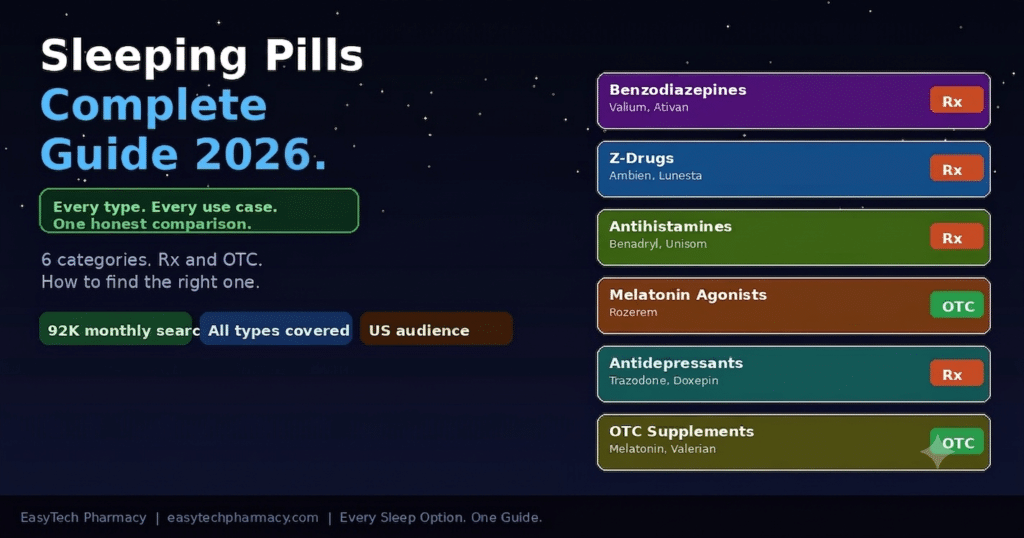
The term “sleeping pills” covers an enormous range of medications. Some are prescription-only controlled substances. Others are OTC supplements you can buy at any grocery store. Some work in 15 minutes. Others take weeks to produce their full effect. Some are safe for years of use. Others are recommended for two weeks maximum.
Most guides treat them as interchangeable. They are not. The right sleeping pill for someone who struggles to fall asleep is a completely different medication from the right option for someone who wakes at 3am. The right choice for a 35-year-old man is different from the right choice for a 68-year-old woman.
This is the complete, honest guide to every category of sleeping pill available in 2026 — what each one is, how it works, who it actually helps, and what the real trade-offs are.
Already know you want Ambien specifically? Our guide on how to buy Ambien online covers the full process. For a speed comparison of every option, our guide on Is Ambien a Narcotic? gives you the onset comparison directly.
Category 1 — Z-Drugs (Sedative-Hypnotics)
Z-drugs are the most widely prescribed class of sleeping pills in the USA. The name comes from the fact that all three major drugs in this class start with the letter Z — zolpidem, zaleplon, and eszopiclone.
Zolpidem (Ambien)
The most prescribed sleep medication in the US. Zolpidem works by amplifying GABA-A receptor activity — the brain’s primary braking mechanism — producing rapid sedation and sleep onset. It comes in immediate-release (Ambien, 5mg/10mg) and extended-release (Ambien CR, 6.25mg/12.5mg) formulations. Onset is 15 to 30 minutes. Coverage is 5 to 6 hours for IR, 7 to 8 for CR.
Best for: sleep onset insomnia (IR), or combined onset and maintenance insomnia (CR). Short-term use of 2 to 4 weeks recommended. Schedule IV controlled substance.
Zaleplon (Sonata)
The shortest-acting Z-drug. Half-life of approximately 1 hour — meaning it clears from the system faster than any other prescription sleep medication. This makes it uniquely useful for people who need help falling asleep but do not want any next-morning sedation effects. It can also be taken in the middle of the night if there are at least 4 hours remaining before waking.
Best for: pure sleep onset difficulty, or middle-of-the-night waking with at least 4 hours still available. Not effective for sleep maintenance. Schedule IV.
Eszopiclone (Lunesta)
The longest-acting Z-drug. Half-life of approximately 6 hours — significantly longer than zolpidem. This gives Lunesta stronger sleep maintenance properties. It is one of the few sleep medications with FDA approval for longer-term use rather than strict short-term limitation.
Best for: both sleep onset and maintenance, and for people who need longer-term pharmaceutical sleep support. Notable side effect — a bitter metallic taste in the mouth that many users report. Schedule IV.
For the complete comparison of how these medications differ in onset speed, our guide on Generic Ambien (Zolpidem) has the full breakdown.
Category 2 — Benzodiazepines
Benzodiazepines were the primary prescription sleep medications before Z-drugs became available. Several remain in clinical use for insomnia today. They work through broad GABA-A receptor enhancement — similar to Z-drugs but less selective, producing stronger anxiolytic and muscle-relaxant effects alongside sedation.
Temazepam (Restoril)
The benzodiazepine most commonly used specifically for insomnia. Half-life of 8 to 22 hours — producing substantial next-morning sedation at higher doses. Works for both onset and maintenance insomnia. Schedule IV.
Triazolam (Halcion)
A short-acting benzodiazepine used for sleep onset. Half-life of 1.5 to 5.5 hours. Less commonly used today given the availability of Z-drugs with better side effect profiles. Schedule IV.
Key Difference vs Z-Drugs
Benzodiazepines carry higher dependence potential than Z-drugs for most patients. They also produce stronger next-day sedation due to longer half-lives. They remain useful in specific clinical situations — particularly when anxiety is a significant component of the insomnia — but Z-drugs have largely replaced them as the first choice for straightforward sleep onset insomnia.
According to the National Heart, Lung, and Blood Institute, cognitive behavioral therapy for insomnia (CBT-I) is recommended as the first-line treatment for chronic insomnia — with medication as an adjunct rather than a primary solution for most patients.
Category 3 — Antidepressants Used for Sleep
Several antidepressants are prescribed off-label for insomnia — meaning they are not FDA-approved specifically for sleep but produce reliable sedation through their mechanism of action at lower doses than those used for depression.
Trazodone
The most commonly prescribed non-controlled medication for insomnia in the USA. At low doses (50 to 100mg) it works through serotonin and histamine pathways to produce sedation. Not a controlled substance — no tolerance or dependency risk in the way Z-drugs and benzodiazepines carry. Can be used longer term without the escalating dose concerns of Schedule IV medications.
Best for: chronic insomnia where sustained medication use is needed, insomnia with anxiety or mood components, or anyone for whom controlled substance risk is a significant concern. Our comparison of trazodone vs Ambien covers how these two options compare in detail.
Doxepin (Silenor)
A tricyclic antidepressant that at very low doses (3mg to 6mg) has FDA approval specifically for insomnia. Its mechanism involves histamine receptor blocking — producing reliable sedation without the GABA pathway concerns of Z-drugs. Particularly effective for sleep maintenance rather than onset. Non-controlled at the doses used for sleep.
Mirtazapine (Remeron)
An antidepressant that produces significant sedation through histamine and serotonin receptor activity. Often prescribed off-label for insomnia — particularly in people who also have depression, anxiety, or appetite difficulties. Can cause significant weight gain with extended use. Non-controlled.
Category 4 — Melatonin Receptor Agonists
Ramelteon (Rozerem)
The only prescription sleep medication that works through the melatonin system rather than GABA. Ramelteon binds to melatonin receptors (MT1 and MT2) in the brain’s circadian rhythm center, signaling the body to prepare for sleep it does not produce the sedative “knock-out” effect of GABA medications.
It is not a controlled substance — no abuse potential, no dependence risk, no tolerance development. It is FDA-approved for sleep onset insomnia with no limitation on duration of use. However, its effects are subtle compared to Z-drugs. It works best for people with mild sleep onset difficulty or circadian rhythm disruption rather than severe insomnia.
Best for: older adults where controlled substance risk is a significant concern, people who travel frequently across time zones, mild sleep onset insomnia, and anyone who wants a non-controlled pharmaceutical option.
Category 5 — Antihistamines (OTC Sleep Aids)
Over-the-counter sleep aids in the USA are almost universally based on one of two antihistamines: diphenhydramine or doxylamine. These are the active ingredients in products like ZzzQuil, Unisom, Benadryl, and Tylenol PM.
Diphenhydramine
Produces sedation by blocking histamine H1 receptors — the same mechanism that makes allergy medication make you drowsy. Works reasonably well for occasional sleep difficulty. However, tolerance to its sedative effects develops very quickly — often within 3 to 5 days of consecutive use. Beyond this point, the medication produces side effects (next-morning grogginess, dry mouth, urinary retention) without much additional sleep benefit.
Doxylamine
Similar mechanism to diphenhydramine but with a longer half-life. Produces more pronounced next-morning sedation. Unisom SleepTabs use doxylamine as their active ingredient. Same rapid tolerance development pattern as diphenhydramine.
Who OTC Antihistamines Are For
Occasional, situational sleep difficulty — jet lag, a particularly stressful night, sleeping in an unfamiliar environment. They are not appropriate for ongoing insomnia. Using them more than a few nights in a row produces rapidly diminishing benefit with persistent side effects. People with enlarged prostate, glaucoma, or dementia should be particularly cautious as anticholinergic effects can be significant.
Category 6 — Supplements and Natural Options
This category covers non-pharmaceutical sleep aids available without authorization. Efficacy varies widely. For mild sleep difficulty, several have meaningful evidence. For clinical insomnia, none replaces proper treatment.
Melatonin
The most widely used sleep supplement in the US. Most effective for circadian rhythm issues — jet lag, shift work sleep disorder, delayed sleep phase syndrome — rather than straightforward insomnia. The therapeutic dose is much lower than most OTC products provide. Research supports doses of 0.5mg to 3mg; most OTC products contain 5mg to 10mg. Higher doses do not produce proportionally better sleep — they simply extend next-morning grogginess.
Magnesium Glycinate
At doses of 200mg to 400mg before bed, magnesium glycinate supports GABA activity and reduces cortisol — the stress hormone that keeps the nervous system alert at night. Particularly helpful for people whose sleeplessness involves physical tension, nighttime muscle cramps, or stress-related hyperarousal. Non-habit-forming. Safe for most adults at standard doses.
L-Theanine
An amino acid found in green tea that promotes alpha brain wave activity — the relaxed but alert state associated with meditation. At 100 to 200mg, it helps transition the nervous system from anxious hyperarousal toward the calm state needed for sleep. Often paired with magnesium for a synergistic effect without any sedative medication.
Valerian Root
Herbal supplement with mixed evidence for mild insomnia. May produce modest improvements in sleep onset time with regular use over several weeks — unlike most sleep aids, its effects build gradually rather than being immediate. Generally well-tolerated. Not effective for clinical insomnia.
For the complete guide to non-habit-forming options at every level from supplements to prescription, our guide on sleeping pills that are not habit forming covers every option with specific guidance on who each one fits.
New Class — Orexin Receptor Antagonists
A newer class of sleep medication that works differently from all the above. Rather than sedating the brain, orexin antagonists block the wakefulness signal — the brain’s “stay awake” mechanism — allowing natural sleep to emerge.
Suvorexant (Belsomra) and Lemborexant (Dayvigo)
Both FDA-approved for insomnia Both work by blocking orexin receptors that normally promote wakefulness. The resulting sleep is considered by some researchers to be more natural in architecture than GABA-induced sleep — less suppression of REM and deep sleep stages.
They tend to work better for sleep maintenance than onset. Next-morning impairment is a concern at higher doses. They are more expensive than generic Z-drugs. However, for patients who have not responded adequately to Z-drugs or who experience problematic side effects with GABA medications, orexin antagonists represent a genuinely different approach rather than just an alternative in the same class.
How to Choose the Right Sleeping Pill for Your Situation
| Your Sleep Problem | Best First Option | Alternative | Avoid |
|---|---|---|---|
| Can’t fall asleep | Zolpidem IR 5mg | Zaleplon, Ramelteon | Doxylamine long-term |
| Wake up at 3am | Zolpidem CR or Lunesta | Doxepin, Lemborexant | Zaleplon (too short) |
| Both problems | Zolpidem CR or Lunesta | Trazodone + CBT-I | OTC antihistamines |
| Anxiety + insomnia | Trazodone | Doxepin, Mirtazapine | Z-drugs alone |
| Chronic insomnia (3+ months) | CBT-I first + Trazodone | Lunesta (longer approval) | Benzodiazepines |
| Jet lag or shift work | Melatonin 0.5–3mg | Ramelteon | Z-drugs for this purpose |
| Older adult (65+) | Trazodone or Ramelteon | Doxepin 3mg (low dose) | Benzodiazepines |
| Occasional difficulty only | Diphenhydramine OTC | Melatonin + L-theanine | Prescription Z-drugs |
What the Evidence Says — CBT-I vs Medication
For chronic insomnia, the clinical evidence is consistent across multiple large trials. CBT-I — cognitive behavioral therapy for insomnia — produces sleep improvements that are more durable than any medication, with effects that continue improving after the treatment ends rather than returning to baseline when the intervention stops.
This does not mean medication has no role. It means that medication works best as part of a strategy — a short-term bridge while behavioral approaches are being established — rather than as an indefinite standalone solution. People who use both CBT-I and medication during the same period consistently have better long-term outcomes than those who use medication alone.
CBT-I is now available through telehealth platforms, apps (like Sleepio and Somryst), and licensed therapists — no in-person referral required in most cases.
Sleeping Pills and Safety — The Key Points
- All prescription sleep medications carry next-morning impairment risk — especially in women and older adults. The 7 to 8 hour sleep window requirement is not arbitrary. For dosing guidance see our detailed guide on Ambien dosage.
- Alcohol amplifies every sleep medication’s effects unpredictably — the combination with GABA-acting medications is particularly dangerous
- OTC antihistamines develop tolerance in 3 to 5 days — they are not solutions for ongoing insomnia
- Non-controlled options exist at every level of severity — from melatonin for mild difficulty to trazodone for chronic insomnia
- Starting at the lowest effective dose reduces side effects without reducing therapeutic benefit for almost all patients
For the complete breakdown of Ambien-specific side effects, our dedicated guide on Ambien side effects covers everything from common to serious.
Frequently Asked Questions
What are sleeping pills?
Sleeping pills is a general term covering any medication or supplement used to improve sleep. The category includes prescription Z-drugs (zolpidem, zaleplon, eszopiclone), benzodiazepines (temazepam), antidepressants used for sleep (trazodone, doxepin), melatonin receptor agonists (ramelteon), orexin antagonists (suvorexant, lemborexant), OTC antihistamines (diphenhydramine, doxylamine), and supplements (melatonin, magnesium, L-theanine).
What is the most effective sleeping pill?
Effectiveness depends entirely on which sleep problem you have speed of onset, zolpidem and zaleplon are fastest for sleep maintenance, eszopiclone and Ambien CR perform best. For long-term sustainable use, trazodone and CBT-I combined produce the most durable outcomes. No single sleeping pill is universally best.
Are sleeping pills safe to take every night?
Most prescription sleeping pills are approved for short-term use only — 2 to 4 weeks for Z-drugs and most benzodiazepines. Non-controlled options like trazodone, ramelteon, and low-dose doxepin can generally be used longer term. OTC antihistamines lose effectiveness in 3 to 5 days of consecutive use. CBT-I remains the recommended long-term solution for chronic insomnia.
What sleeping pills are available without a prescription?
OTC options include diphenhydramine (ZzzQuil, Unisom SleepMelts, Benadryl), doxylamine (Unisom SleepTabs), and supplements including melatonin, magnesium glycinate, L-theanine, and valerian root. All prescription Z-drugs, benzodiazepines, antidepressants, and orexin antagonists require a valid authorization.
What is the safest sleeping pill for older adults?
Trazodone and low-dose doxepin (3mg) are generally considered the safest prescription options for adults over 65. Ramelteon is another well-tolerated option. The American Geriatrics Society’s Beers Criteria specifically flags Z-drugs and benzodiazepines as potentially inappropriate for older adults due to fall risk, cognitive impairment, and extended clearance times.
Bottom Line — The Right Sleeping Pill Depends on Your Specific Sleep Pattern
The complete answer to sleeping pills is not a single medication name. It is a matching process — your sleep problem, your health history, your age, and how long you need support — mapped to the available options at each level of intervention.
For short-term sleep onset difficulty — Ambien or zaleplon therefor maintenance insomnia — Ambien CR or Lunesta for chronic insomnia with anxiety — trazodone plus CBT-I however older adults who need long-term support — trazodone or ramelteon. For occasional difficulty — melatonin or a single-use OTC antihistamine.
The more specific you can be about what your sleep problem actually is — when it happens, how often, what pattern it follows — the more precisely the right option can be identified.
At EasyTech Pharmacy, we carry FDA-approved generic zolpidem, generic trazodone, and a full range of sleep medication options with transparent pricing, fast delivery, and pharmacist support available to help you identify which option fits your situation.
Looking for local options near you? Our Ambien near me guide covers pharmacy access across the US.
Visit EasyTech Pharmacy — find the right sleep medication for your situation today.