Ambien Over the Counter Alternatives — 7 Options You Can Buy Tonight
There is a specific kind of night when the search for “Ambien over the counter alternatives” starts. You need sleep. You do not have a current authorization. The pharmacy is right there. And you are wondering whether anything on those shelves can actually do what you need it to do.
The honest answer is — some of them can. Others cannot and people buy them anyway. And the difference between the ones that work and the ones that disappoint comes down to understanding what each one actually does versus what the packaging implies.
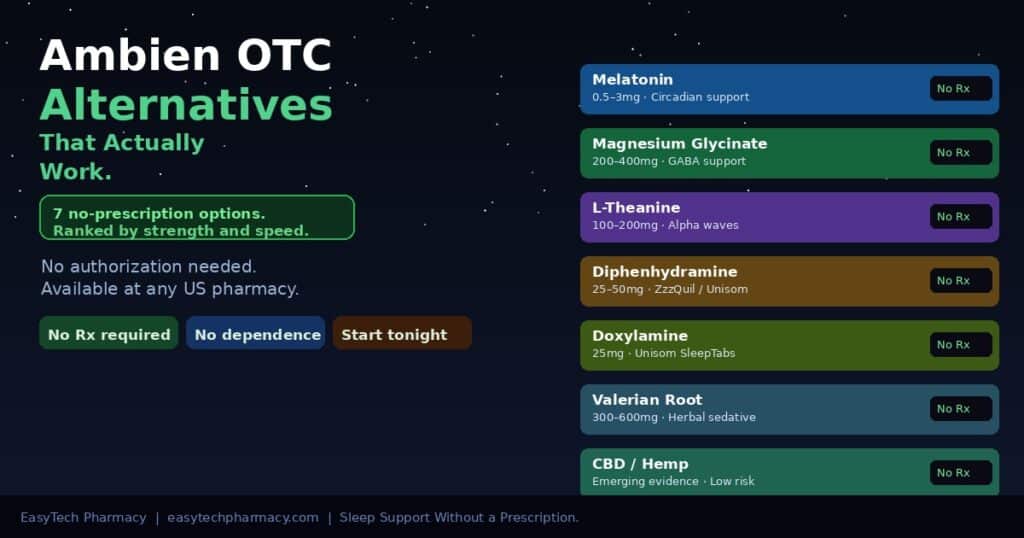
This guide covers all seven meaningful OTC sleep options available in the US — what they actually do at the neurological level, who they genuinely help, the right doses, and the honest limitations. No inflated claims. No vague reassurances.
If you are also exploring whether the step up to prescription options makes sense, our complete sleeping pills guide covers every level from OTC supplements through prescription medication in full detail.
Can Anything OTC Actually Replace Ambien
The short honest answer: not exactly — but some OTC options come closer than most people expect, and for certain types of sleep difficulty they are genuinely the better choice.
Ambien (zolpidem) is a Schedule IV prescription medication precisely because of its potency. It produces reliable, fast sleep onset through direct GABA-A receptor amplification — a mechanism that no OTC product can fully replicate because anything that powerful carries dependence risk that regulators require a prescription to access.
However, OTC options address the same problem from different angles. Some support GABA activity indirectly. Some promote the melatonin rise that allows sleep to begin. Some reduce the cortisol and norepinephrine arousal that blocks sleep. None is as fast or as powerful as zolpidem — but for mild to moderate sleep difficulty, several produce meaningful, reliable results without the controlled substance concerns.
According to the FDA, approximately 70 million Americans experience sleep difficulties — and the majority of cases involve sleep problems that respond to non-prescription interventions before pharmaceutical sleep aids become necessary.
Option 1 — Melatonin (Best for Timing Problems)
Melatonin is the most widely used sleep supplement in the US and the most consistently misunderstood. It is not a sedative. It does not knock you out. What it does is signal to your brain that it is time to prepare for sleep — shifting the body’s internal clock toward sleep readiness.
This makes melatonin highly effective for specific situations and largely ineffective for others.
Works well for: jet lag, shift work sleep disorder, delayed sleep phase syndrome (naturally falling asleep very late), and resetting a disrupted sleep schedule.
Less effective for: primary insomnia where the issue is hyperarousal or anxiety rather than circadian timing. If you lie awake at a normal bedtime for reasons of stress, racing thoughts, or chronic insomnia — melatonin alone will not solve it.
Dose: Most OTC products contain 5mg to 10mg — significantly more than the research-supported therapeutic dose. Studies consistently show that 0.5mg to 3mg is as effective as higher doses and produces far less next-morning grogginess. If you are currently taking 10mg melatonin and finding it groggy in the morning, try cutting to 1mg or 2mg first.
Timing: Take it 60 to 90 minutes before your target bedtime — not immediately before. It works by shifting the clock, not by producing immediate sedation.
Option 2 — Magnesium Glycinate (Best for Tension and Stress)
Magnesium glycinate is consistently underestimated as a sleep aid — and consistently overperforms for people who discover it. At 200 to 400mg taken 30 to 60 minutes before bed, it directly supports GABA activity and reduces cortisol — two of the primary physiological mechanisms that block sleep onset.
Many US adults are mildly deficient in magnesium without knowing it. This deficiency measurably impairs both sleep onset and sleep quality. Supplementing to adequate levels — which magnesium glycinate achieves efficiently due to its high absorption rate — restores normal sleep function for many people within 5 to 7 days of consistent use.
Works well for: sleep difficulty involving physical tension, muscle tightness, nighttime anxiety, stress-related arousal, and mild insomnia. Also helps with restless legs syndrome, which frequently disrupts sleep.
Less effective for: severe insomnia or sleep disorders with a specific clinical cause. It is a support, not a sedative.
Important note: Choose magnesium glycinate specifically — not magnesium oxide or magnesium citrate. Oxide has poor absorption and primarily acts as a laxative. Glycinate is absorbed efficiently and is gentle on the digestive system at therapeutic doses.
Option 3 — L-Theanine (Best for an Anxious Mind)
L-theanine is an amino acid found in green tea that promotes alpha brain wave activity — the relaxed, alert state associated with meditation. At 100 to 200mg taken before bed, it quiets cognitive hyperarousal — the racing thoughts and mental chatter that keep many people awake — without producing sedation or next-morning impairment.
Works well for: people whose sleep difficulty is driven by mental overactivation — overthinking, planning, worrying — rather than physical tension or circadian issues. Often pairs effectively with magnesium glycinate for a combined behavioral and physiological effect.
Less effective for: deep sedation or fast sleep onset in people with significant insomnia. Its effect is subtle — a quieting of the mind rather than a forcing of sleep.
For the full picture on managing anxiety-driven sleep problems, our guide on sleeping pills that are not habit forming covers every non-controlled option at every level.
Option 4 — Diphenhydramine (ZzzQuil, Benadryl, Unisom SleepMelts)
This is the active ingredient in most branded OTC sleep products. Diphenhydramine is an antihistamine that produces sedation by blocking histamine H1 receptors — the same mechanism that makes allergy medication make you drowsy.
Works well for: occasional, situational sleep difficulty — one difficult night, jet lag, sleeping in an unfamiliar environment. It works on the first use.
Critical limitation: Tolerance to the sedative effect develops in 3 to 5 consecutive nights of use. After this point the medication produces its anticholinergic side effects — dry mouth, grogginess, urinary difficulty — without providing meaningful sleep benefit. It is not appropriate for ongoing insomnia.
Who should be cautious: Adults over 65 should use diphenhydramine carefully. The American Geriatrics Society specifically flags it as potentially inappropriate for older adults due to anticholinergic effects, cognitive impairment risk, and urinary retention. Men with enlarged prostate and people with glaucoma should also avoid it or use only under pharmacist guidance.
Dose: 25mg to 50mg taken 30 minutes before bed. The 25mg dose is often sufficient and produces fewer side effects than 50mg.
Option 5 — Doxylamine (Unisom SleepTabs)
Doxylamine is the second antihistamine used in OTC sleep aids — found specifically in Unisom SleepTabs (not the gel caps, which use diphenhydramine). It has a longer half-life than diphenhydramine — approximately 10 hours compared to 6 to 8 hours — which produces more pronounced next-morning sedation but longer initial sleep duration.
Works well for: people who fall asleep but wake in the middle of the night — the longer half-life provides some sleep maintenance benefit that shorter-acting diphenhydramine does not. Also commonly used for morning sickness in pregnancy in combination with vitamin B6 (as the medication Diclegis).
Same limitation as diphenhydramine: rapid tolerance development within 3 to 5 days of consecutive use. Next-morning grogginess is more pronounced than diphenhydramine due to the longer half-life. Not recommended for regular use.
Dose: 25mg taken 30 minutes before bed.
Option 6 — Valerian Root (Gentlest Herbal Option)
Valerian is an herbal supplement with the longest history of use for sleep of any plant-based option. It works through mild GABA-ergic activity — similar in direction but much weaker in magnitude than zolpidem. Its effects build gradually over two to four weeks of consistent use rather than producing immediate sedation.
Works well for: mild sleep difficulty, people who prefer plant-based options, and situations where a gentle effect building over time is acceptable. Some research supports benefits for sleep onset latency and sleep quality at doses of 300mg to 600mg taken 30 to 60 minutes before bed.
Honest limitation: The evidence base for valerian is mixed. Studies show variable results. It is unlikely to help severe insomnia. However, it is extremely safe, well-tolerated, and inexpensive — making it a reasonable first-line option for people with mild sleep difficulty who prefer non-synthetic options.
Note: Valerian has a distinctive smell that some people find strong. This does not reflect its quality — it is simply a characteristic of the root.
Option 7 — CBD and Hemp-Based Products
CBD (cannabidiol) products have become widely available and are increasingly used for sleep. The evidence base is still developing but early research suggests CBD at meaningful doses (25mg to 75mg) may reduce anxiety-driven sleep difficulty and improve sleep quality in some users.
CBD does not produce the “high” associated with THC. It is not sedating in the direct way antihistamines are. Its proposed sleep benefit comes through anxiety reduction and indirect effects on the body’s endocannabinoid system rather than direct sedation.
Works best for: anxiety-driven insomnia where the primary issue is mental overarousal rather than a sedation deficit. Some users report significant benefit; others notice no effect. Individual response varies considerably.
Important note: CBD products are not regulated by the FDA in the same way as pharmaceutical products. Quality varies significantly between brands. Look for products with third-party certificates of analysis (COA) confirming actual CBD content and the absence of contaminants.
Side-by-Side Comparison — All Seven Options
| Option | Best For | Onset | Tolerance Risk | Next-Morning Effect |
|---|---|---|---|---|
| Melatonin (0.5–3mg) | Timing/circadian issues | 60–90 min | None | Minimal at low dose |
| Magnesium glycinate | Tension, stress, anxiety | Days to weeks | None | None |
| L-Theanine | Mental overactivation | 30–60 min | None | None |
| Diphenhydramine | Occasional sleep aid | 30 min | 3–5 days | Moderate grogginess |
| Doxylamine | Occasional/middle-night | 30 min | 3–5 days | Significant grogginess |
| Valerian root | Mild ongoing insomnia | 2–4 weeks | None | Minimal |
| CBD | Anxiety-driven insomnia | 30–60 min | Low | Minimal |
When OTC Is Not Enough — The Next Step
OTC options work reliably for mild to moderate, situational, or occasional sleep difficulty. However, they have clear limits. If your sleep problem has persisted for more than three months, affects your daytime function, or involves waking repeatedly through the night — OTC alternatives are unlikely to fully solve it.
The next level involves non-controlled prescription options — particularly trazodone, which can be accessed through a telehealth consultation and requires no controlled substance authorization process. Our comparison of trazodone vs Ambien explains why trazodone is often the best bridge between OTC supplements and full Schedule IV medications.
For people who need the speed and reliability of zolpidem specifically, our guide on generic Ambien explains how to access it affordably. And for pricing comparisons across every option, our guide on Ambien price shows what you should realistically be paying.
Stacking OTC Options — What Combines Well
Several OTC sleep options work well in combination — producing synergistic effects without significant interaction risk.
- Magnesium glycinate + L-theanine: The most consistently useful combination for stress-driven sleep difficulty. Magnesium addresses the physiological arousal; L-theanine addresses the cognitive arousal. Together they cover both dimensions of the hyperarousal problem.
- Melatonin (low dose) + magnesium glycinate: Effective for jet lag recovery or schedule reset. Melatonin signals the circadian clock; magnesium supports the physical relaxation needed for sleep once the timing cue is in place.
- L-theanine + low-dose melatonin: For people whose anxiety delays their sleep timing. The theanine quiets the mind; the melatonin supports the body’s transition.
Do not combine: OTC antihistamines (diphenhydramine or doxylamine) with prescription sedatives, benzodiazepines, or alcohol. The combined CNS depression can be significant. Our guide on Ambien and alcohol covers why sedative combinations require care.
Where to Buy These OTC Alternatives
All seven options are available without authorization at most major US pharmacies and online retailers. CVS, Walgreens, Walmart, Costco, and Amazon all carry the full range. Pricing is consistent and generally affordable.
For the most cost-effective options delivered to your door, our guide on how to get sleeping pills delivered to your door covers every delivery option including same-day pharmacy delivery in most metro areas.
Frequently Asked Questions
Is there an over the counter version of Ambien?
No — zolpidem (Ambien) is a Schedule IV controlled substance available by prescription only in the US. There is no OTC version. However, several OTC options address similar sleep problems through different mechanisms — particularly magnesium glycinate and L-theanine for stress-driven insomnia, and melatonin for timing-based issues.
What OTC sleep aid works most like Ambien?
Diphenhydramine (ZzzQuil, Benadryl, Unisom SleepMelts) is the OTC option that most closely mimics Ambien’s sedative effect in terms of speed and strength. However, it works through a completely different mechanism (histamine blockade rather than GABA amplification), develops tolerance in 3 to 5 days, and produces more next-morning grogginess than zolpidem at comparable doses.
Can melatonin replace Ambien?
Not directly. Melatonin and Ambien work through completely different mechanisms. Melatonin is effective for circadian timing issues; Ambien directly sedates through GABA amplification. For primary insomnia where the issue is hyperarousal rather than timing, melatonin alone is rarely sufficient. However, melatonin combined with magnesium glycinate and L-theanine addresses a broader range of sleep difficulty than any single supplement alone.
What is the strongest OTC sleep aid available in the US?
Doxylamine 25mg (Unisom SleepTabs) is generally considered the strongest available OTC sleep aid in the US based on its sedative potency and duration. However, strength is not always the right metric — it also produces the most significant next-morning impairment and has the same rapid tolerance development as other antihistamines.
Are OTC sleep aids safe to use every night?
Supplements like melatonin (at low doses), magnesium glycinate, and L-theanine are safe for most adults to use regularly. OTC antihistamines (diphenhydramine, doxylamine) are not recommended for nightly use beyond 3 to 5 days due to rapid tolerance development and accumulating side effects. For ongoing sleep support, non-antihistamine options or a pharmacist consultation for prescription alternatives is the more appropriate approach.
Bottom Line — OTC Options Work Best for the Right Situation
The best Ambien over the counter alternative depends entirely on what is actually keeping you awake. Circadian timing problems respond to melatonin. Physical tension and stress-driven arousal respond to magnesium glycinate. Cognitive hyperarousal responds to L-theanine. Occasional acute sleep difficulty responds to diphenhydramine — briefly.
None of these replaces Ambien’s speed and power for acute severe insomnia. But for mild to moderate sleep difficulty — which is most people most of the time — the right OTC combination produces genuine, meaningful results without controlled substance concerns, next-morning impairment risk, or prescription access barriers.
At EasyTech Pharmacy, we carry FDA-approved generic zolpidem for patients who need prescription-level sleep support — alongside access to non-controlled prescription options like trazodone for those who prefer to avoid Schedule IV medications. Transparent pricing, fast delivery, and pharmacist support available when you need guidance on which level of intervention fits your situation.
Looking for the most affordable prescription options if OTC is not enough? Our guide on the cheapest place to buy zolpidem online in the USA covers current real-world pricing across every pharmacy. And for local access, our Ambien near me guide covers options near you across the US.
Visit EasyTech Pharmacy — every level of sleep support, with the right guidance behind it.